


2025-12-13 00:38:56
Netflix’s $83 billion deal to buy most of Warner Bros. would unite Stranger Things and KPop Demon Hunters with Game of Thrones and The White Lotus, creating a streaming powerhouse. With Netflix’s Ted Sarandos and Greg Peters at the helm, the combined company would also be led by the smartest team in the entertainment industry. I know Ted and, like most who meet him, admire him.
I don’t know David Ellison, and I find kids of billionaires trying to reshape the culture with a 12-figure jackhammer a bit … gross. But the Paramount boss — who’s trying to thwart Netflix with a hostile $108 billion bid for Warner Bros. — is right: A Netflix takeover would likely be bad news for consumers at a time when many are facing an affordability crunch. The fight over the century-old studio is also a great example of the cronyism and head-up-your-ass economics of the Trump administration that adds fuel to the crisis.
Anticompetitive
Ellison argued on CNBC that allowing two of the biggest streaming services to join forces is “anticompetitive.” As the son of Larry Ellison, the world’s third-richest person, Paramount’s CEO has close ties to Donald Trump and access to a seemingly bottomless pool of capital. It’s obnoxious listening to a guy raised in a gravity-free financial environment warning others about the dangers of market distortion. After giving that interview, did he go into the kitchen of the restaurant and lecture the line cooks on the dignity of minimum wage? I digress.
Socialism
After giving the elder Ellison a significant role in his plan to transfer TikTok’s U.S. operations to a group of American investors, Trump is pledging to get involved in the regulatory fate of a Warner Bros. takeover. This is straight-up socialism — the state controlling the means of production.
Everyone knows we’re sliding into a stew of autocracy/kleptocracy, so Sarandos also wooed Trump in the lead-up to announcing his agreement on Dec. 5, securing a secret White House meeting with the president. But before unveiling his rival offer two days later, Ellison reminded his adversary who has the political edge. The Silicon Valley scion was spotted beside Trump at a ceremony in D.C. Who the president, or podcasters, believe is the rightful owner shouldn’t matter. It’s simple: It should be whoever shows up with the biggest check and passes regulatory reviews.
Dominant Position
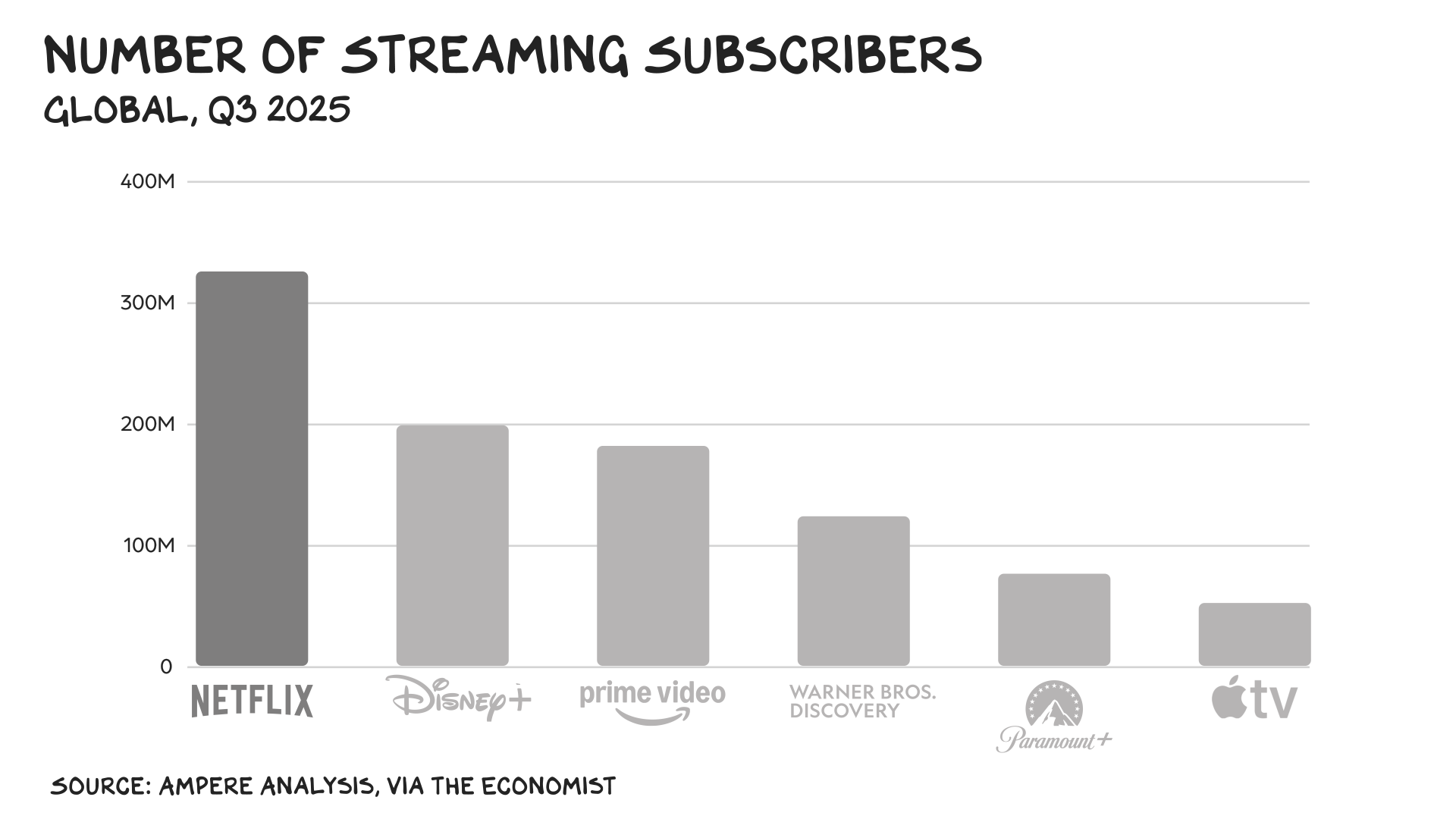
Concentration of power in streaming might corrupt the market, similar to the corruption the country endures when a few people can reshape media, tech and Washington. Anyway, back to streaming. With more than 300 million subscribers, Netflix already has a leading position. Netflix, Amazon Prime, and Disney control over 60% of the market. Acquiring Warner Bros. would give it even more power, with one of the largest libraries of premium scripted content and some of the most valuable entertainment franchises. Combining HBO — the gold standard of television — with Netflix — the streaming superstore — is like fusing LVMH and Walmart.
Less Choice, Higher Price
If Netflix captures HBO Max, the streaming war (ad-free, original content) is over. The upshot, despite Netflix’s assurances that the combo will create greater value for consumers, is fewer choices. At some point, as concentration intensifies, all the companies’ stocks will fall, as there are fewer people who can afford to buy their stuff.
This trend is well underway, with the top 10% already accounting for 50% of consumer spending, making the economy more fragile. One-tenth of the population can crash the train. A Paramount deal also raises competition concerns, given the two companies have rival film studios with theatrical releases and overlapping streaming services. But there’s a reason Paramount would probably face an easier regulatory path — and it’s not just the support it would receive from Trump. It boils down to market share.
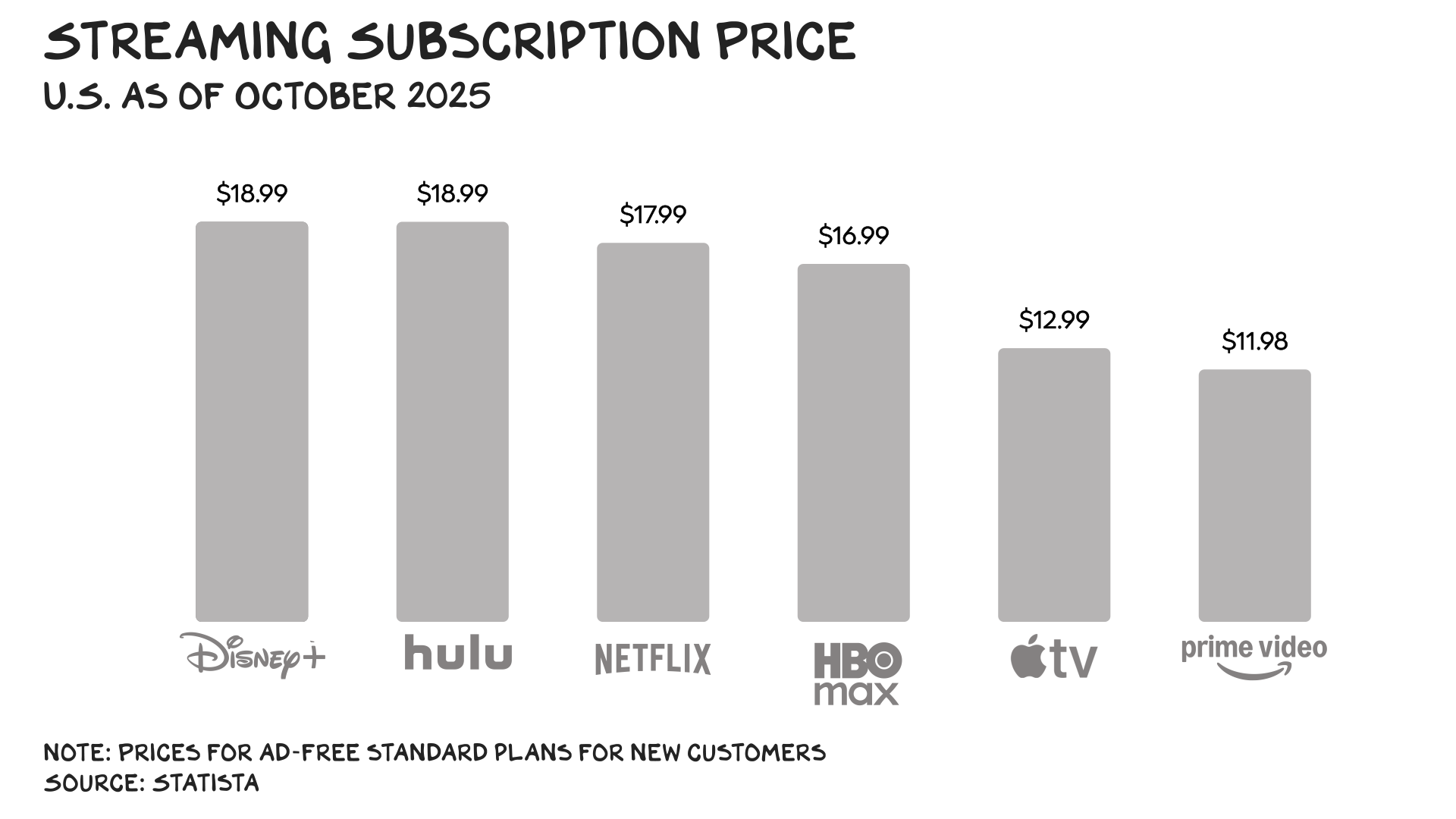
Streaming prices are climbing, along with the cost of groceries, gas, and housing, as the industry consolidates. The average subscription price for the top 10 U.S. platforms has risen 12% this year, far outpacing inflation, following double-digit increases since 2022. U.S. households spend an average of $70 a month on streaming services, a significant sum for people whose grocery bills have climbed 30% over the past five years.
Chicken vs. Beef
The companies say they have to raise prices to pay for the premium content they provide. But what the increases really signal is a transfer of capital from consumers and labor to shareholders. Adding the studio and streaming assets of Warner Bros. would give Netflix even more leverage.
If Netflix wins, the most critical question will be whether it’s competing with premium streaming platforms or virtually all digital video content vying for attention. Netflix isn’t nearly as dominant if you factor in Alphabet’s YouTube and ByteDance’s TikTok, as Kara Swisher, my Pivot co-host, points out. But regulators should adopt the narrower market definition. Otherwise it’s akin to chicken producers defending their control of the market by suggesting their competition extends to cattle ranchers and pistachio farmers.
Also, consolidation won’t stop with Netflix or Paramount and Warner Bros. The deal will only put more pressure on rivals, including Comcast, to follow with their own transactions to scale their streaming platforms.
From Indignation to Ideas
Streaming subscriptions are just one part of a wider debate. Everyone from Donald Trump to New York Mayor-elect Zohran Mamdani is talking about affordability. However, the country is long on indignation and short on ideas or programs to actually bring prices down. The president has insisted that tariffs will boost the economy, when in fact they’re pushing prices higher and fueling concerns over the cost of living. Trump, who once vowed to “make America affordable again,” now calls concerns about increasing prices a “hoax” perpetrated by the Democrats.
Americans know this is bullshit. The use of buy-now, pay-later services is rising to record levels this holiday season. Yet they’re also not buying the message from Democrats, who highlight the need to curb health, housing, food, and energy costs but resort to stoking outrage and throwing money at people vs. implementing concrete structural change. Here are four ideas that aren’t sexy (i.e., they will take work):
Build, Baby, Build
Housing should be at the top of the agenda, as it’s the primary culprit driving the lack of affordability. Half of renter households in the U.S. are cost-burdened, meaning they spend 30% or more of their income on shelter. Higher expenses curb labor mobility and productivity, deter families from seeking medical care, contribute to anxiety and depression, and fuel homelessness. While rent control is tempting, it suppresses development longer term, only adding to the problem. Higher costs for labor, building materials, and regulatory compliance exacerbate the housing shortfall.
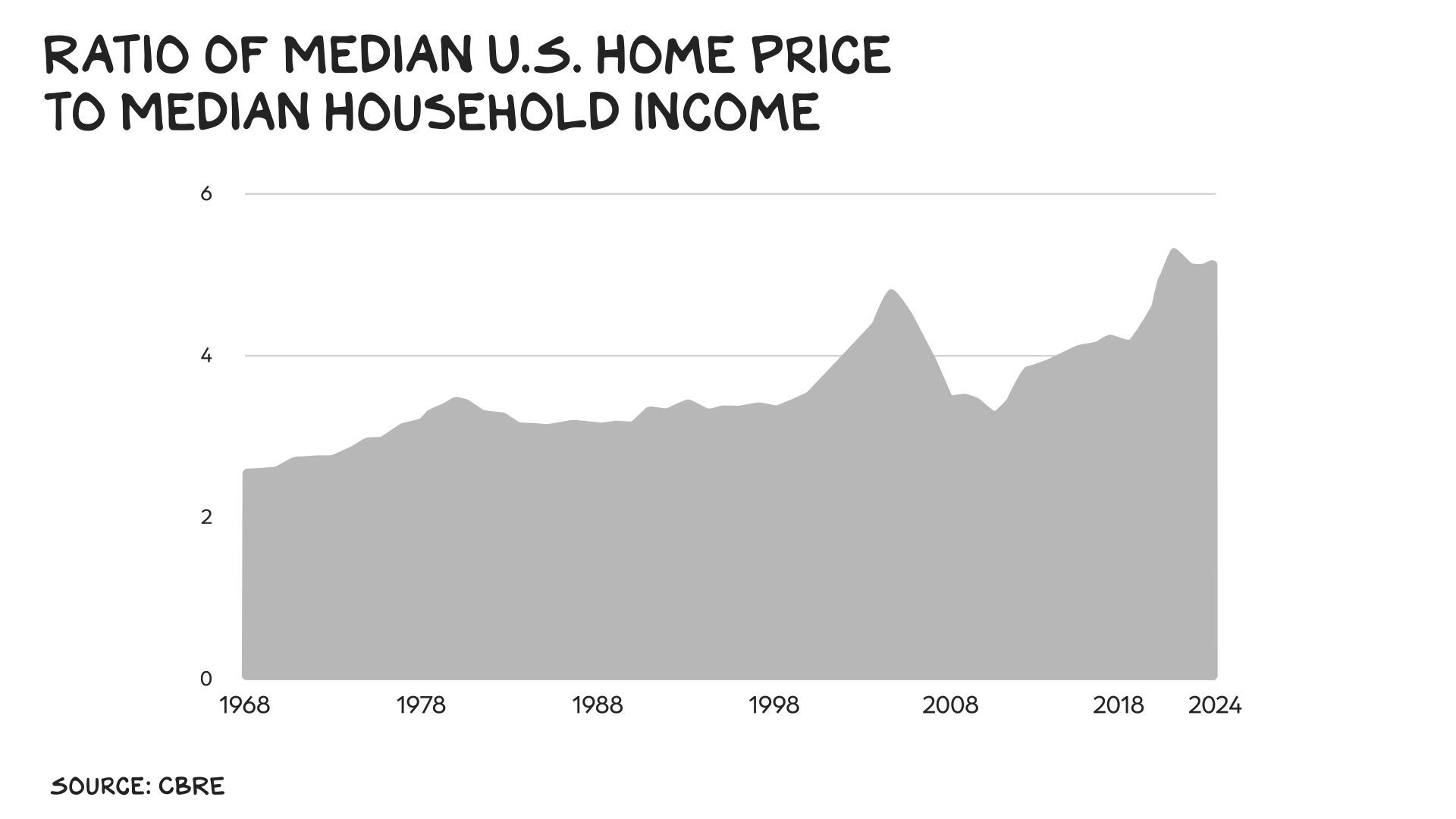
We should have tax credits to unleash private development to build 8 million to 10 million homes in the next decade. Yimby laws (yes in my backyard) and cost-effective building are also part of the solution. Manufactured homes, built in factories and finished on site, are 35% to 73% cheaper than homes built entirely on location.
Nationalize Medicine
The U.S. healthcare system is broken — for the bottom 90%. Many Americans are one medical expense away from sliding into debt. More than 30 million citizens, especially Black and Hispanic adults, borrowed money to pay for healthcare last year, accumulating $74 billion in medical debt. Enough.
Let’s take Medicare and lower eligibility by two years every year for the next decade. That would bring the age of eligibility to 45 in 10 years. What is that called? Nationalized medicine. We can help younger people in other ways. They aren’t the ones accounting for the vast majority of surging health costs.
Impose Tuition Caps
We also need tuition caps based on income. As a freshman at UCLA, I benefited from an annual tuition of just $1,350 (and an admissions rate of 74%). A degree from a prestigious school opens doors and potentially quadruples the income a person can expect to make, but the ROI has declined as costs have ballooned.
If your family is middle-class, the tuition should reflect that. Colby last year announced a program to cap the cost of tuition, room, and board at $10,000 a year for families who earn up to $100,000, and $15,000 for those with incomes ranging from $100,000 to $150,000. That compares with a net price of as much as $53,000 a year.
If universities with endowments greater than $1 billion aren’t increasing freshman enrollment faster than the population is growing, they should lose their tax-free status. They’ve decided they’re Birkin bags, not public servants.
Trust-Busting
Concentration of power harms consumers and workers, with the benefits flowing to shareholders. It’s up to regulators to break up or block harmful oligopolies that stifle competition. The nation’s regulators are supposed to enforce antitrust law based on guidelines about market share and other standards, but giving the president the ability to “engage in post hoc manipulation” undermines the rule of law, as Herbert Hovenkamp, an antitrust scholar, told the New York Times.
More Oxygen
The pursuit of Warner Bros. is more than just a transaction. It’s a microcosm of a wider emergency. We can’t complain about surging costs while ignoring the factors behind them. We need to have an adult conversation, saying no to harmful deals and yes to policies that spur competition and rein in health, housing, and education costs.
It’s telling that the loudest objection to this nascent monopoly comes from a Hollywood mogul who’s never lived outside one. But we should listen to him. Consolidation is a tax on the young and the poor, levied to protect the old and the rich. Affordability begins with a simple idea: more firms, more competition, more oxygen.
Life is so rich,

P.S. This week I spoke with Tristan Harris, former Google design ethicist and co-founder of the Center for Humane Technology, about the AI dilemma. Listen here on Apple or Spotify, or watch on YouTube.
2025-12-06 00:14:36
“Don’t read the comments,” I tell people, just before I have a drink and … read the comments. I knew my book Notes on Being a Man would spark controversy, as you get the most flak when you’re over the target, and some of the criticism (likely) misses the mark. The comment that hits home: I reverse-engineer what’s worked for me (economic security, relationships) to masculinity and don’t acknowledge other paths to fulfillment. Fair. Many others offered constructive criticism, and some of the criticism has merit. What surprised me was how many of the commenters were therapists parroting talking points along the lines of “Before anything, men must work on themselves (i.e., get therapy).” This is nonsense.
I want to be clear: Therapy is a good thing, especially for the 23% of American adults who experience mental illness. But mental health influencers position therapy as a prerequisite for a better life, rendering it a Birkin bag for your feelings (i.e., a luxury good), and position many of life’s obstacles as traumas to be addressed for $200/hour. This is a misdirect. I believe America’s mental health crisis is a multidimensional problem largely shaped by economic precarity. Five of the world’s 10 happiest countries are Nordic nations with strong social safety nets. Costa Rica and Mexico (ranked 6th and 10th) achieve comparable happiness scores thanks to their strong family and social ties. My solve? A: Detonate a mental health bomb in America, and invest in programs that increase material well-being — a $25/hour minimum wage, affordable housing, universal healthcare, and a stronger social safety net. The free gift with purchase? Reducing financial stress would mean Americans could worry less, socialize more, start families, and, if they struggle with mental health, pay for therapy.
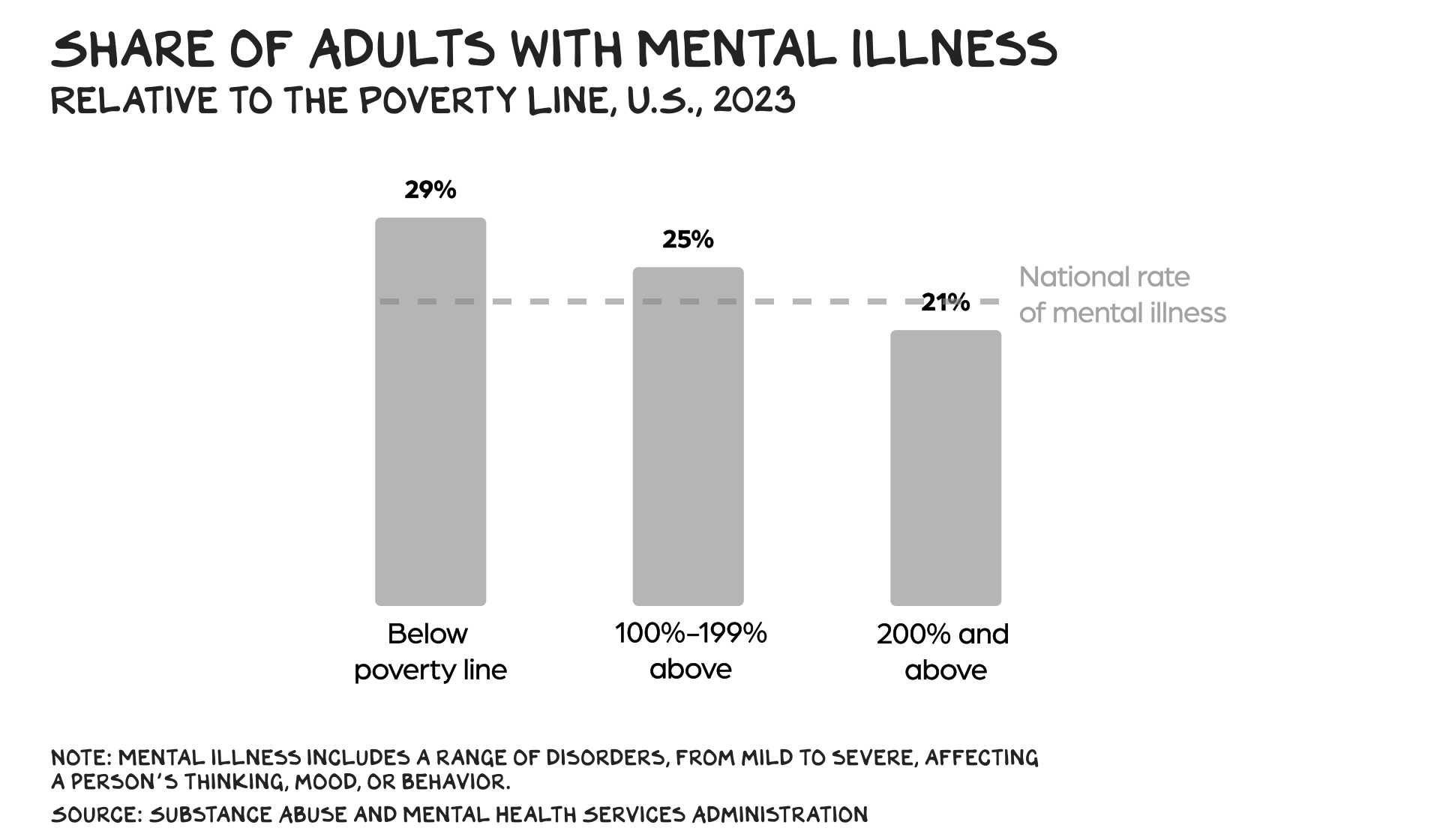
Doctors currently believe there are 227 symptom combinations that can lead to a diagnosis of depression, but there are no blood tests or imaging scans to aid that diagnosis. In an estimated 15% of cases, antidepressants provide benefits beyond the placebo. Talk therapy also helps, but the range of modalities make it difficult to quantify the impact of treatments. As neuroscientist Barbara K. Lipska wrote in 2018, “mental illness remains deeply enigmatic, its causes generally unknown, its cures undiscovered.” And yet, social media feeds are overrun with mental health influencers peddling therapy as the answer.
Writing in the New Yorker, Katy Waldman observed in 2021 that therapy-speak had left the couch and conquered social media. It’s only gotten worse: Scroll through your feed and you’ll see posts about self-care, coping mechanisms, codependent relationships, and avoidant attachment styles. Centering ourselves, setting boundaries, sitting with our discomfort, and being present don’t require explanation — these terms are as essential to internet culture as LOL. For many this vocabulary screams privilege. According to Waldman, the confessional/performative nature of social media results in “the language of suffering often find[ing] its way into the mouths of those who suffer least.”
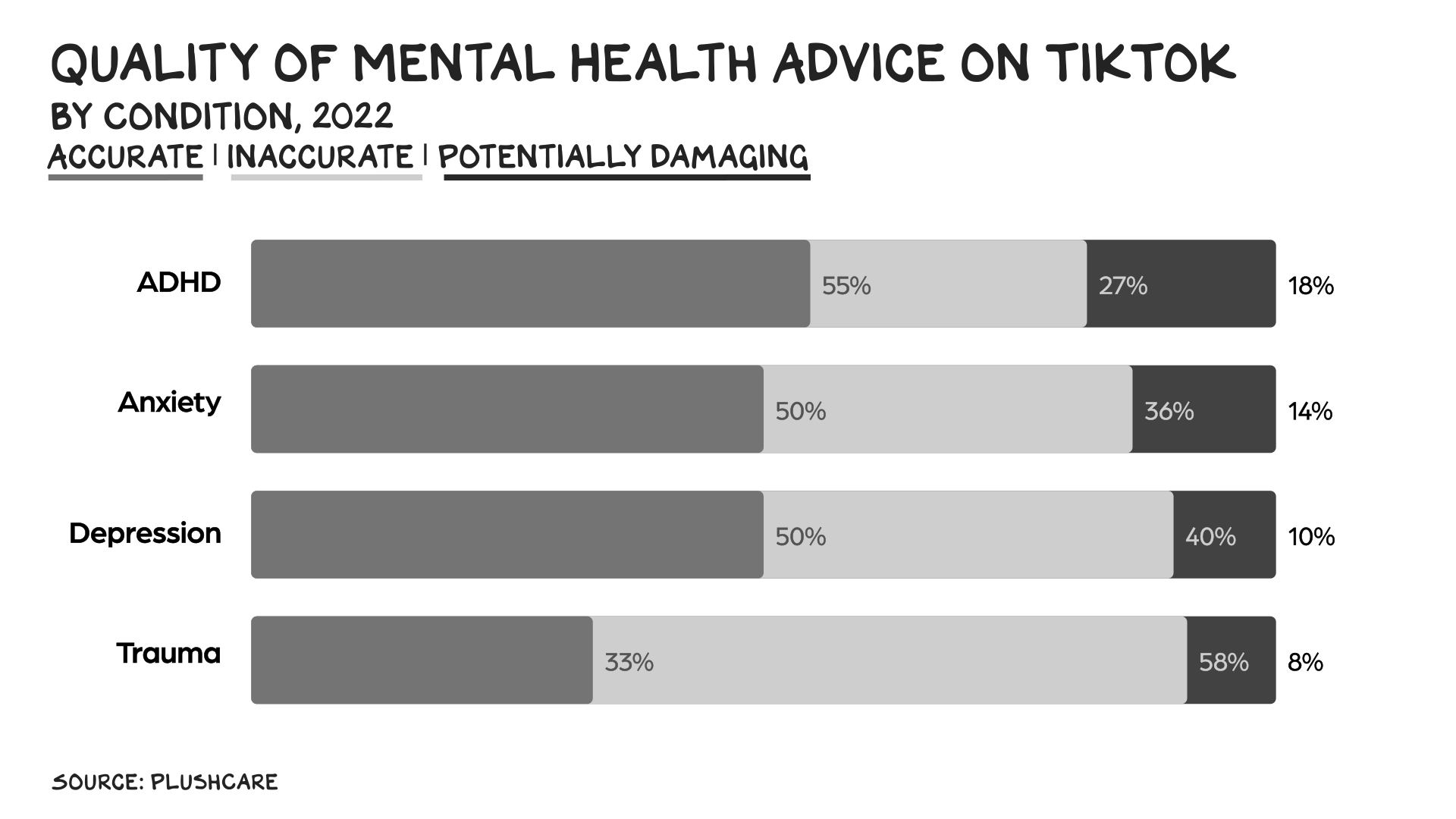
Scaled beyond its intended domain, therapy-speak is corrosive. According to psychotherapist Jonathan Alpert, the rise of therapy culture has turned a tool for meaningful change into a “comfort industry” that’s making Americans sicker, weaker, and more divided. “We live in an era where disagreement is treated like trauma, and emotional reactions are weaponized for political gain,” Alpert writes. “On social media, vulnerability is currency. On TikTok, influencer ‘therapists’ dish out instant validation in 30-second bursts. The most anxious voices often hold the most influence. Complex issues get reduced into content. Millions watch, but few get better.” One 2022 study of mental health videos on TikTok found that 83% were misleading, 14% provided potentially damaging advice, and only 9% were produced by content creators with relevant professional qualifications. Similar to supplements, therapy is a good thing that’s easily exploited by hucksters. But if supplements are a pipeline to getting red-pilled, therapy culture is a sinkhole of misinformation, manufactured fragility, and needless suffering.
I’ve had limited experience with therapy. Before my divorce, my wife and I saw a couple’s counselor. I’ve also tried ketamine therapy. The session was illuminating, but I haven’t gone back. There was a time when a couple in a bad marriage would’ve talked to a priest. But the share of adults who say religion is an important part of their daily life has dropped from 66% in 2015 to 49% today, according to Gallup, closing off one avenue of talk therapy for many Americans. Sharing your troubles with your local bartender has also fallen out of fashion. Talking to your friends remains an option, though friendship rates are declining, with 12% of people today saying they have no close friends at all. Alcohol consumption is at a 90-year low, with Gen Z driving the abstinence trend, robbing young people of one vital form of social lubrication.
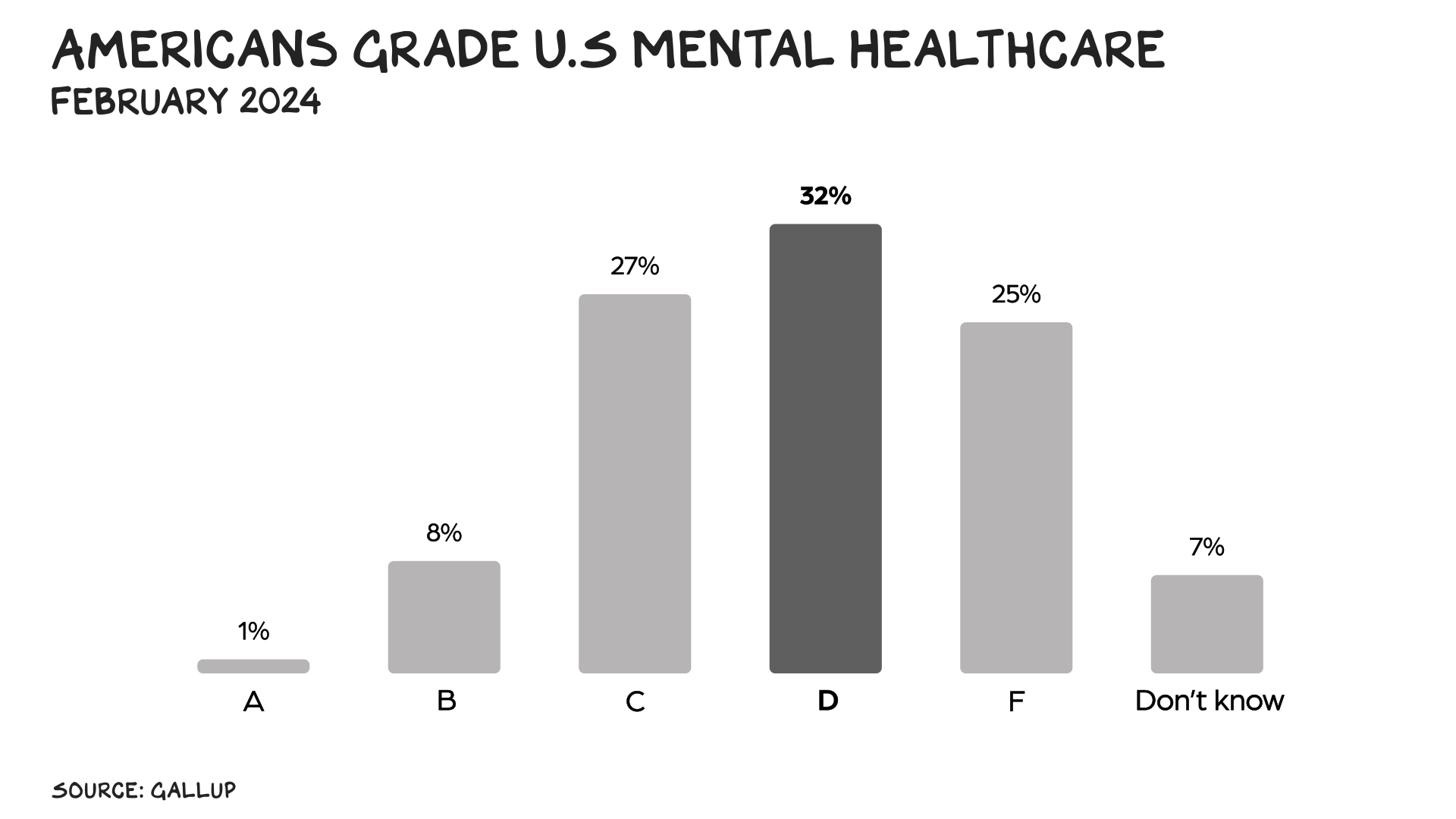
I’ve been criticized for saying alcohol can be additive for many young people, but the risk to a 25-year-old liver is dwarfed by the risk of social isolation. If I told young people to attend church, I’d likely get pushback from some quarters. Meanwhile, counseling young people to invest in their fitness and take social risks so they can make friends and form romantic partnerships are nonstarters for therapy culture … unless and until you’ve had therapy. We’re social animals. As social connections atrophy and fray, we’re becoming more anxious and depressed. Therapy is an expensive Band-Aid for a larger problem. But even taken on its own merits, only 9% of Americans give the U.S. healthcare system a grade of A or B for addressing mental illness, according to Gallup.
The U.S. has a shortage of mental healthcare providers. But where some see a supply problem, I see a distribution problem. Including psychiatrists, psychologists, licensed clinical social workers, counselors, marriage and family therapists, and advanced practice nurses specializing in mental health care, there are 344 mental health practitioners per 100,000 people in the U.S. We have more mental health practitioners than medical doctors (297 per 100,000) and 5x the number of dentists. According to the U.S. Bureau of Labor Statistics, employment for some mental-health-related occupations is projected to grow by 18% over the next decade — faster than the 3% average for all occupations.
Cost is the No. 1 barrier to accessing mental health services, according to the Kaiser Family Foundation, while getting time off work ranks second. Stigma comes in fourth, behind concerns about efficacy. The two-thirds of Americans who have private insurance likely have access to mental health services, though one-third of therapists don’t accept insurance at all. If you can swing $280 to $400 a month, platforms like BetterHelp are an option. (Note: BetterHelp is a Prof G podcast sponsor.) Meanwhile, Americans living in rural areas likely can’t find a therapist at all. According to one study, counties outside of metropolitan areas had one-third the supply of psychiatrists and half the supply of psychologists as their more urban counterparts. People covered by Medicaid and Medicare struggle to find providers that accept their insurance because of the low reimbursement rates. Finally, underserved groups — people of color, non-English speakers, and LGBTQ communities — often struggle to find appropriate services. But if you’re wealthy, therapy is as easy as reserving a space at SoulCycle. According to the Wall Street Journal, the next big thing in luxury travel is a vacation with a family therapist. The price tag: $80,000.
For everyone else, AI therapy is Sam Altman’s answer. Therapy/companionship was the No. 1 AI use case in 2025, up from No. 2 the previous year. One trial for an AI called Therabot found that it achieved an average 51% reduction in symptoms of depression and a 31% decline in symptoms of anxiety, compared with people who got no treatment. But Celeste Kidd, a psychologist at the University of California at Berkeley who tested another therapy AI called Ash, concluded it was “clumsy” and unresponsive. I’m bullish on AI, but even if it eventually outperforms human therapists, I’m skeptical that Big Tech will provide adequate guardrails. See: Kara Swisher’s interview with the parents of Adam Raine, who died by suicide at 16. They’re suing OpenAI, alleging that ChapGPT was complicit in their son’s death.
No group in America has fallen further, faster than young men. When I began talking about this several years ago, that was a controversial statement, especially on the left, where many pathologize masculinity. While the right has suggested the solution is to take women and non-white people back to the 1950s, the left’s view is that young men don’t have problems, they are the problem. Neither attitude helps. As the left ignores the issue, the right fills the void with misogyny and racism. The result is that a significant number of young men, embracing figures like Andrew Tate and Nick Fuentes, swung right, helping elect a strong man. (If strong equals corrupt and stupid.) To borrow from the vocabulary of therapy-speak, young men don’t feel seen/heard in spaces that are the polar opposite of the manosphere.
Women are twice as likely to receive mental health treatment as men. But is that a failing of masculinity, or the mental health profession, where three-quarters of providers are women? “Guys are built differently,” clinical psychologist John Farrell told Monitor on Psychology. “They have different brains and different ways of being emotional. Male therapists understand male issues differently than females do.” If that sounds sexist, change the pronouns and get back to me.
Therapy has a lot to offer. It also has massive blind spots, especially around class and gender. It’s easy to sling bromides about how everyone needs therapy, but it’s more productive to ask why therapy excludes so many people and too often fails to help the people it does reach. If you’re looking for help on social media, understand this: The platforms and influencers make more money when you stay broken.
Life is so rich,
P.S. This week I spoke with Pulitzer Prize–winning historian Anne Applebaum about what’s really happening inside the Ukraine peace talks. Listen here on Apple or Spotify or watch on YouTube.
2025-11-21 23:47:57
Today you can “trade” on the outcome of thousands of future events, from the Fed decision next month to the Grammy Awards in February. Without leaving the house, you can wager on Taylor Swift’s wedding or Time magazine’s person of the year. One of Kalshi’s MIT-trained founders says their platform is “like the stock market, but instead of buying and selling companies, you’re buying ‘yes’ or ‘no’ on whether something is going to happen.” The Gen Z billionaire at the helm of Polymarket touts his exchange as a “global truth machine.” These platforms do harness the “wisdom of the crowds,” but, to be clear, this is gambling rebranded as “prediction markets.”
America was built on risk and speculation. The country could fairly be described as a “casino economy,” however, and prediction markets — alongside crypto, options trading, and sports betting — are taking it to new levels.
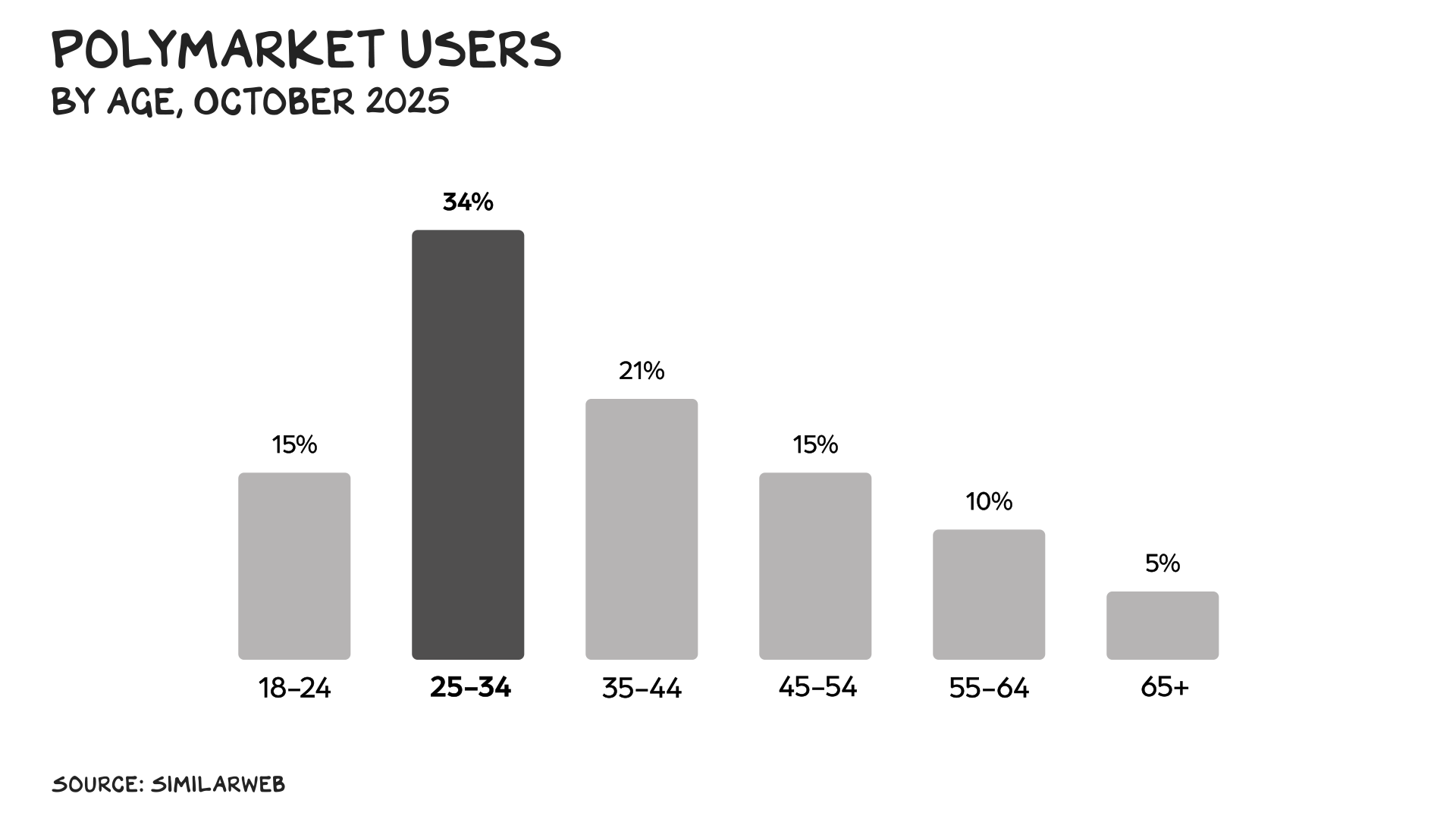
Weekly volumes for Kalshi and Polymarket breached the $2 billion mark for the first time in October, surpassing the peak reached during the last presidential election. Then came the New York City mayoral election. As residents headed to the polls, they saw billboards flashing the odds: MAMDANI (94%) — CUOMO (6%). With the race over, we can now bet on the likelihood of city buses becoming free before 2027 or rents being frozen. Leveraging its popularity, Polymarket is in talks to raise money at a valuation of $15 billion. Kalshi is attracting offers from VC investors valuing it at $10 billion.

Amid the mania, these platforms are moving deeper into the mainstream:
Sports leagues are also getting in on the action. In October the National Hockey League signed agreements in the U.S. with Polymarket and Kalshi, naming both official partners. Kalshi’s CEO said it’s a clear sign “prediction markets are here to stay.”
Many people seem to have forgotten about Alex Kearns. I haven’t. I remember staring at his photo — a 20-year-old with a big smile and a fascination with the markets — and seeing my oldest son. In 2020, after receiving incorrect messages saying he owed the online trading platform Robinhood $730,000 (he owed nothing), the University of Nebraska student spent much of the night desperately trying to get in touch with the company. The next morning he left a note for his family saying he didn’t want to burden them with this debt. Then he took his own life.
That should have been a wake-up call. Instead, America has doubled down.
The operators have drawn legal challenges from state authorities. The Massachusetts attorney general sued Kalshi, arguing that the company “disguises” sports betting as “event contracts,” which are regulated by the federal Commodity Futures Trading Commission. In states where sports betting is off-limits, customers are turning to prediction markets to “invest” in sports. Sportsbooks mostly restrict access to people under 21. Prediction markets are available to anyone 18 and up.
Don’t count on the Trump administration to intervene. A week before Trump returned to the White House, Kalshi named the president’s eldest son, Donald Trump Jr., as a strategic adviser. Days later, the company publicized its entry into sports betting. Now Trump’s social media company is launching Truth Predict, allowing users to bet on events ranging from elections to inflation-rate changes.
America’s pastime isn’t baseball but gambling.
We spend 10x more on gambling than music, Netflix, and cinema combined. Twenty million Americans struggle with or are at high risk of developing an online gambling problem. Young men are especially vulnerable. Men are more susceptible to gambling than women, just as they’re more likely to engage in illicit drug use, drink excessively, or die of opioid-related overdoses. Gambling has the highest suicide rate of all addictions. When you have a meth addiction, people notice — the sores, tooth loss. When you’re gambling, and you’re in deep, you lose your kids’ college fund or mortgage the house, but your struggles remain hidden.
The Supreme Court’s decision in 2018 to overturn a federal ban on sports betting has fueled the nation’s compulsion. Before the ruling, Americans legally wagered less than $5 billion on sports annually. Last year, with sports gambling legal in more than three dozen states and D.C., those bets ballooned to $160 billion. The mediums shapeshift to distract, but they are gambling. Some of the costumes:
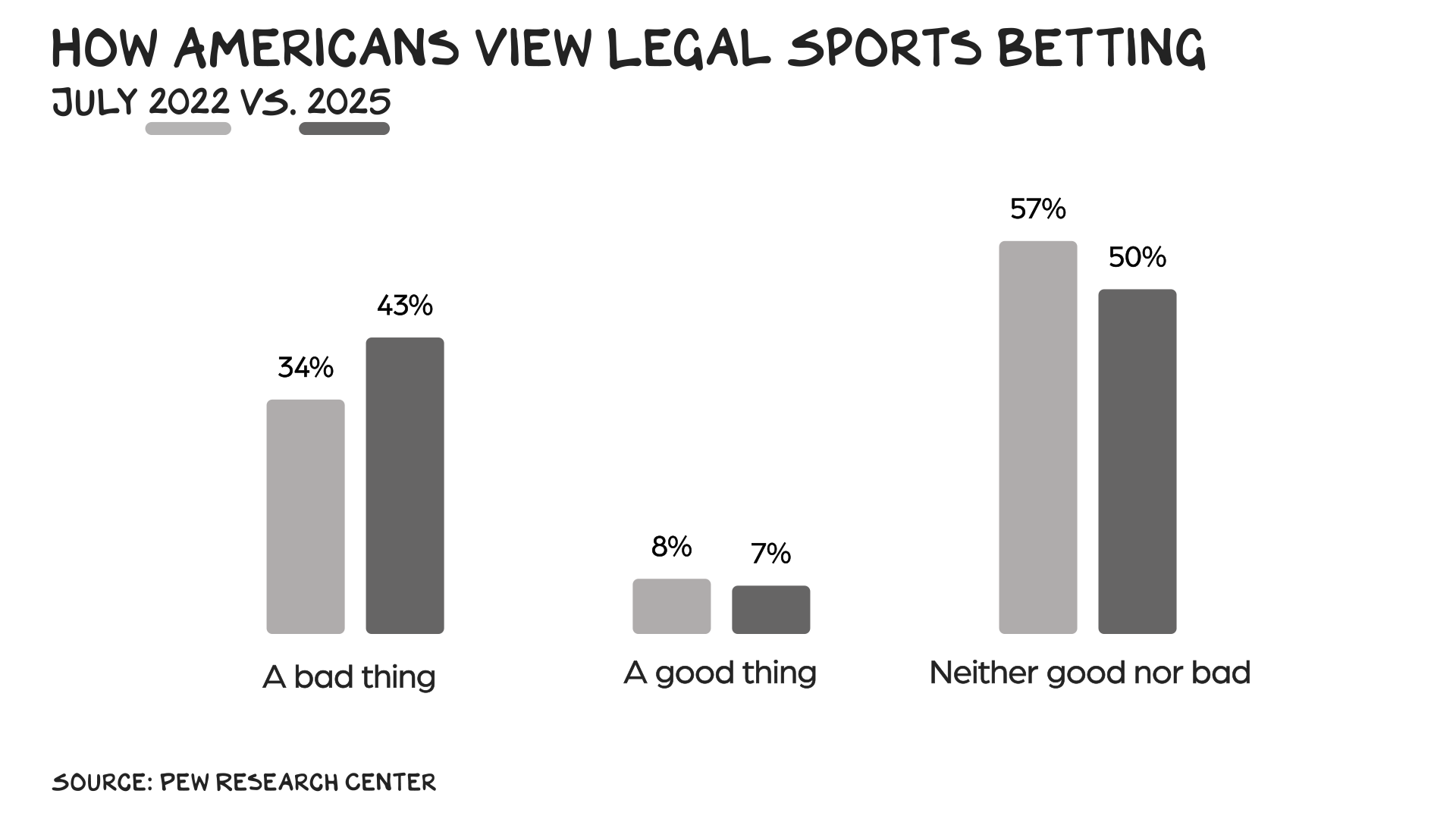
We know what happens when you give states the green light: Bankruptcies soar 30%. Americans grasp the scale of the crisis. More than 40% of adults see legalized sports betting as a “bad thing for society.” Still, the dopamine cocktail is too much to resist.
Sports leagues aren’t going to lose their zeal for gambling, despite back-to-back betting scandals in the NBA and MLB that raised concerns about the integrity of the games. Spoiler alert: The leagues will distance themselves from the alleged conspirators — but not from the gambling industry. Direct sponsorship deals between legal sportsbooks and top leagues may be worth more than $1 billion annually. A number of teams have agreed to put physical betting shops inside their stadiums and arenas.
For a moment, it appeared the NFL was concerned. In June the league announced a partnership with the International Center for Responsible Gaming to support research into gambling among college athletes and students. But this is a league that aligned with Caesars, FanDuel, and DraftKings and hosted its first Superbowl in Vegas last year. Just as we’ve made a conscious decision to transfer wealth from young to old and poor to rich, we’ve accepted a system in which money flows from fans to leagues.
There are solutions, if we have the courage to implement them. We could do more to educate consumers about the dangers and impose tougher regulations, including age restrictions. Limiting annual losses, restricting advertising, and setting up firewalls between research into gambling’s impact and the industry itself are all on the table. Paul Tonko and Richard Blumenthal, Democratic lawmakers, have proposed measures that would be a good start. However, it’s an uphill battle. The most profitable firms in history are squatting in a building (our economy) that has no scaffolding on its instincts … any sort of dopa regulation trails institutional production.
Prediction marketplaces say they aren’t on the other side of the trade — users are trading with their peers, not against the “house.” As traders buy and sell, prices fluctuate to reflect the “collective sentiment and knowledge of market participants.”
But whether you’re putting money on the Mets or Mamdani, this is gambling, and whatever you want to call it, users can develop an addiction. I am not immune. I find these markets fascinating — I tried to bet on the presidential race but couldn’t, as I’m an American citizen living in the U.K. My documented worker status saved me from myself: I was convinced Kamala Harris had a greater-than-37% likelihood of capturing the White House. And there is a solid argument we shouldn’t infantilize grown-ups — and we should let them spend their hard-earned money as they see fit.
In the U.S. we’ve monetized healthcare, the White House, and the pardon process. However, these are dwarfed by the opportunity to monetize the less developed prefrontal cortex of a young man. Once Polymarket starts expanding in the U.S., more Americans will be swept up by the wave. Not because everyone will be in Vegas, but because Vegas will be in everyone. If policymakers aren’t motivated by the threat to Americans’ finances and mental health, they should worry about the risk of foreign governments using the platforms to influence elections and public perception.
The most profitable companies all do the same thing: They tap into our flaws and monetize them, then pretend it’s innovation rather than exploitation. We need to have a wider debate about the society we want. Rather than celebrating gambling, we should embrace a different kind of risk: asking someone out, approaching a stranger, investing in relationships with friends and potential mates. This is what I ask myself when I mentor young men: How can I increase their risk appetite for the real world? How do we create a societal movement to convince people to bet on each other, not platforms? Will there be thoughtful regulation?
I don’t know, but I’m certain we’ll be able to bet on it.
Life is so rich,
P.S. I’ll reveal my Predictions for 2026 on December 4th at a free live event hosted by Section. Sign up here.
2025-11-15 01:03:35
An Office Hours listener asked what I’d say to President Trump if he invited me to the White House. I’ve struggled my whole life with being right vs. being effective. So, as we’re meeting with the president … let’s focus on being effective. We don’t have much common ground, but we’re both fathers. Let’s start there. As we’d likely have only a few minutes, we’d need to be focused — one issue max. The one thing I’d advocate for? I’d make a case for mandatory national service, as I believe that even the most polarized societies can find common ground when it comes to their children. (Yeah, I know, the whole denying SNAP benefits to kids. But it’s my imaginary meeting, so just go with it.)
I believe young Americans are fed up with a country they’re raised to love but that doesn’t love them back. Our spending priorities (entitlements), tax policies (capital gains and mortgage interest deductions), and fiscal priorities (bail-outs of incumbents) are the greatest transfer of wealth from young to old in history. Old people have figured out a way to vote themselves more money, and even if the younger generations aren’t good at it, they can do math.
The unemployment rate among 16- to 24-year-olds is 10.5% — the highest since the pandemic and, excluding that period, the highest since 2016. Zoomers report feeling more lonely, depressed, and anxious, and less successful, than other generations. It doesn’t help that 200-plus times a day they receive notifications on their phone that they’re failing, as their cohort vomits fake wealth/success onto them. The most noxious emission in America isn’t carbon but shame. Young people aren’t facing one crisis but a cascade of them — and that’s made worse by adults who enjoyed the shade of trees planted by others but are now clear-cutting forests meant for the next generation.
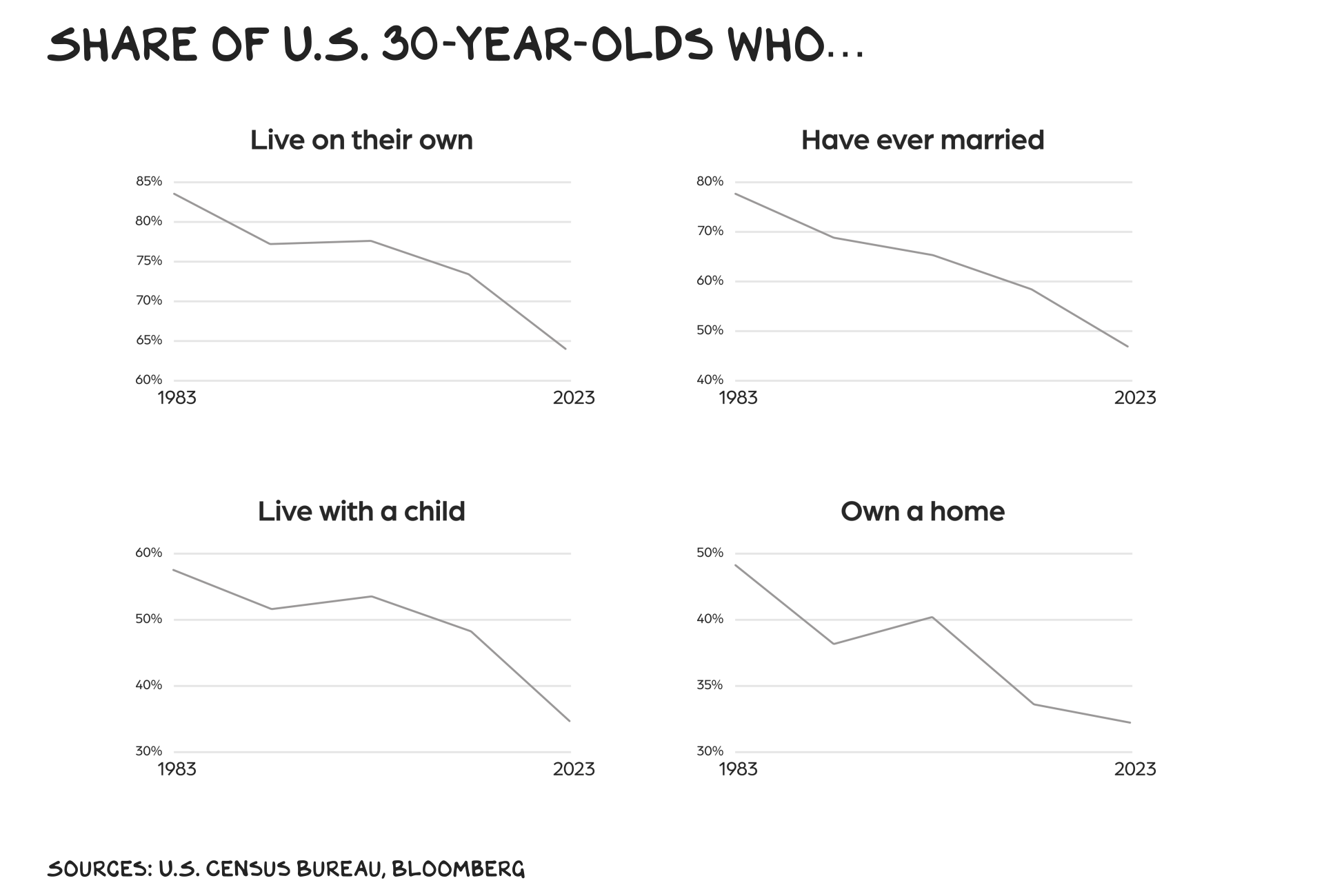
My parents belonged to the Greatest Generation. Their collective sacrifice won World War II, while their sense of national identity, forged by service, fueled the prosperity and progress of post-war America. On Prof G Conversations, historian Heather Cox Richardson told me “there was a very different sense of what it meant to be an American” then, adding that people prided themselves not on how much money they made, but how they took care of their communities. Writing about the people who came of age in post-war America, journalist Tom Wolfe coined the term the Me Generation. Prosperity created what Wolfe called “the luxury of the self.” I know that luxury well. I didn’t serve my country — one of my great regrets. Marketplace host Kai Ryssdal, a contemporary and Navy veteran, told me national service would transform America. “We don’t know each other anymore,” he said. “It’s a generational thing.”
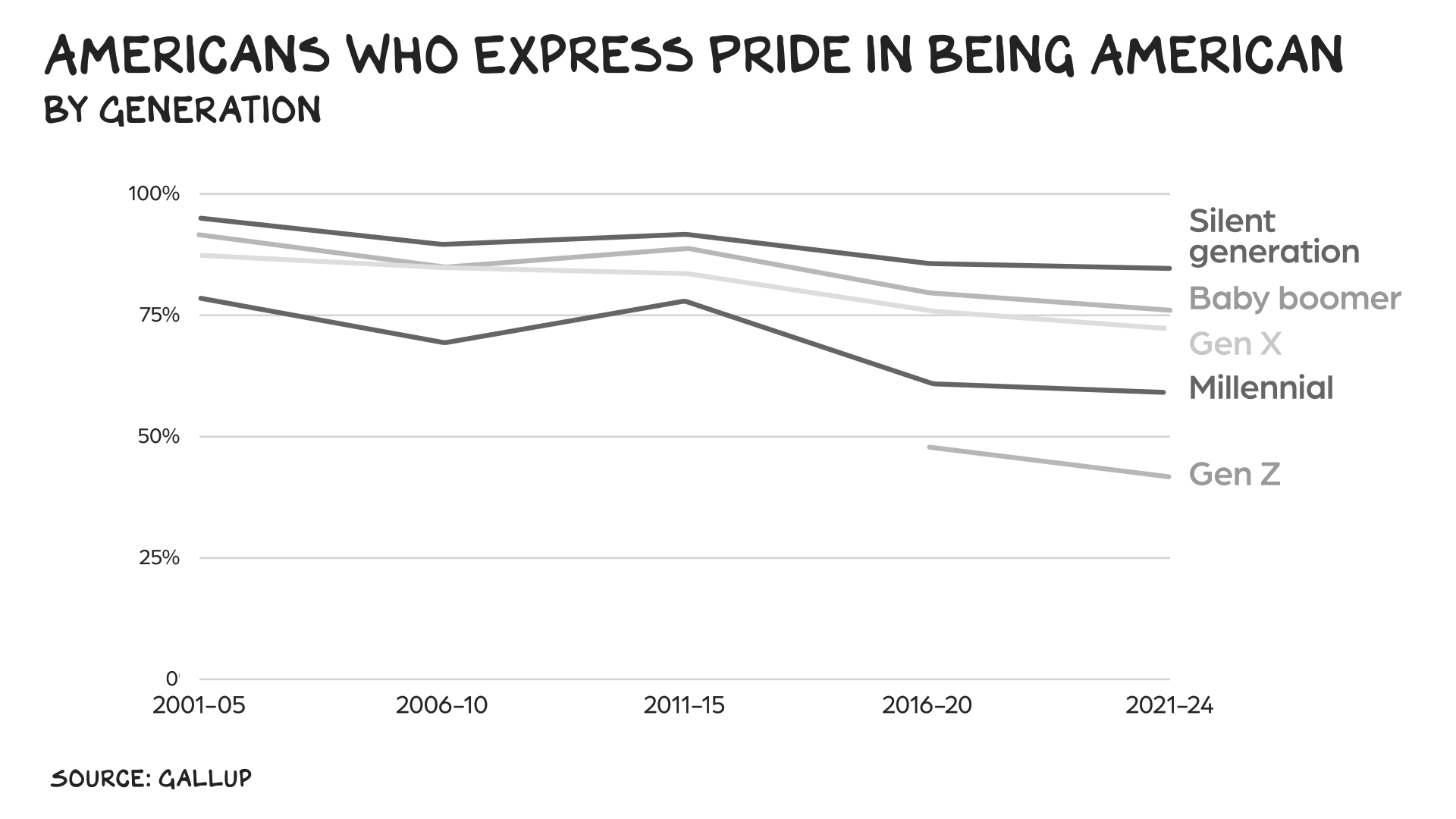
At the end of Notes on Being a Man, I close with a letter to my sons, urging them to be patriots — to vote, pay taxes, and be evangelists for America and its values. I encourage them to give others the benefit of the doubt and treat them with respect, if only because they’re fellow Americans. For my boys’ generation, their fellow citizens are strangers. Our connective tissue is fraying. According to Gallup, the youngest Americans are the least patriotic. I believe mandatory national service could help repair the damage by encouraging young people to see themselves as Americans, first and foremost, and to be proud of that identity.
National service in Singapore, the most religiously diverse nation on Earth, is called “school for the nation,” because of its ability to forge a national identity. A study that looked at Singapore’s national service programs concluded that socialization is a key mechanism for transmitting norms and values, while contact with people from different groups reduces prejudice. Those who serve in units that are housed together were 17% less likely to close ranks around their demographic group. By comparison, each year of education beyond secondary school achieves the same effect, but by only 2.5%.
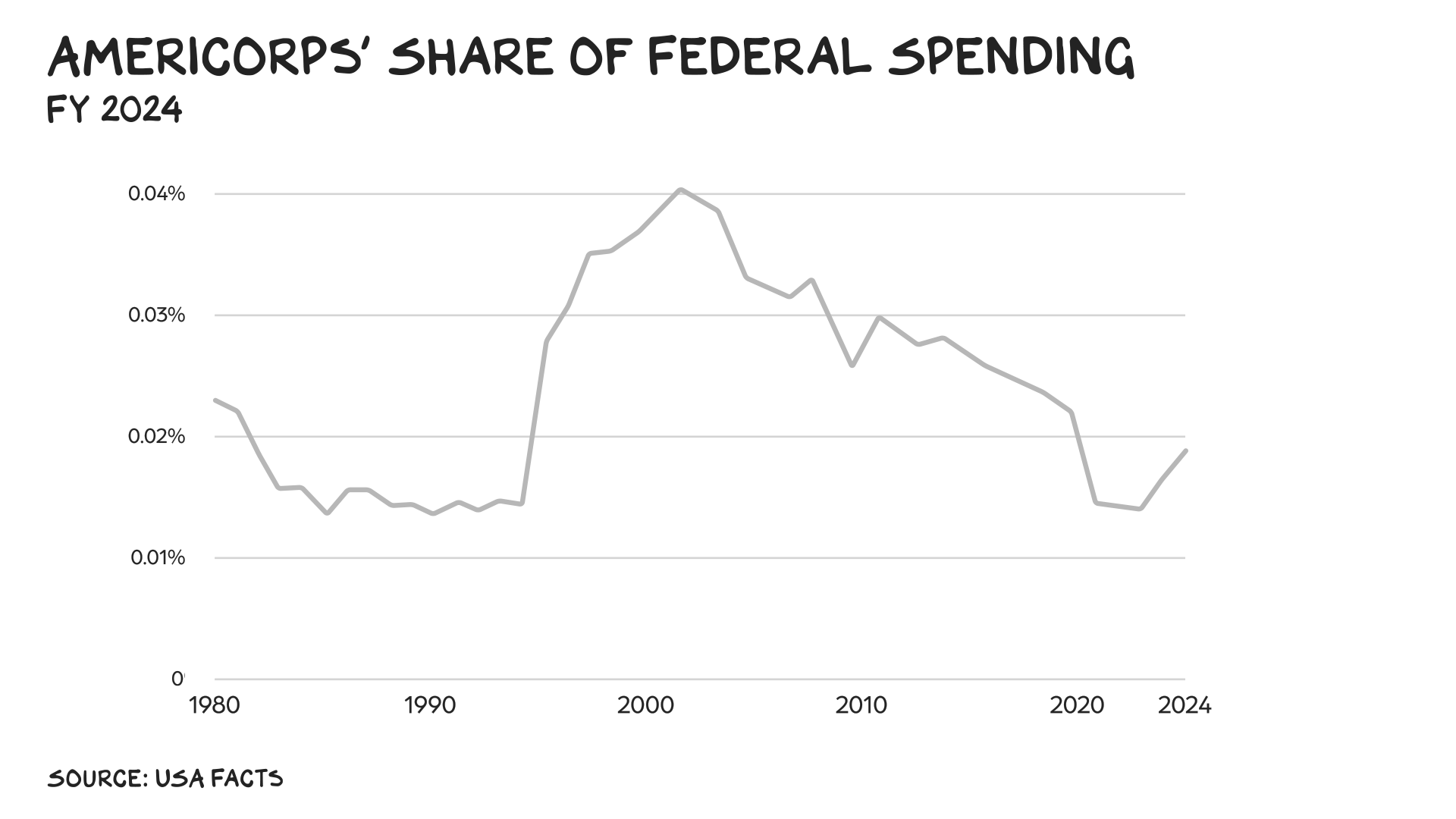
In the U.S., 6% of adults are veterans, while active-duty service members comprise less than 1% of all adults. An estimated 64,000 young Americans and an additional 200,000 seniors volunteer for AmeriCorps, the primary umbrella organization for civilian service programs. We have the programs, but lack scale. Still, we know what works. Democratic Congressman Jason Crow, an Army veteran, favors expanding voluntary national service. On Raging Moderates he said, “When city kids get together with farm kids, and white, Black, Asian, Latino, straight, and gay people roll up their sleeves and build something together … that creates a foxhole mentality that breaks down barriers and connects us.” The sentiment is bipartisan. Republican Senator Bill Cassidy has co-sponsored bills to strengthen AmeriCorps and provide tax relief to volunteers. Republican Senator Todd Young co-sponsored the Unity through Service Act. In 2016 candidate Trump said there was “something beautiful” about national service. On that point, we agree.
Enlisting in the military isn’t the only way to serve. The U.S. has a long history of civilian national service programs. While the mission of each program varies, Congress has historically identified two goals for national service: meeting the needs of communities and developing the capacities and character of participants. Underinvestment in these programs is an American tragedy. As a 2018 NIH report put it, “Higher levels of civic responsibility, voting, volunteering, employment, respect for diversity, and overall life skills such as decision making and time management are all associated with AmeriCorps participation.” We should ramp up AmeriCorps and define service broadly, as our nation’s needs are as diverse as our people. How young people serve — being rural firefighters, volunteering in a no-kill animal shelter, helping seniors, working in our national parks, — isn’t nearly as important as the service itself.
Budgets illuminate national priorities and values. Our three largest expenditures — Social Security, Medicare, and the interest on the debt — are nearly half of the federal budget, mostly benefiting the 18% of Americans who are over 65. The Department of Education and SNAP — spending that overwhelmingly benefits the 30% of Americans under 25 — register 4% and 1.5% of the budget, respectively. To paraphrase Warren Buffet, there’s a generational war in America, and my generation is winning. The D in Democracy only works when wealthy (i.e., old) Americans elect even older Americans who then vote themselves more money.
What if instead of using “the future” and “children” for rhetorical flourish, we actually walked the walk and invested in them? A Brookings report estimated that if we expanded existing national service programs to include 600,000 young people, it would cost $19 billion per year; Americans spent 8x that amount on their pets last year. Scaling up to include all 3.9 million members of the high school class of 2025 would increase the cost to $123 billion. That’s real money, but it’s only about 17% of our nearly $700 billion annual tax gap — the difference between taxes owed and taxes collected. Expanding service opportunities would also generate an estimated 17x return on our investment, according to a 2020 analysis of AmeriCorps programs.
The benefits would be felt across society, as participants would augment nonprofits, as well as state and local government initiatives. Federal and local governments would also benefit from programs that address community challenges early, lessening dependence on other government programs and reducing expenditures in criminal justice, welfare, and public health. Meanwhile, people who complete a national service program would enter college or the workforce with more skills and greater confidence.
National service benefits everyone who serves, but the benefits are likely more profound for boys — a cohort that’s fallen farther and faster than any other group in recent memory. For boys, physical development progresses more rapidly than intellectual or emotional maturity. My friend Richard Reeves has argued in favor of “red-shirting” boys, just as we hold back college athletes for a year so they can develop further on the field. A structured period of one or two years after high school would give boys the opportunity to mature without the pressures of college or a career. It would also give some a second chance. Former IDF boss General Aviv Kochavi called national service a “societal take two” for young Israelis. “It doesn’t matter where you came from or what your background is,” he wrote. “A mediocre pupil or youth with a criminal past who dropped out of school can leave the past behind and become an outstanding leader.” We should give the same opportunity to every young person in America.
If we want our youth to feel invested in their country, then America needs to invest in its youth.
Life is so rich,
P.S. In our newest Prof G Podcast, China Decode co-hosts Alice Han and James Kynge unpack how the U.S. and China are building massive data centers that are reshaping global energy use and government policy. Listen here on Spotify or Apple or watch on YouTube.
2025-11-07 23:24:16
Donald Trump pulled off a stunning political comeback because of … young men. While the Democrats ignored this demographic, the far right rushed in to fill the void, flooding the manosphere with rockets, Hulk Hogan, coarseness, and crypto. The last presidential election was supposed to be a referendum on women’s rights. It wasn’t. It was a referendum on struggling young men.
Five years ago my advocacy for young men sparked a hostile response. Today society is ready to have a productive dialogue, rejecting the far right’s attempts to send non-white people and all women back to the 1950s and the left’s belief that young men don’t have problems but are the problem. This isn’t a zero-sum game. We can build on the gains women have registered over the past three decades and ensure there’s room for boys and young men in the conversation. Democrats are starting to tackle the crisis, but we can’t rely on prominent party leaders to drive the change. We can count on the tech industry, however, to keep supporting their massive valuations by connecting profits with the sequestration and enragement of young men. Men ages 20 to 30 now spend less time outside than prison inmates.
Men of my generation have a debt to these young men. Our unfair advantage must be paid forward (or backward). We need to get involved in their lives, advocate for policies to right the ship, and model a healthier vision of masculinity. All of us have a role to play in giving young men a code — a positive set of principles — to live by.
Below is an excerpt from my new book, Notes on Being a Man. This one is personal. I hope it resonates with you.
________________
One of the semi-exciting perks of being an academic and “thought leader” is uncovering data, especially when it’s both obvious and hidden. Years ago, the alarming state of American boys and men overtook my attention. I track closely the emails I get. Most are from parents, particularly mothers, concerned about their sons, along these lines: “I have a daughter who lives in Chicago and works in PR and another daughter who’s at Penn.
My son lives in our basement, vapes, and plays video games.” Moms, not dads, were leading the charge. Others were either ignoring the problem or didn’t want to talk about it. Absent, too, was any sober, data-driven analysis. The gag-reflex cultural response seemed to be Wow, men are worse than we think, and that the issues they face are a function of their awfulness, and haven’t we spent the past forty years correctly focused on the struggles of other, more deserving groups?
I connected to this topic on a personal level. I thought back on where I came from, my mom’s irrational passion for my well-being, the generosity of California taxpayers who made it possible for an unremarkable kid with mediocre grades to attend college and business school, and all the obstacles, temptations, and traps that could have easily hampered my socialization — smartphones, online dating, porn, gambling, video games, remote work. I wondered why what was happening to boys and young men was in fact happening and how I could raise my sons in a world where they — and males of any age — thrive.
The data around boys and young men is overwhelming. Seldom in recent memory has there been a cohort that’s fallen farther, faster. Why? First, boys face an educational system biased against them — with brains that mature later than girls’, they almost immediately fall behind their female classmates. Many grow up without male role models, including teachers — fewer men teach K–12 than there are women working in STEM fields — with Black and Hispanic school instructors especially underrepresented.
Post–high school, the social contract that binds America — work hard, play by the rules, and you’ll be better off than your parents were — has been severed. Seventy-year-old Americans today are, on average, 72% wealthier than they were forty years ago.
People under the age of forty are 24% less wealthy. The deliberate transfer of wealth from the young to the old in the United States over the past century has led to unaffordable and indefensible costs for education and housing and skyrocketing student debt, all of which directly affect young men. It’s why twenty-five-year-olds today make less than their parents and grandparents did at the same age, while carrying debt loads unimaginable to earlier generations. Neither the minimum nor the median wage has kept pace with inflation or productivity gains, while housing costs have outpaced both. As the costs of college have soared beyond the reach of most families, many of the manufacturing jobs that didn’t require a college degree and were often a ticket to the middle class for (mostly) men have been offshored. A prohibitive real estate market is a contributing factor to why 60% of young men between the ages of eighteen and twenty-four live with their parents and 1 in 5 still live with their parents at age thirty. Stuck and unable to afford greater economic opportunities in nearby cities, they find the same crush and collision of density, stimulation, humanity, creativity, eroticism, and conversation that urban areas offer on their phones instead. In Manhattan, a four-hundred-square-foot apartment costs $3,000 a month. In its stead is a seventeen-square-inch mobile studio apartment costing roughly $42 a month, served up by AT&T, T- Mobile, or Verizon.
Meanwhile, algorithmically generated content on social media contributes to—and profits from—young men’s growing social isolation, boredom, and ignorance. With the deepest-pocketed firms on the planet trying to convince young men they can have a reasonable facsimile of life on a screen, many grow up without acquiring the skills to build social capital or create wealth. The percentage of young men aged twenty to twenty-four who are neither in school nor working has tripled since 1980. Workforce participation among men has fallen below 90%, caused by a lack of well-paying jobs, wage stagnation, disabilities, a mismatch of skills and/or training, and falling demand for jobs traditionally held by prime-age men.
This is deadly. From 2005 to 2019, roughly 70,000 Americans died every year from deaths of despair — suicide, drug overdoses, alcohol poisoning — with a disproportionate number of those fatalities being unemployed white males without a college degree. Excluding deaths caused by the opioid epidemic, America’s suicide and alcohol-related mortality rate for all races is higher than it’s been in a century. It’s also a mating crisis, as women traditionally mate horizontally and up socioeconomically, whereas men mate horizontally and down. Up until the mid–twentieth century, homogamy — marriages between men and women from similar educational backgrounds — was more common than not. Today, hypogamy, where women marry men who have less education than themselves, is on the rise. When the pool of horizontal-and-up young men shrinks, there are fewer mating opportunities, less family and household formation, and not as many babies. Here’s a terrifying stat: 45% of men ages eighteen to twenty-five have never approached a woman in person. And without the guardrails of a relationship, young men behave as if they have … no guardrails.
Why are we so averse to identifying and celebrating what’s good about men and masculinity, and why does it matter? Because we won’t prosper if we convince boys and young men that they’re victims, or that they don’t have to be persistent and resilient, or that their perspective isn’t valuable. If we do, we’ll end up with a society of old people and zero economic growth. If we can’t convince young men of the honor involved and the unique contributions inherent in expressing what makes them male, we’ll lose them to niche, rabid online communities.
As my Pivot podcast cohost Kara Swisher commented once, it should matter to everyone if men aren’t thriving. Women and children can’t flourish if men aren’t doing well. Neither will our country.
Life is so rich,
P.S. Notes on Being a Man was published this week and is available in all the usual places.
2025-10-31 23:19:31
At the end of every year, I pick a Big Tech stock I believe will outperform its peers in the coming year. My 2025 pick was Alphabet: I believed the market had overestimated the threats to Google’s search businesses by AI and antitrust. At the time, Alphabet was trading at a P/E ratio of 17, compared to the S&P average of 24. For Alphabet, these “existential” threats were akin to being trapped inside a speeding car with a wasp — potentially serious, in the moment, but in hindsight … more of a nuisance. Today, Google’s search share remains around 90%, and the company is integrating AI into its results. Google, not OpenAI, will likely continue to monopolize search. Speaking of monopoly, Alphabet lost its search and advertising lawsuits, but the remedy/punishment it was given was the equivalent of me threatening (again) to take my son’s phone away (i.e., meaningless). BTW, Alphabet is up 61% year over year, second only to Tesla in the Magnificent 7.
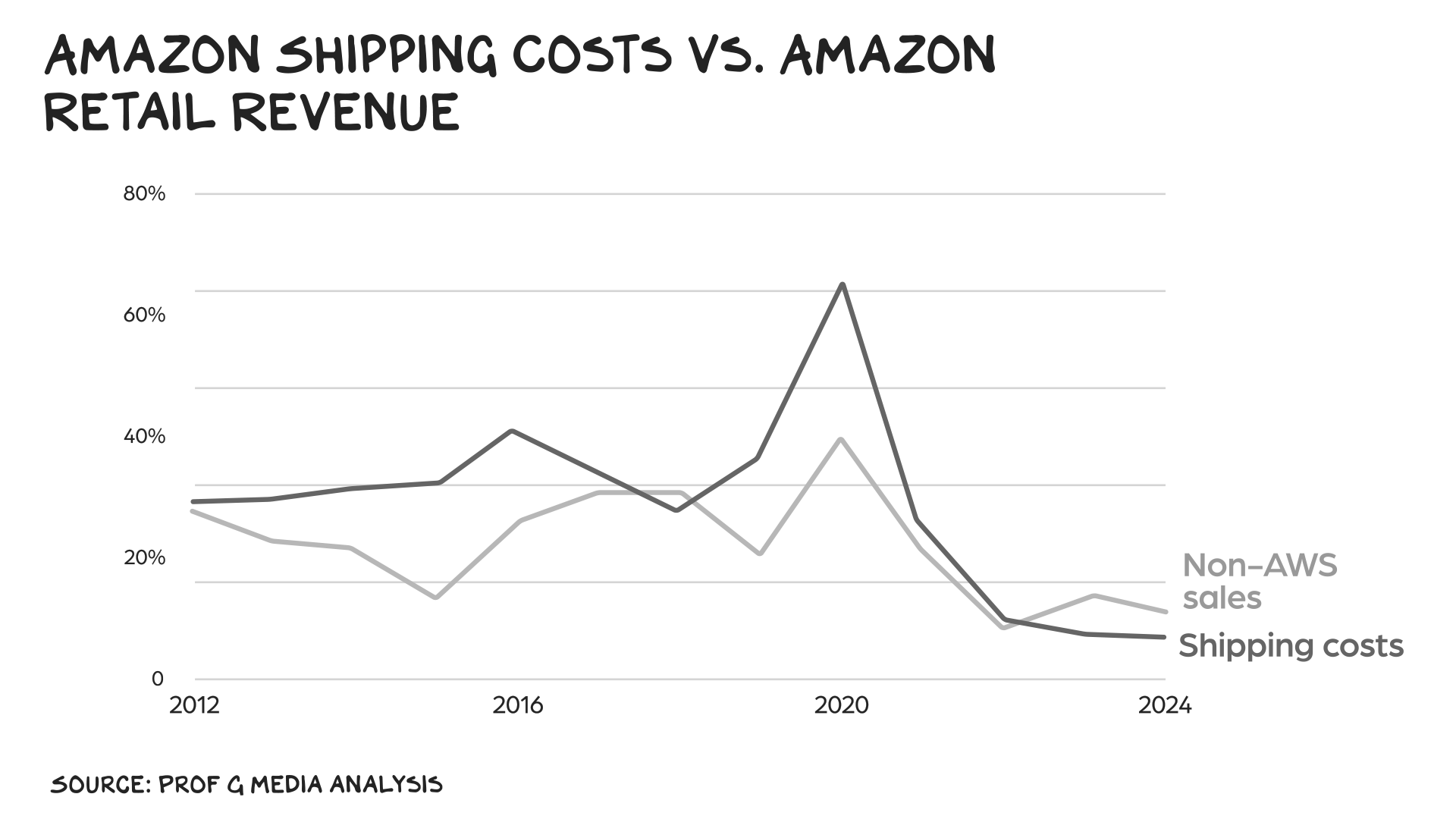
Where the market overestimated Alphabet’s existential threats, I believe it’s underestimating Amazon’s not-so secret weapon (automation) and missing its next growth engine (retail). For more than a decade, people thought of Amazon as a cloud company with a retail unit. AWS and the ad business drove its margin expansion, while on the retail side fulfillment and shipping costs increased faster than sales. Two years ago, Amazon began to reverse that trend. Investments in automation, primarily robotics but also AI, are beginning to deliver operational leverage.
Amazon is projected to have almost 40 delivery fulfillment centers equipped with robots by the end of next year, resulting in an estimated cost savings of $4 billion per year. A Morgan Stanley report estimated that if 30% to 40% of Amazon’s orders in the U.S. are fulfilled through its next-gen warehouses by 2030, the company could save $10 billion a year. Based on last year’s financials, $10 billion in cost savings translates to an additional $170 billion in enterprise value. As the Prof G Markets team observed in our other newsletter, investors are “pricing in AWS’s dominance, but missing the retail margin story,” making Amazon one of the most underappreciated members of the Mag 7. Amazon’s shares are trading at 34x earnings, well below the company’s five-year average of 60x. The stock had been up around 2% so far this year, but it popped after this week’s earnings call on news that AWS revenue had beaten expectations.
One of technology’s tectonic unlocks has been the elevation of information (bits) over objects (atoms). Our digital lives are (mostly) frictionless. One-click purchasing, personalized algorithmic feeds, and swiping right put shopping, entertainment, and mating at our fingertips. But in the physical world, friction is the defining feature. To fulfill a one-click purchase, Amazon deploys armies of human workers, leveraging machines, global supply chains, and infrastructure. Five companies in the Mag 7 primarily move bits. One, Tesla, moves atoms. Straddling both worlds, Amazon is a logistics company at its core. With 40,000 semitrucks, 30,000 vans, and 110 aircraft (equivalent to the armed forces of Austria, Denmark, or Norway), Amazon excels at moving atoms. The company delivers 60% of Prime orders on the same or next day. According to the most recent data, almost three-quarters of Americans live within one hour of an Amazon fulfillment center.
Recently, I wrote that America’s economy is one big bet on AI. That bet has inflated the valuations of companies that move bits and distracted attention from companies using automation to reduce friction in the physical world. Two-thirds of Amazon’s revenue comes from three segments: online retail, physical stores, and fulfillment services for third-party sellers. Those business lines account for one-third of Amazon’s operating expenses — $26 billion in the last quarter alone. The more it automates, the more Amazon can cut costs in its core business by reducing real-world friction. It’s already happening. According to the Wall Street Journal, Amazon averaged roughly 670 employees per facility last year — the lowest number in 16 years. Meanwhile, those employees now handle 22x as many packages, on average, as they did a decade ago.
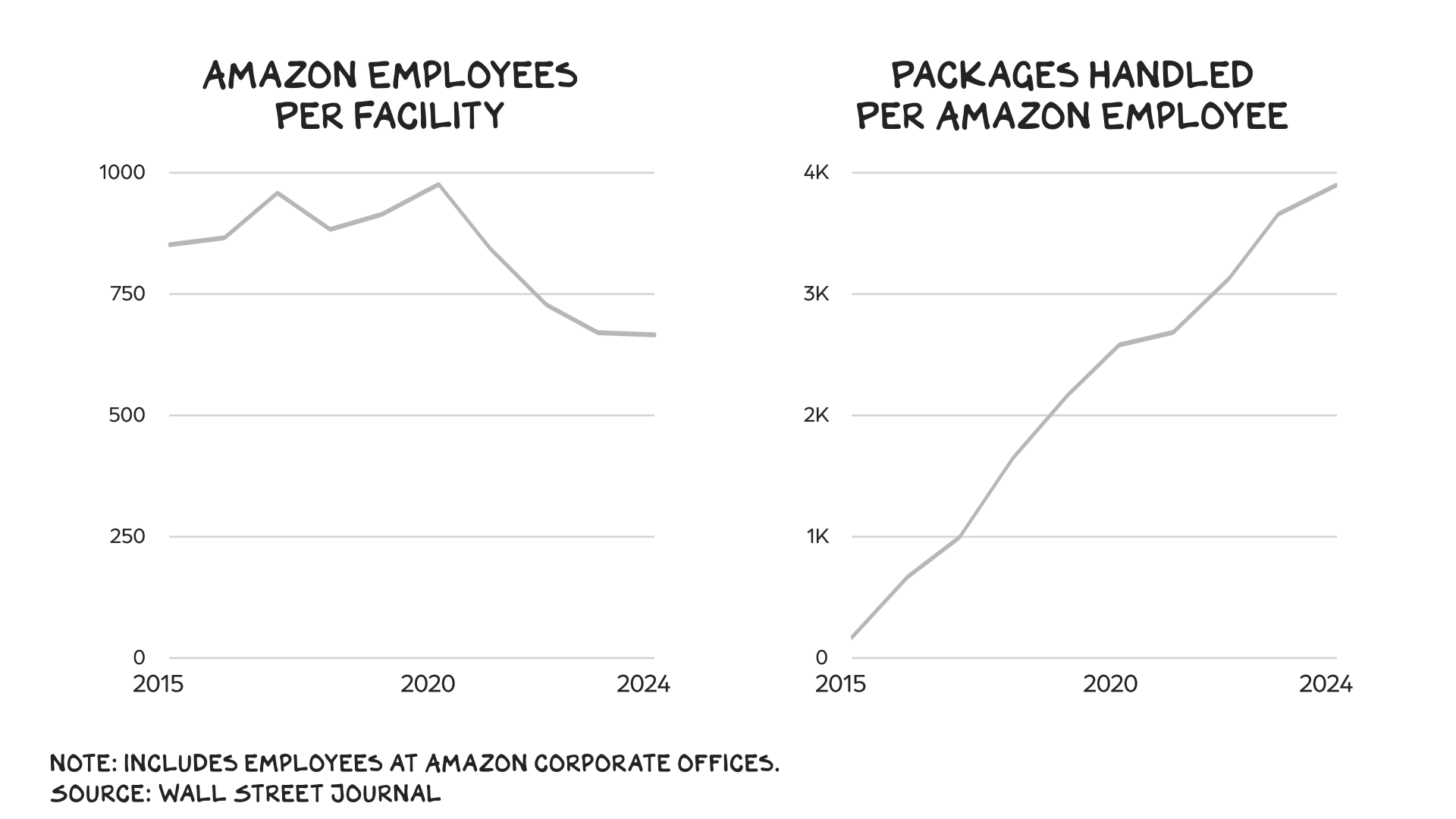
This week, Amazon announced plans to lay off 30,000 corporate employees. That 10% reduction represents the largest cut to headcount in the company’s history, but it’s a fraction of what’s coming for warehouse workers. Amazon’s U.S. workforce has increased 3x since 2018, to almost 1.2 million (70% of the company’s employees are based in the U.S.). But according to the New York Times, Amazon believes that by 2027 it can avoid hiring more than 160,000 workers it would otherwise need in America. Ultimately, Amazon believes it can automate up to 75% of the company’s warehouse operations.
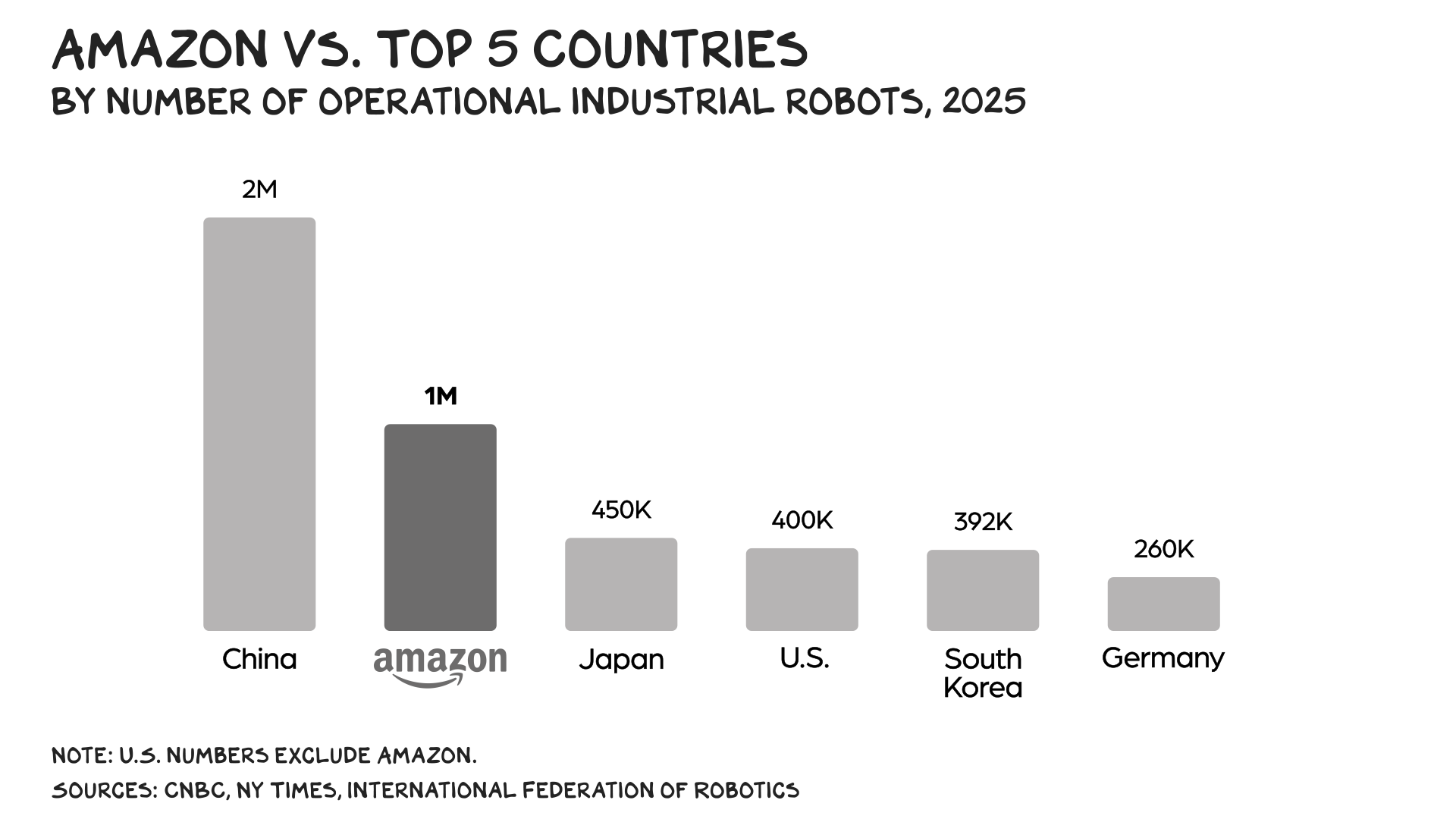
Consider Amazon’s most recent automation milestone. In June, it deployed its millionth robot worker, putting the company on pace to have more robots than humans in its warehouses by yearend. I believe that, just as Mark Zuckerberg, Satya Nadella, and Sundar Pichai dream of AI replacing high-priced tech talent at Meta, Microsoft, and Alphabet, Amazon CEO Andy Jassy dreams of a robot workforce that will never unionize, get injured, demand a raise, go to the bathroom, take time off, or post about poor working conditions on social media. At Amazon’s scale, it’s not a robot workforce, but a robot nation. One of the fears about AI is that it could build a robot army that turns on us. It’s here, it’s Amazon, and (so far) it’s not looking to kill us. It will replace a lot of us, though.
Amazon began investing in robotics a decade ago, purchasing Kiva Systems for $775 million. Since then, Amazon has identified six categories of automation: movement, manipulation, sorting, storage, identification and packing. A robot called Hercules moves heavy carts, while another, Pegasus, sorts and shuttles packed orders. A robotic arm called Sparrow, designed to replace human pickers, is capable of handling 200 million different products of varying sizes and weights. A new address labeler can label 3,000 packages per hour. In tests, Amazon says Sequoia, an automated inventory management system, can process packages 25% faster than its current management system at a quarter of the cost.
This year, Amazon plans to spend $100 billion to capture what Jassy called a “once-in-a-lifetime business opportunity,” adding that “the vast majority of that capex spend is on AI for AWS.” But investments in AI are paying dividends in robotics as the technologies converge. As a Citigroup report put it, “AI is a huge upgrade to robotics,” allowing robots to see, move, talk, learn, and act. It’s the difference between a robot programmed to perform a task and one capable of doing any task within its physical constraints. If you’ve taken a Waymo, you’ve seen convergence firsthand — the car is a robot operated by an AI driver. At Amazon, the peanut-butter-and-chocolate combo of AI and robotics shows up in three ways:
Unlike other jobs, loading and unloading trucks is primarily done by humans even in the most automated warehouses. It’s the same story for last-mile delivery; Amazon’s goal is to deliver 500 million packages per year via drone by the end of the decade, but for now it relies on humans to deliver more than 6 billion packages annually. This is dangerous work, akin to playing Tetris with heavy weights, often in extreme heat or freezing cold. According to BLS data, transportation and warehouse workers sustain serious injuries at twice the rate of manufacturing workers and nearly 4x the rate of workers in mining, oil, and gas.
Last year, Tye Brady, chief technologist at Amazon Robotics, described the tactile skills and situational awareness needed to load and unload a truck as the “holy grail of robotics,” adding “we aren’t there yet.” We is the operative word. This year, DHL ordered 1,000 robot truck-loaders from Boston Dynamics. Through its $1 billion Industrial Innovation Fund, Amazon invested in Rightbot, a startup that designs robot truck-loaders. As soon as a robot truck-loader comes online, it’ll connect with two other robot systems — Cardinal and Proteus — that sort packages and move them to the loading dock. When that happens, some of America’s most dangerous jobs will (mostly) vanish.
Automation represents a massive wealth transfer from Amazon’s workers to its shareholders and customers. Leaked documents show the company hopes to automate away 600,000 jobs by 2033. An MIT study found that adding one robot to a local area reduces employment in that area by six workers. A 2019 Oxford Economics report estimated automation could displace 8.5% of the global manufacturing workforce by 2030. As with AI, it’s possible that robotics will increase GDP while reducing employment.
Five years ago, my friend Andrew Yang ran for President with the slogan “Humanity First.” He warned that we needed to prepare humanity if/when automation decimates labor. This year, President Trump’s Big Ugly Bill made 100% bonus depreciation permanent for machinery, robotics, and automation equipment, while simultaneously gutting healthcare, education, and social safety net programs.
Tax policies illuminate a nation’s values. Our policies suggest we want to birth robots faster and expedite the death of workers.
Life is so rich,
P.S. I’ll reveal the full list of my 2026 Predictions at a free live event hosted by Section. Sign up here.

