


2026-06-17 00:00:00
THE BEAUTIFUL GROTESQUES OF MEGAHEX ARE BACK WITH MORE TALES OF DEPRAVITY AND FRIENDSHIP

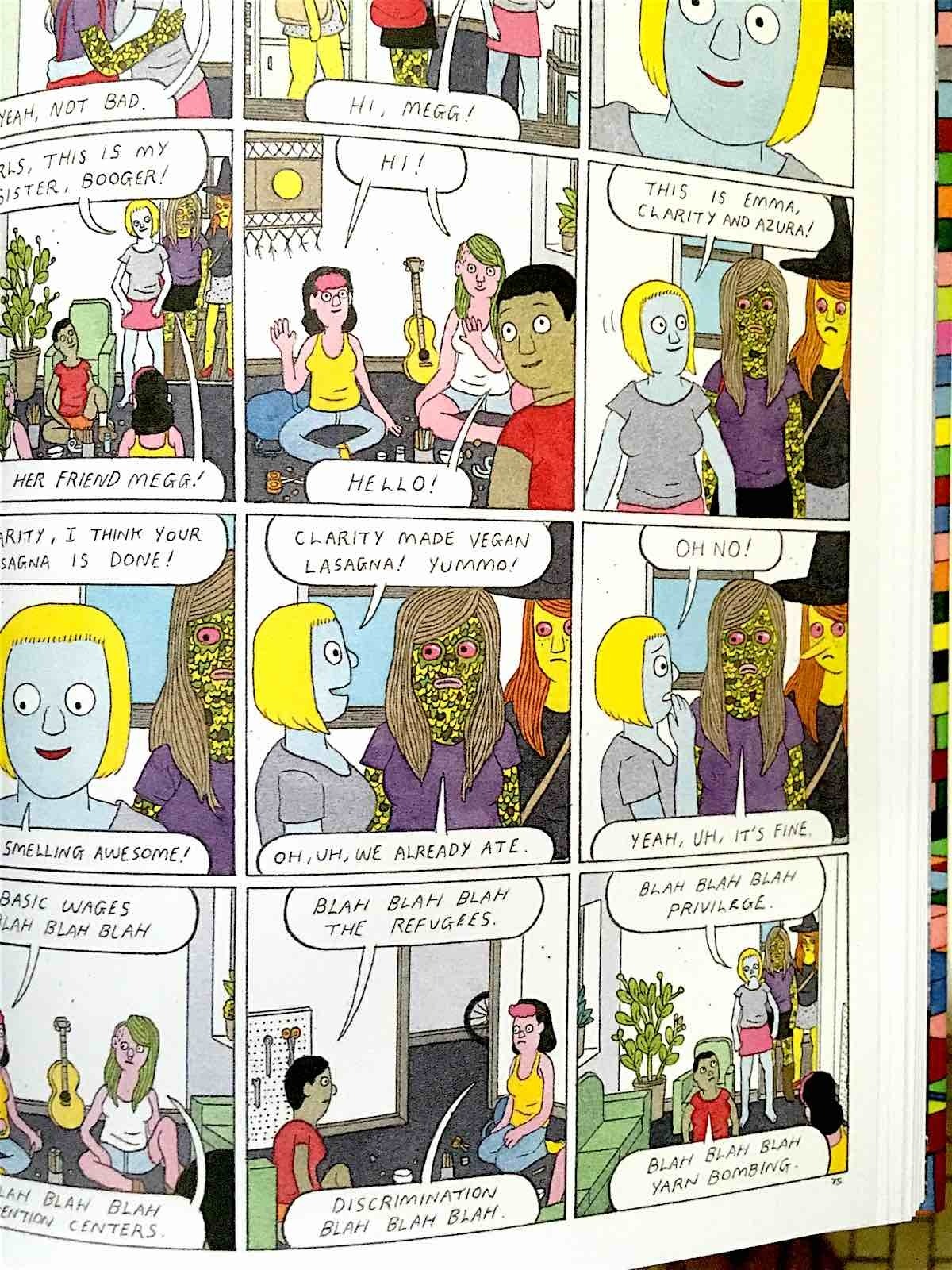
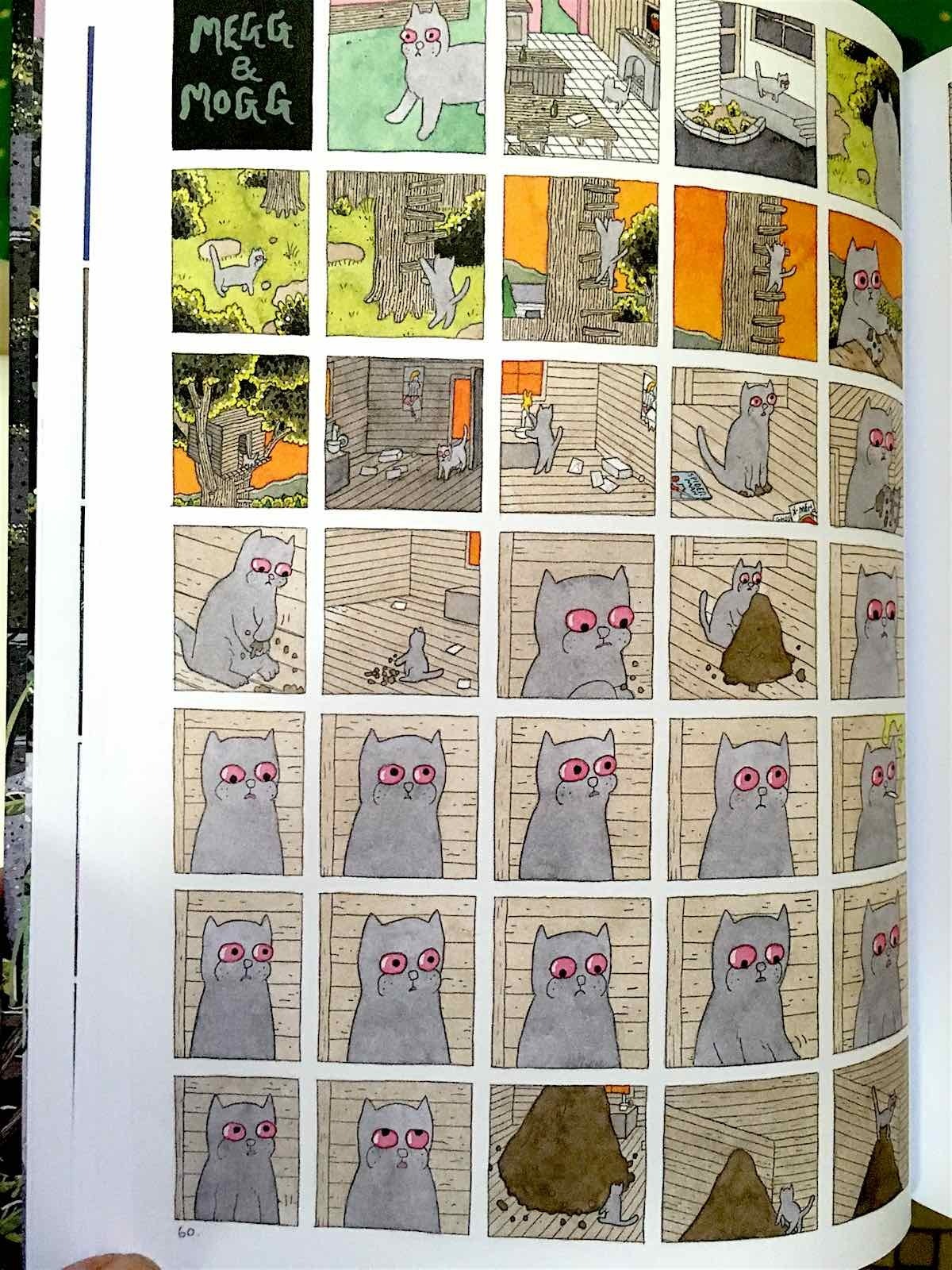
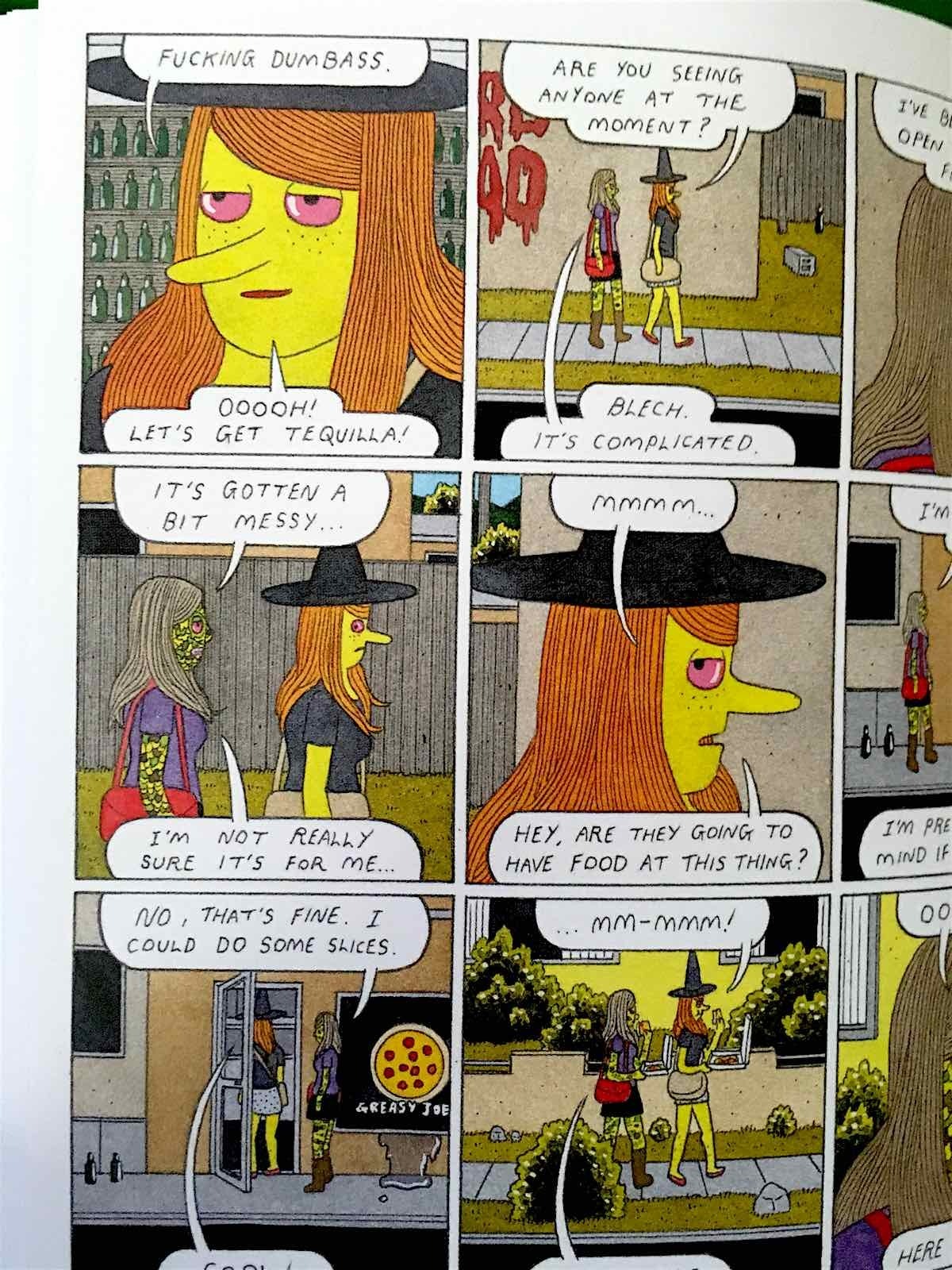
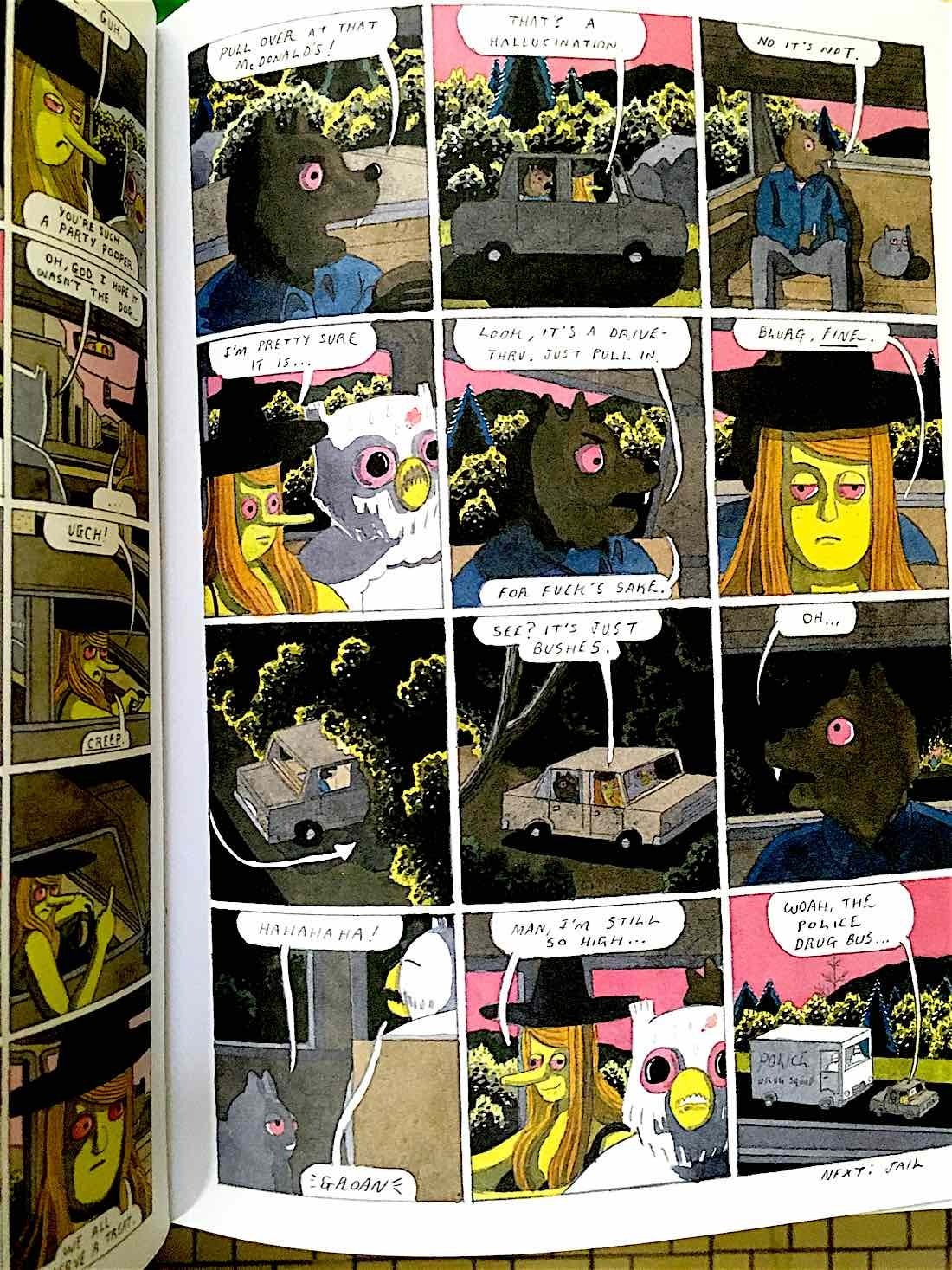
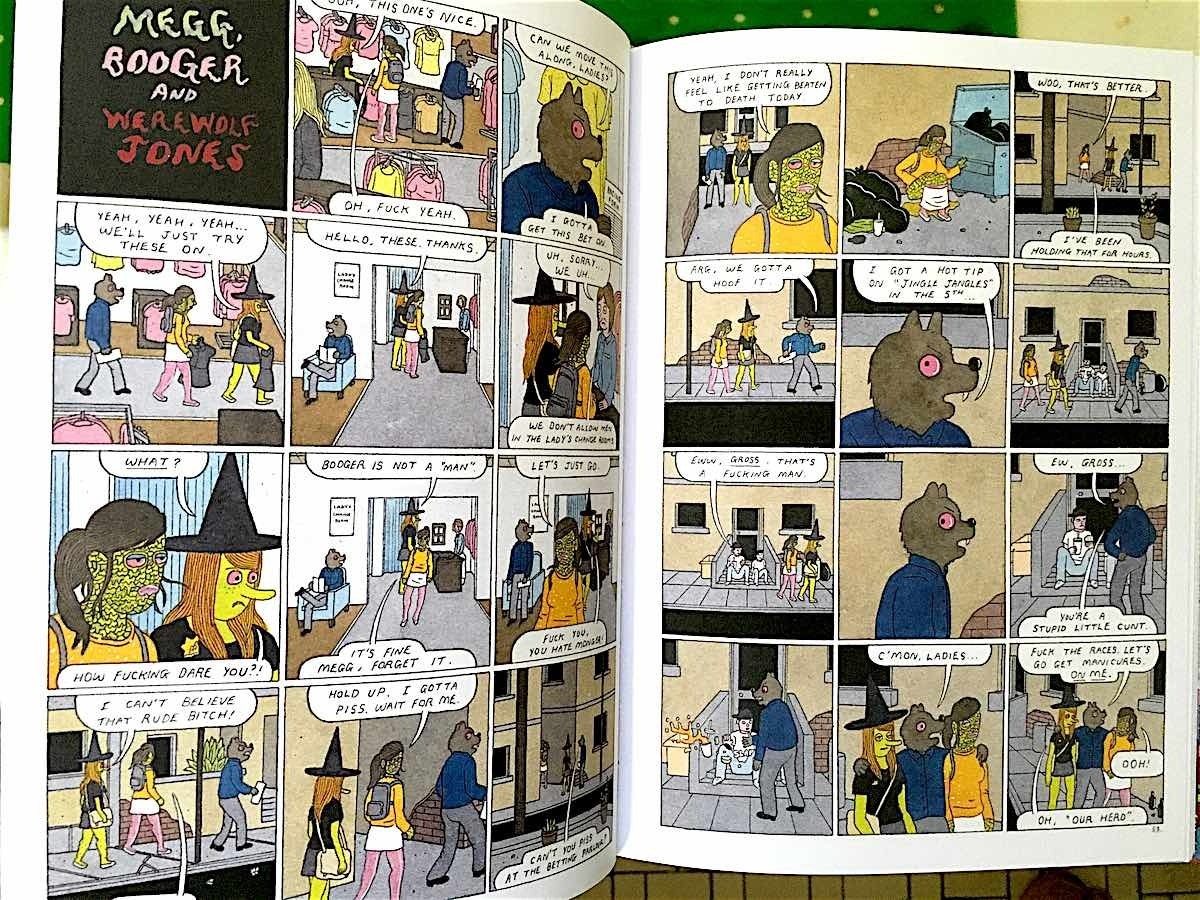


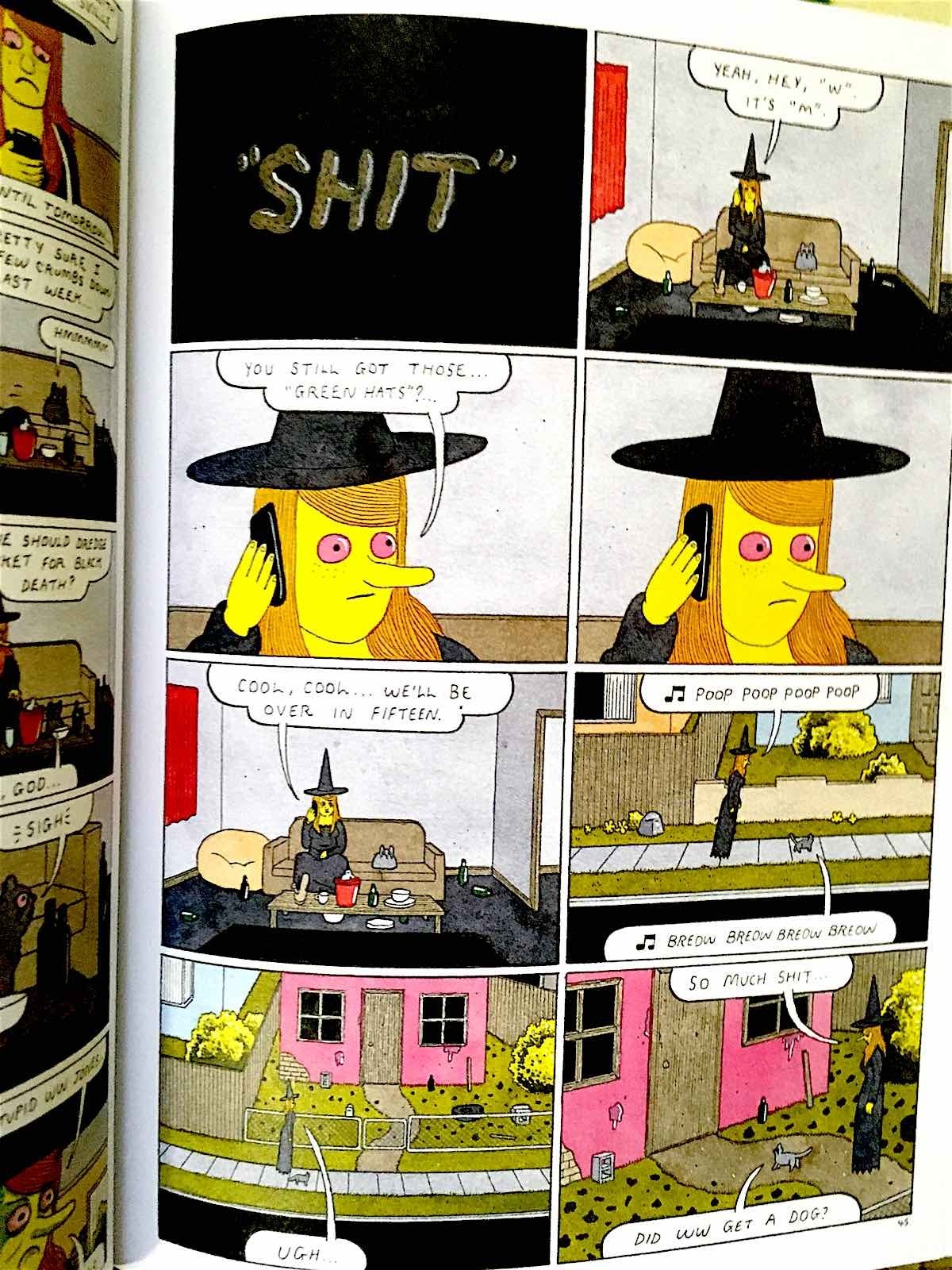
Megg and Mogg in Amsterdam (and Other Stories)
by Simon Hanselmann
Fantagraphics
2016, 164 pages, 6.6 x 9.1 x 0.8 inches
The entire loveably dysfunctional freak family that stole our hearts in Megahex (and sold them on the black market for hookers and blow) are back in Megg and Mogg in Amsterdam (and Other Stories). Once again we enter the bizarre funhouse world of Megg the witch, her cat familiar/lover Mogg, and their coterie of hangers on: Owl, Werewolf Jones, Mike the Gnome, Booger (a boogey woman), Dracula, Jr., and others.
On the surface, little has changed. The revolving door of Megg and Mogg’s house still spins to let their drug-addled crew enter, hatch a series of ridiculous schemes, inhale all of the drugs and fast food, and then we get to watch as one nightmarish scenario after another plays out like a slow-motion train wreck. But there are deeper relationship themes that run through Megg and Mogg in Amsterdam. Over the course of the book, strips begin to introduce trouble in Megg and Mogg’s relationship, and Megg’s growing attraction to Booger. Werewolf Jones also is having trouble in his marriage and is fighting to retain custody of his two sons (while doing every boneheaded thing in the world to ensure that doesn’t happen). The title of the book refers to a trip that Megg and Mogg take to Amsterdam to try and patch up their failing relationship.
The level of depression and depravity that drives Megg and Mogg (even more intense here than in Megahex) might be too much for some, but there is also an undeniable heart that beats at the center of this work. There is obviously a lot of love and solidarity to be found within the complex relationships between these characters – in the midst of the binge drugging, the frequent release of bodily fluids, and the seeming complete lack of any motivation or ambition on anyone’s part. The gloss of Megg and Mogg is undeniably juvenile, but it all feels deftly counter-balanced by an intelligence and a weird shape of hope that always keeps me rooting for these cartoon human monstrosities. – Gareth Branwyn






The Collector
by Sergio Toppi
Archaia
2014, 252 pages, 8.5 x 11 x 1 inches
I was delighted to discover this terrific collection of comics by Italian artist Sergio Toppi. Although I’d never seen his work before, it instantly got my attention and seemed familiar. It combines a flat graphic art style, a swashbuckling sensibility and witty writing that I found irresistible.
Sergio Toppi (1932-2012) was an artist and illustrator from Italy, whose books have been published for decades in Europe but only recently translated and available in the U.S. through Archaia, a division of Boom Entertainment. The Collector won the Soleil D’Or prize for Best Series at the Soliès-Ville Festival. It’s easy to see why.
The book follows the exciting exploits of an 1880’s rogue and dandy, known as “The Collector,” as he travels the globe in search of treasures. Not a seeker of gold or jewels, he collects only artifacts with historical significance. This sets the stage for adventures featuring Hopi Indians in the American Southwest, camel-riding Ethiopians, Mongol tribesmen, warring Irish clans, Maori chieftains and more. Although the artwork is in black and white, it’s most highly folkloric and historically colorful. The separate wide-ranging episodes and characters are knitted back together into a satisfying finale.
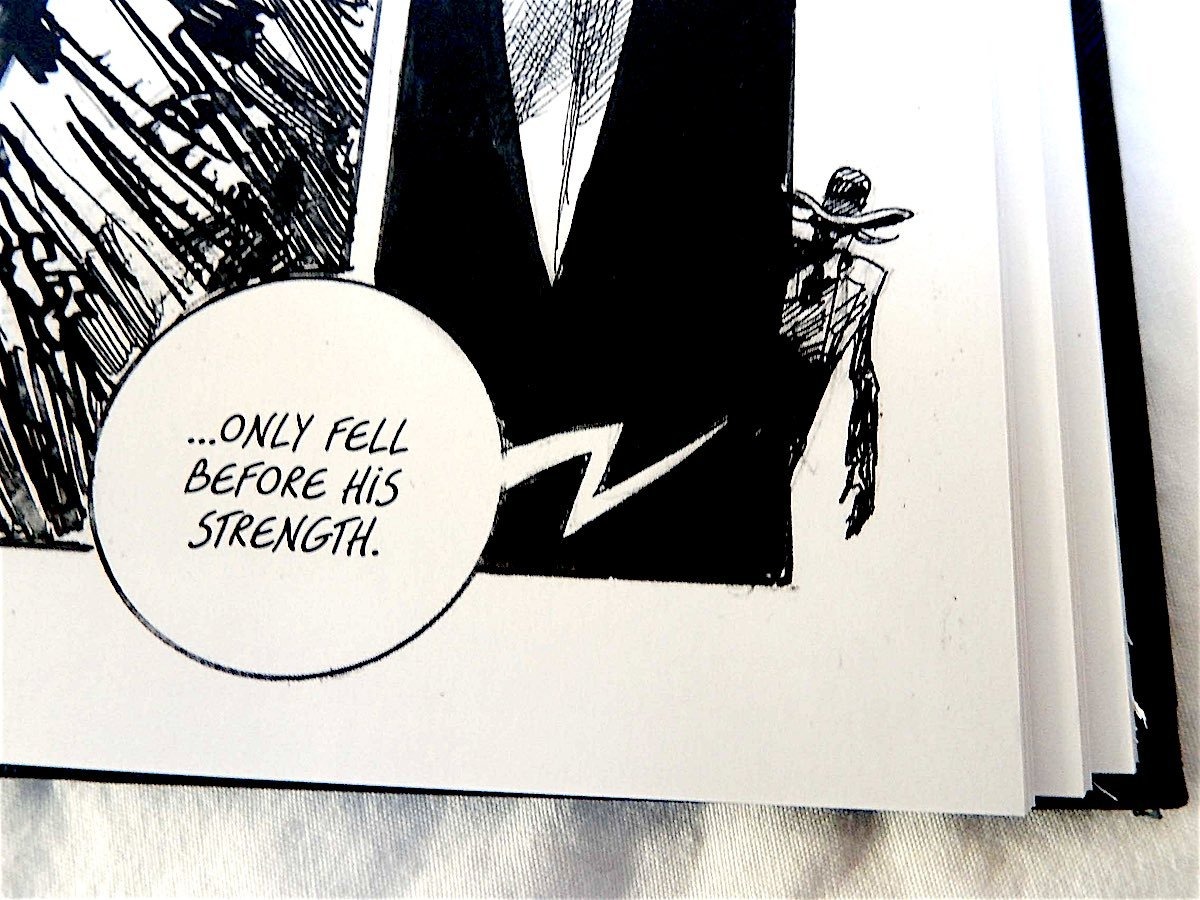
Each page is laid out in dramatic fashion with bold layouts. Some pages have conventional multiple comic panels, while others feature free-wheeling compositions, along with other full-page designs, more fine line illustration than comic book. Toppi is a master of drawing the human figure and the characters are richly rendered in various cultures’ costumes and in far-flung settings. That, combined with his inventive crosshatching, splatters, scratches and bold use of solid blacks, reminds me of two of my favorites: Bernie Fuchs and Mike Mignola.
I enjoyed the cinematic approach of the staging and the clever use of scale. Tiny figures draw you into a wider landscape, then are immediately juxtaposed against a close-up portrait, all within one page’s layout. If you remember that scene from the film Lawrence of Arabia where a nearly infinitesimally tiny camel-riding Peter O’Toole is boldly placed into a Cinerama desertscape, you’ll know what I mean – wow! I’m looking forward to reading another translated Toppi book: Sharaz De: Tales from the Arabian Nights. – Bob Knetzger
Books That Belong On Paper first appeared on the web as Wink Books and was edited by Carla Sinclair. Sign up here to get the issues a week early in your inbox.
2026-06-16 00:00:00
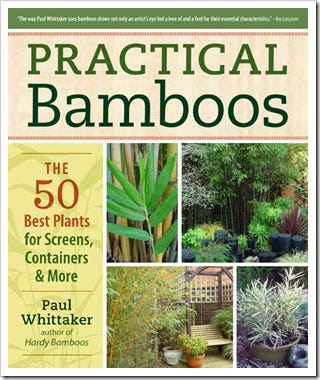
In our yard we’ve been nursing along some small clumps of bamboo, and since then I’ve been investigating other hardy bamboos. I own a lot of bamboo books, but Practical Bamboos is by far the most useful of all. Other bamboo books are more encyclopedic; this one focuses on “only” the 50 most useful bamboo species, spelling out what types are good for fence rows, which are drought resistant, which work well in containers, and how to identify those variants from lookalikes. There’s very specific growing tips for each variety and solid advice about the principles of growing bamboo plants in general. This is the manual to get. — KK
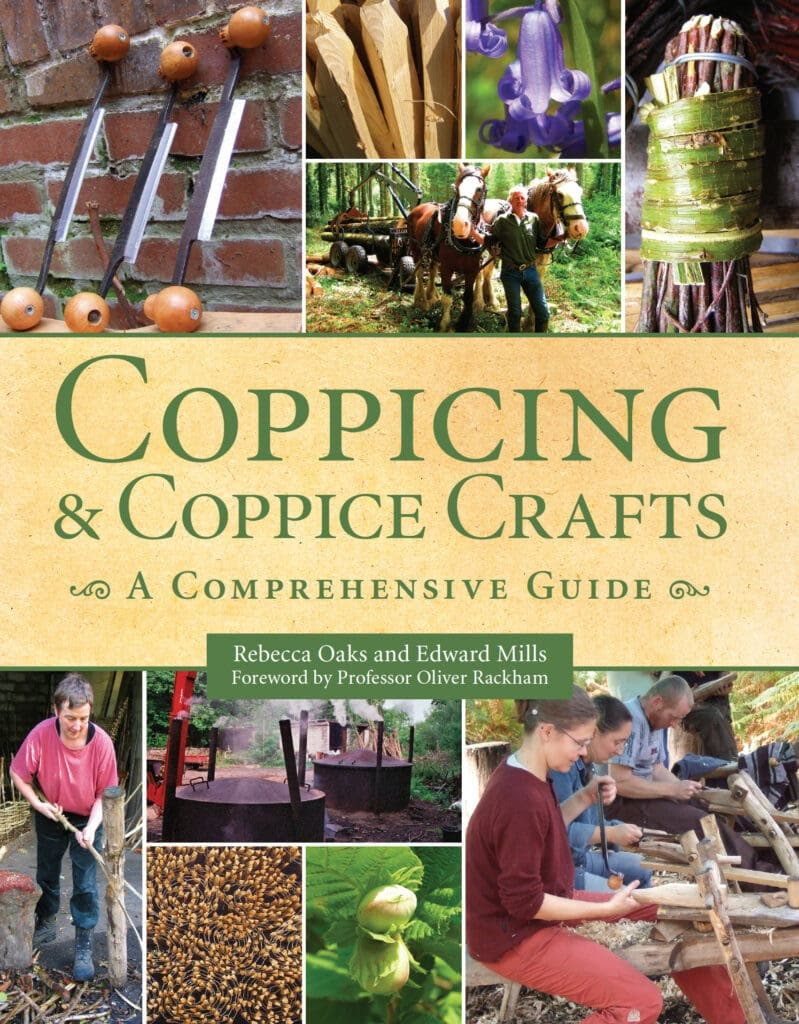
Coppicing is an old art of the repeated harvesting of small-diameter wood from the same bush or tree. Once cut, the branches grow back, often pretty fast. Coppicing is common tradition around the world, particularly where big lumber is scarce. This book teaches the traditions and skills of coppicing as practiced in England. Coppicing is a useful art for homesteaders because you can sustainably extract wood products from a small lot or even fence row. Coppiced wood can be woven, used for carving, making chairs, charcoal, and for firewood. This English book is the best guide to the craft, instructing you in how to grow, manage, and use coppice bounty. One note, emphasized by the book: the biggest challenge in coppicing today is controlling deer, which were not a problem in old days (everyone ate them), but their huge populations now devour coppice shoots indiscriminately. — KK


Coppicing makes use of a mysterious property that most trees have: when cut down they do not die but grow again from the stump or roots. People have used this behavior for at least 6,000 years to generate renewable supple of wood for fuel or to use for many crafts, simple or specialized.

Bamboo works. Bamboo does more things than any other material. Many of its traditional uses are inventoried here. A shape-shifter, bamboo’s super-human abilities are amazing. Its grass fiber is all that plastic would like to be, plus more. This is an encyclopedia of bamboo ideas. — KK


Once a week we’ll send out a page from Cool Tools: A Catalog of Possibilities. The tools might be outdated or obsolete, and the links to them may or may not work. We present these vintage recommendations as is because the possibilities they inspire are new. Sign up here to get Tools for Possibilities a week early in your inbox.
2026-06-15 00:00:00
Mechanical-pencil.com reminds me of the Way Things Work book I loved as a kid, but with 3D animations that make it even more illuminating. Mechanical engineer and artist Bryan Macomber tears down familiar objects — a Pilot G2 retractable pen, a Zippo lighter, a Pez dispenser, a BIC mechanical pencil — and walks you through how each one works, part by part. Watching the push-push mechanism inside a clicky pen click into place is genuinely satisfying. I hope Bryan keeps adding to this series. — MF
Storied Colors is nerdy and delightful. More than 250 colors are indexed and searchable so you can read the stories behind their origin, chemistry and use. This is especially meaningful to me because not only do I pride myself on knowing the various names for different shades of color, but when I was a young weird kid, instead of playing with dolls, I would play with my box of crayons as characters, assigning personalities based on their color. Color has always been a portal to the imaginal for me, rather than just a simple tint. There’s a mention on their website of an upcoming newsletter version that you can sign up for. — CD
The hosts of a great podcast we have featured on Recomendo before, Acquired, conclude each of their 3-hour episodes about legendary companies with several personal recommendations each. These could be any apps, books, destinations, shows, apparel, or devices they have personally enjoyed in the last month. They have good taste, lots of variety and a wide range, over their 10-year run. This sounds familiar! They call these reviews, “carve outs” (not connected to the show’s topic) but they are really Acquired’s version of Recomendo. I’ve found some good stuff this way. — KK
I’ve been wearing the RingConn Gen 3 and the Oura Ring 4 side by side for over a week, and their core tracking is nearly identical — sleep profiles, heart rate, and other vital signs all line up closely between the two. So on accuracy, it’s basically a wash. But I prefer the RingConn for two reasons: it doesn’t charge a $6/month subscription to see your own data, and it lets you export that data — neither of which Oura allows. The RingConn also has vibration alerts for a low battery, too much sitting, and other health nudges (you can silence them while sleeping). The one thing Oura does better: a small dimple that lets you orient the sensors toward your palm. The RingConn lacks that, so it sometimes rotates, and I’m not sure it’s reading accurately. — MF
Obsessive effort spent on ridiculous memes, over-the-top projects about stupid things, absurd seriousness about nonsense. Also meticulous craftsmanship at scale: these are the hallmarks of art projects by Sunday Nobody, a young “meme artist” who posts on YouTube and Instagram. For a recent example of his gonzo projects, watch his Taco Bell Funeral. To finance his performances he sells limited editions of his very collectable art. His real art is the whole nerdy process. — KK
Johnny Webber put together a great list of resources for anyone contemplating purchasing or building their own Writer Deck, a single-purpose, distraction-free writing device. I still use my AlphaSmart Neo2, which I recommended in 2019 when you could still find them super cheap on Amazon, and the tactile keyboard feels so satisfying to type on while the battery life lasts for months and months. Someday I might invest in a newly made writer deck, but for now this works. — CD
Sign up here to get Recomendo a week early in your inbox.
2026-06-14 00:00:00
This is such an eye-opening mini-doc on the history of Heathkit and the role it played in post-WWII DIY/maker culture. I’m fascinating by that period in American history when all of these skilled G.I.s came home and turned their talents toward auto and motorcycle mechanics, aviation and aerospace, electrical and other engineering, Ham radio, and more. It was a remarkable moment when technical literacy, hands-on problem-solving, and the confidence to build and repair things yourself were woven into the fabric of everyday life. And the cost of owning your own tools and the space to use them became affordable to many.
In Heathkit’s case, they turned war surplus electronics components into kits with highly technical, clearly illustrated instructions that became home training for generations of hobby and professional electronics enthusiasts. I still remember, in the 1970s, as a teen, seeing a friend’s oscilloscope kit being built on his workbench and marveling at his methodical journey through the assembly instructions, checking off each step as he went. He was so freakin’ proud of that thing when he finally finished it and it worked!

In this episode of Project Farm, Todd tests 17 different pairs of work gloves, ranging in price from $2.80 to $32. He tests them for comfort, thickness, force required to bend glove fingers, puncture and abrasion resistance (wear), impact protection, cut resistance, and grip. The results are surprising, and as he points out at the end, it’s always so rewarding when some of the cheaper options come out on top. In this case, the $2.80 G&F gloves got As in almost every testing category. But sadly, they got a C and D in comfort and bendability. The glove with the best price/performance sweet spot was the leather $10 WZQH glove. You can see the final results matrix here.

In Kevin Kelly’s Tools for Possibilities, in a piece about the book How to Find Lost Objects (available as a free e-book), Kevin shares his own object-finding strategy:
The majority of lost objects are right where you figure-once you take a moment to stop and figure.
Others, however, are in the immediate vicinity of that place. They have undergone a displacement-a shift in location that, although minor, has served to render them invisible.
Some examples:
A pencil has rolled beneath a typewriter.
A tool has been shoved to the rear of a drawer.
A book on a shelf has gotten lodged behind other books.
A folder has been misfiled, several folders away from where it belongs.
Objects are apt to wander. I have found, though, that they tend to travel no more than eighteen inches from their original location. To the circle described by this eighteen-inch radius I have given a name. I call it the Eureka Zone. With the aid of a ruler, determine the Eureka Zone of your lost object. Then explore it. Meticulously.
I just ran across this maker channel, Evan Monsma, and I’m digging the vibe. He had me at his mission statement: “I want to encourage everyone to build a shelf and change their own oil, that’s all.” Subscribed!
In this video, Evan introduces his hardware system of color-coded mint tins for housing screws, nuts, bolts, washers, and misc. small parts. But his tins collections is getting out of hand so he decided to build storage shelving using a technique he’d never tried: dado joints. The way he talks through his planning and building process is very satisfying. And I enjoyed see him using a white Pentel Presto pen and drawing out the build directly onto his desk and the material. But I have to admit chuckling when I saw him drafting the dimension for the shelves on the shelf stock itself, thinking: “He’s about to cut those calculations up,” and then him admitting later on in the video that he had lost the dimensions in cutting out his parts. Oops.
Years ago, a plumber told me to never follow the directions on a bottle of Drano (where it suggests pouring as much as a half the bottle into your clog). “That’s marketing hype to get you to waste your money,” he told me. “Just use about a shot-glass worth at a time. Then a kettle of boiling water. And repeat as needed until the drain clears.”
I’ve been doing it that way ever since. A small amount of drain cleaner. Wait 20 minutes. Then pour of a kettle of hot water. Repeat. In my experience, it has worked most every time on the usual suspects: bathroom hair, sink sludge, and kitchen grease slowdown.
The logic, as he explained it, is simple. Most clogs aren’t epic blockages. They’re small, localized buildups. You don’t need half a bottle of caustic chemicals sitting in your drain trap. A small dose often begins the breakdown. The hot water helps move things along. Less chemical, less waste.
But there are caveats. Most chemical drain cleaners are highly caustic. Even in small doses, repeated use can stress older metal pipes. Boiling water and PVC don’t get along well, either. Extremely hot water can soften PVC joints over time.
There’s also the bigger truth: mechanical solutions are usually better. A simple drain snake will often solve what chemicals only nibble away at. And enzymatic cleaners, while slower, are gentler on pipes.
Still, for minor clogs, the shot-glass method has been a reliable trick in my house.
Relatable.

[From New Yorker cartoonist, Emily Bernstein.]
I now have well over 10,000 subscribers to this humble little newsletter. And I hover around paid subscribers. A million thanks to all of you. Doing this newsletters is a true joy for me and I especially like feeling like I’m connected to a community of fellow makers. Thanks to everyone who’s sent me an email, made a comment, shared a tip or tool with me. Let’s keep the ball rolling for another 200 issues!
If you want to financially support this work, please consider a paid subscription. It helps keep me in Carhartt work socks. My feet appreciate you.
A very special thanks to Hero of the Realm subscribers: Moses Hawk, Jim Coraci, Donobster, Peter Sugarman, and Will Phillips for your generous support.
2026-06-13 12:00:00

Sleep Groove is a myth-busting guide to circadian science that teaches you to work with your body’s natural rhythms rather than fight them, using accessible explanations, charts, and comics.
As I get older, I wake up in the middle of the night more than I did in my twenties and thirties. A lot of people my age tell me the same thing. Sleep Groove gave me a new way to think about it. Walch argues that the strength and steadiness of your daily rhythm are more important than a single long, unbroken stretch of sleep.
When your internal clock has a strong, well-defined beat, your sleep consolidates around it. When that rhythm flattens out, which tends to happen as we age, sleep breaks into pieces, and you wake more often during the night.
The fix is to make your clock beat louder by keeping a fixed wake-up time, getting bright light early in the day, and staying in darkness at night. Since I started protecting my rhythm, my night wakings have gotten shorter, and I drop back to sleep faster.
Forget the eight-hour rule. Research shows that sleep regularity (how much your sleep schedule on one day resembles your sleep schedule the next day) predicts health outcomes better than total hours of sleep. Going to bed and waking up at the same time every day matters more than hitting a magic number.
Light exposure is the most powerful tool for setting your circadian clock, but timing is everything. Bright light during midday boosts your system and strengthens your rhythms. Light during your biological night confuses your brain and throws everything off. The same light can help or harm, depending on when you get it.
Your body is wired to cycle through a biological rhythm, and when your sleep doesn’t follow that pattern, you feel terrible. The same goes for food, activity, and mood. All of it is rhythmic, and acknowledging that is the first step to feeling better.
Oversleeping on weekends doesn’t make up for undersleeping during the week. Sleep debt doesn’t work like a bank account. The goal isn’t to average out over time but to establish consistent rhythms your body can rely on day after day.
“Light is a drug—use it wisely.”
Book Freak is published by Cool Tools Lab, a small company of three people. We also run Recomendo, the Cool Tools website, a YouTube channel and podcast, and other newsletters, including Recomendo Deals, Gar’s Tips & Tools, Nomadico, What’s in my NOW?, Tools for Possibilities, Books That Belong On Paper, and Book Freak.
2026-06-12 12:00:00
I got especially excited about a package that arrived this week because I was finally able to read my preorder of the new book from Austin Kleon: Don’t Call It Art! The subtitle is 10 ways to create like a kid again and it lives up to that promise. The core idea is to let your inner child loose and make things with joy, as a form of play instead of something you’ll be judged on. As always with his titles, the hardback is full of fun illustrations. This time they’re joined by drawings from his two young sons, which brings the whole message home. It is a fun read and would be a great gift for someone who is stuck in a rut creatively or just starting a new job or business. The author of Show Your Work is on Substack as well.
For the first time since the Great Depression 90 years ago, more people moved out of the USA last year than moved in. That was widely reported around the world, but if you’re wondering where they ended up, most studies I’ve seen peg Mexico, Portugal, Spain, Ireland, and Colombia in the top 5, though sometimes the order is a bit different after the clear winner south of the border. This site lists 10 countries and a reason for each, like a truly useful digital nomad visa in Thailand and Italy’s remote worker visa. I expect #10 Bali to drop off after recent actions. (See the previous issue.)
Bulgaria has gone from unknown to undeniable hotspot in the past 15 years, thanks in part to great conditions for nomads in Bansko and a cost of living advantage that’s hard to beat in Europe. They adopted the euro and became part of the Schengen Zone recently though, so I tapped native Bulgarian Maria Stoynova from Sofia Expats to give me a rundown on how things stand now with prices. See the current results here: The Cost of Living in Bulgaria.
Dollar Flight Club crunched some data and named the destinations that are still a good deal this summer for flights. In general, the most popular cities are up 15-20% over last year, but others have barely budged. In Europe, they point to 10 destinations going for $570 or less round-trip from U.S. gateways. The ten ranged from expensive (Stockholm and Bergen) to bargains (Krakow and Budapest), but in general were secondary cities except for Dublin. Heading south, check Guatemala, Costa Rica, and a few different spots in Mexico and the Caribbean.
A weekly newsletter with four quick bites, edited by Tim Leffel, author of A Better Life for Half the Price and The World’s Cheapest Destinations. See past editions here, where your like-minded friends can subscribe and join you.

