


2026-10-23 23:30:20
From time to time we get reminded that Pika is still considered a new player in the blogging landscape. It always surprises me a bit because it feels like we have been working on Pika for a decade. Further, the idea for Pika came from my experience managing my own blog’s code for at least fifteen years. I’ve been at this a long time!
Updating my personal blog’s code does not really count to a potential customer of Pika. They are comparing Pika to long-standing players, big corporations, and other individuals or small teams offering blogging platforms. For something as personal as a blog, it makes total sense that one would want to make sure that their selected service is not a toy project that could disappear whenever the creator(s) get bored.
For those that have followed us closely, I hope you can sense that Pika is very far from a toy project. When you first found Pika, you may have noticed my giant face plastered on the homepage. I honestly don’t love my face being anywhere, let alone on our homepage, but I’ll admit it is about as clear an indication you can get that this project is very important to me. I’ve wanted Pika to exist since I first stepped foot on the internet, and I plan to work on Pika for the rest of my life.
If you’re just learning about Pika right now, though, you don’t have that experience of watching Pika evolve. These are sincere words, but it’s understandable in today’s world if you’re a little skeptical of words. So here are a few other facts that should help you be confident that Pika is here for the long haul.
Right from the start, Pika launched with the best blogging web editor out there, and that editor has gotten vastly better since then. In 2026 we have invested nearly all of our company’s time in Pika, and it shows. The software running Pika has matured greatly this year, and we plan to bring awesome new features to Pika while continuing to improve its already-great performance and stability.
Our team does not need Pika to be a home run. It may be anathema to the capitalistic internet dogma, but we don’t really want Pika to hit a home run. Our first goal was for Pika to cover its expenses, and that goal was met a long time ago. Pika is doing great, and we’d like it to continue growing at a sustainable pace. Pika will never sell ads, take on sponsors, or sell your data. Our goal isn’t hockey stick growth, nor is it to sell the company. Pika is ours for the duration.
When Good Enough reorganized and became just Lettini and me, we spent a long time working with a lawyer to properly set up our legal agreement. In our younger days we probably would have found some boilerplate to save ourselves a bunch of time and money. Fortunately, our life experience led us to invest in this process, and that led to many long conversations about various unlikely scenarios around, well, our own mortality. 😬 All of that is to say, if one of us has unfortunate luck, we’ve already talked about what happens next, and we have the legal framework to support that transition for Pika and Good Enough.
That is the power of there being two owners of Good Enough. I am incredibly grateful to have Lettini along for this ride. We’re both incredibly grateful to not be doing this on our own. Working in partnership allows us to build a fantastic product like Pika and offer incredible, human support to our customers. It's also a big part of why Pika (and Good Enough) will be here for the long haul. We’re so excited to see what the future brings!
As always, if you have any questions, please write us!
~Barry
2026-10-16 23:29:00
Fall is all up in our business, and that means it’s time for an update on the little Pika things. Some of these bullet points are small tweaks, while others represent literal weeks of work. This weekend we’ll jump in a pile of leaves to celebrate!
Writing posts and pages:
At desktop viewport sizes, Pika will now remember if you prefer to keep the Settings sidebar open or closed
Added a dropdown toggle to the tag editor to see and select from all of your existing tags more easily
Added an option to preview your newsletter before sending it to everyone
Added automatic embed support for Bunny Stream video links
The tags and without_tags Pika variable parameters now accept boolean AND and OR to work with multiple tags
Pasting into the editor now better removes errant spaces
Improved how arrow keys and Enter work with attachments and captions (thanks, Faiz!)
Specified your chosen language in the logged-in view of Pika so handy browser things like spell check work better
Viewing your site:
Added an option to Site Search to include your pages in search results alongside posts and tags
All automatic embed services now look a lot better with a working visual style in email newsletters
Added aria-current="page" to a site’s navigation links when you’re currently viewing that page
When possible Pika will pause video/audio when another video/audio file starts playing on the same page
Added <category> and <author> tags to RSS feeds (most RSS clients don’t surface these, but some do)
Misc & Maintenance:
Added support for Bandcamp URLs for posts created via the Micropub API
Updated Theme settings so its easier to preview color theme changes
Added a “Shuffle” option to help you spice up your color theme
Improved the instructions on the custom domain Settings page
Fixed issues with a site’s custom CSS and how posts display on Pulse and in email newsletters
Fixed issues with the Micropub API’s capability to update posts with new images and tables
Fixed issue where the countdown for a newsletter to be sent could be stale on the Dashboard
Completed a very large restructuring of our database to prepare for some future changes 💪😅
Improved the structure of our database while we were at it
Created import scripts for Day One, Tumblr, and Posthaven
Fixed silent errors with toolbar popovers
Fixed up some deployment and caching issues that could lead to un-styled blog posts
2026-10-16 02:49:24
Now you can edit multiple posts at once in Pika. Well, specifically you can add tags to, remove tags from, or delete multiple posts at the same time:
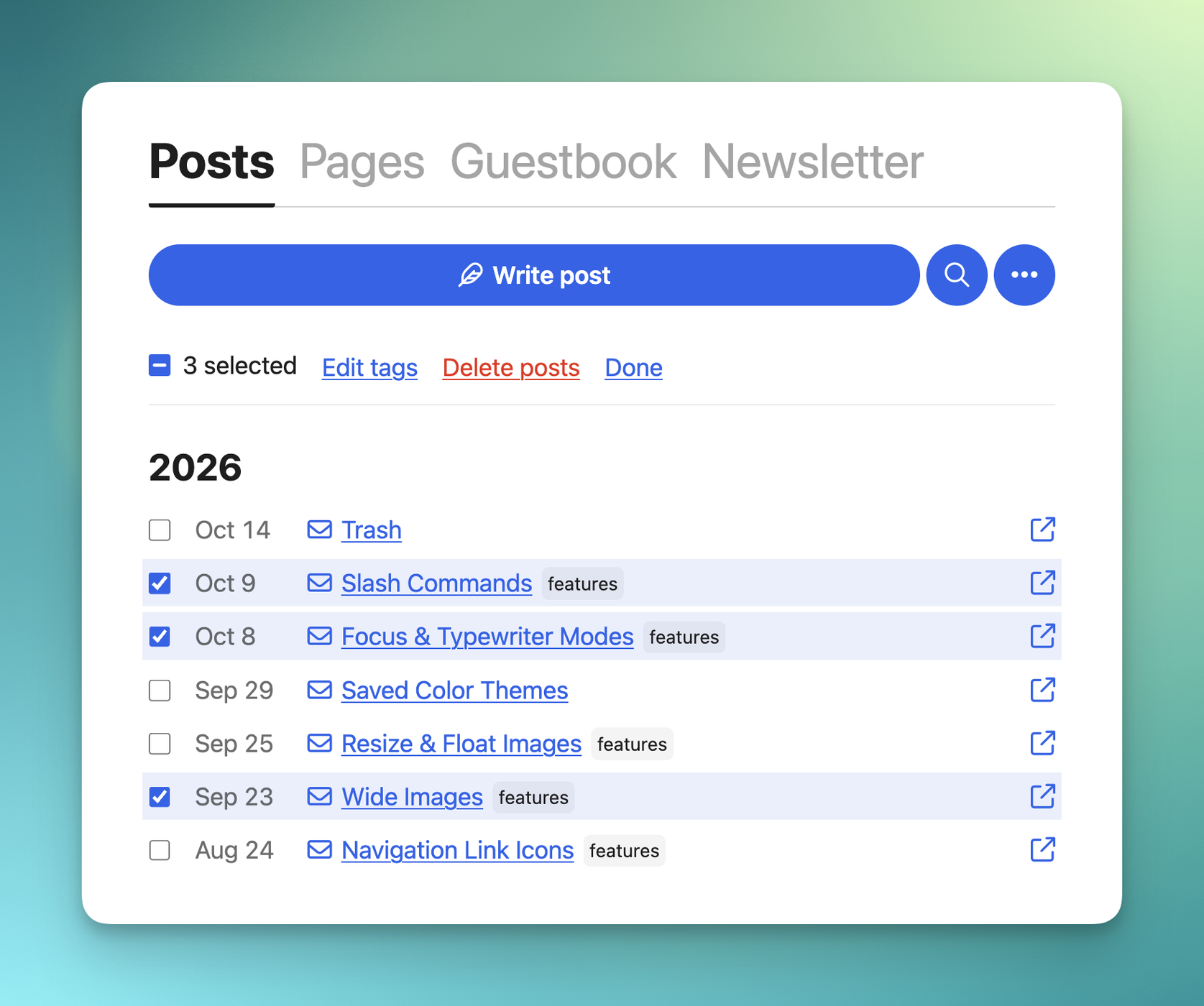
You can find the new “Bulk edit” option under the ••• dropdown in your Posts Dashboard. It’ll add a new bulk edit bar above the list, and checkboxes to every post. This also works after you’ve searched or filtered the list to a specific tag. We hope this makes managing your blogs just a tad bit easier.
2026-10-15 03:30:00
I always feel a bit itchy deleting things. On computers, trash cans seem to be everywhere. On my computer I can recover files from the trash. On my phone I can recover photos from trash. In this case, trash is good.
Now when deleting posts or pages on Pika, they aren’t gone instantly. Instead, they go to a trash bin. If you change your mind the next day, you can recover your trashed post. Sweet relief! Trashed items won’t be deleted permanently until 30 days after you trashed them, so you have time to reconsider.
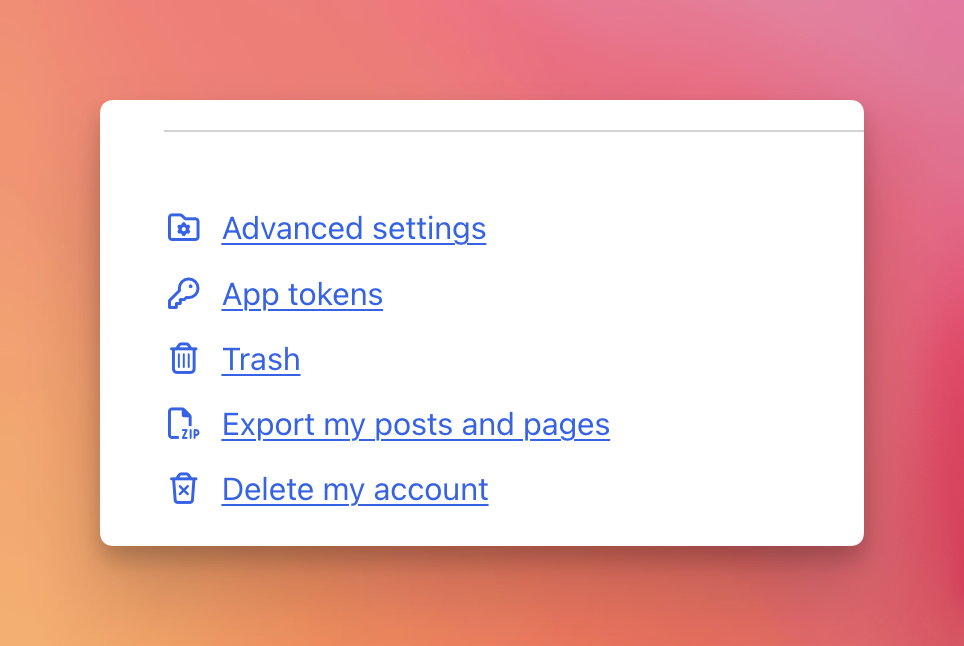
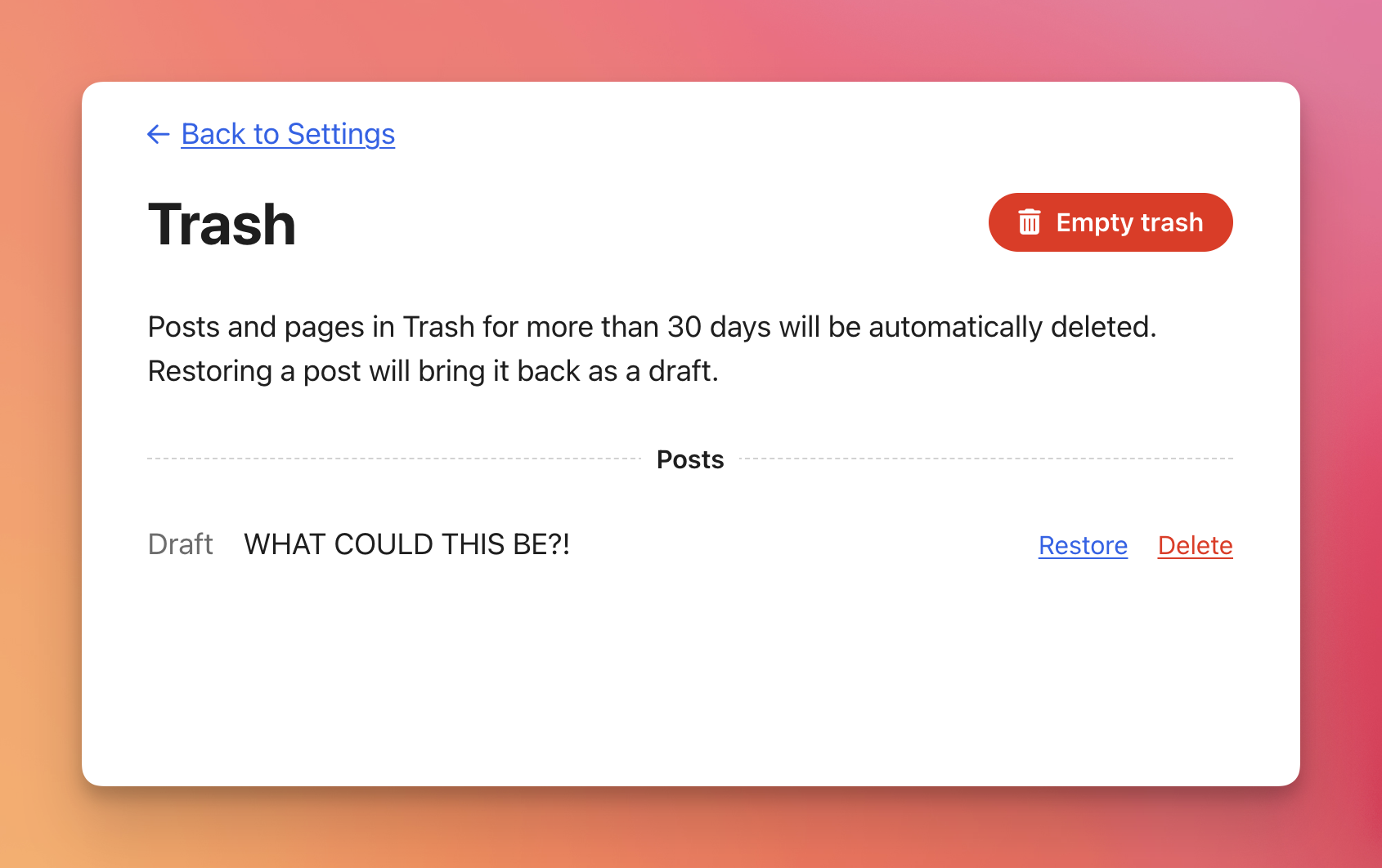
Ah, that sure eases my small anxieties around deleting items from Pika!
(Oh, and for you Micropub API users, post delete came along for the ride!)
2026-10-10 04:21:00
There’s already multiple ways to format your posts in Pika’s editor: clicking the toolbar, using a keyboard shortcut, writing in markdown. Today, we’re introducing yet another way: “/slash” commands.
Just type “/” (forward slash) and you’ll get a dropdown of Pika formatting options. You can navigate through the list with arrow keys and select, as well as continue typing to narrow down the list.
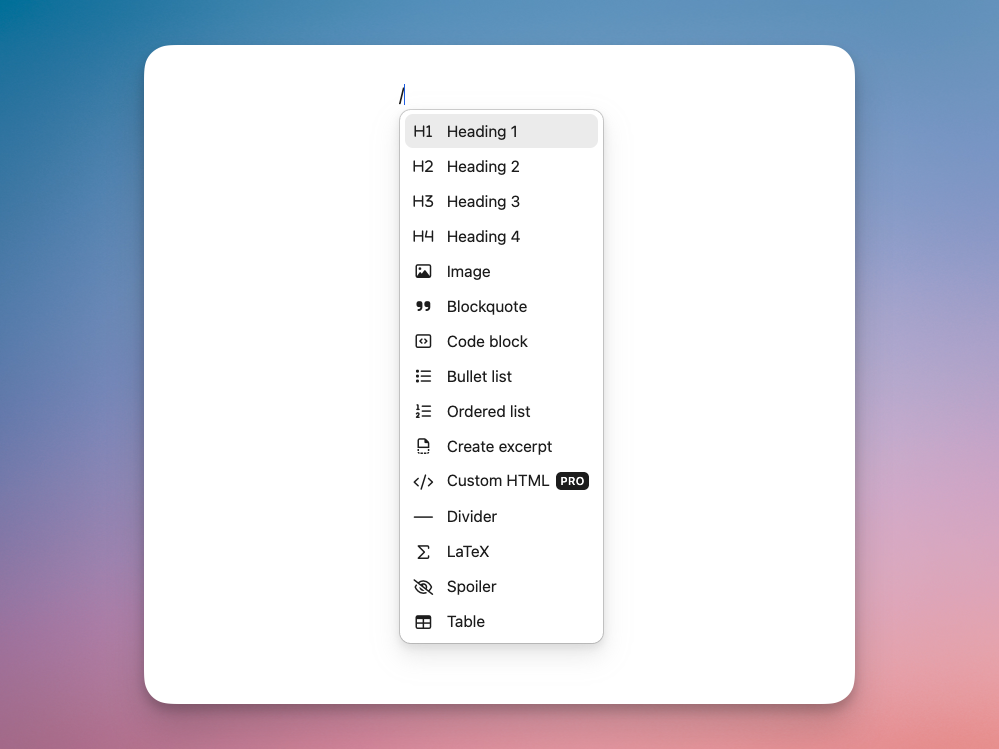
We hope every blogger can find the formatting option(s) they prefer here at Pika!
Update: An earlier version of this post suggested slash commands would only work at the beginning of a paragraph and only support block-level formats. That is no longer the case! Feel free to type /link in the middle of your sentences.
2026-10-09 04:37:00
When we set out to build Pika, our north star was to create the best place to write your thoughts on the web. That means a great writing editor first, both in terms of features and design. We aim to create a blogging platform that makes you want to write, and we’re continually working towards that goal.
For those of you who write long-form, today we’re introducing two new features to Pika’s editor that you’ll typically find in other great writing software:
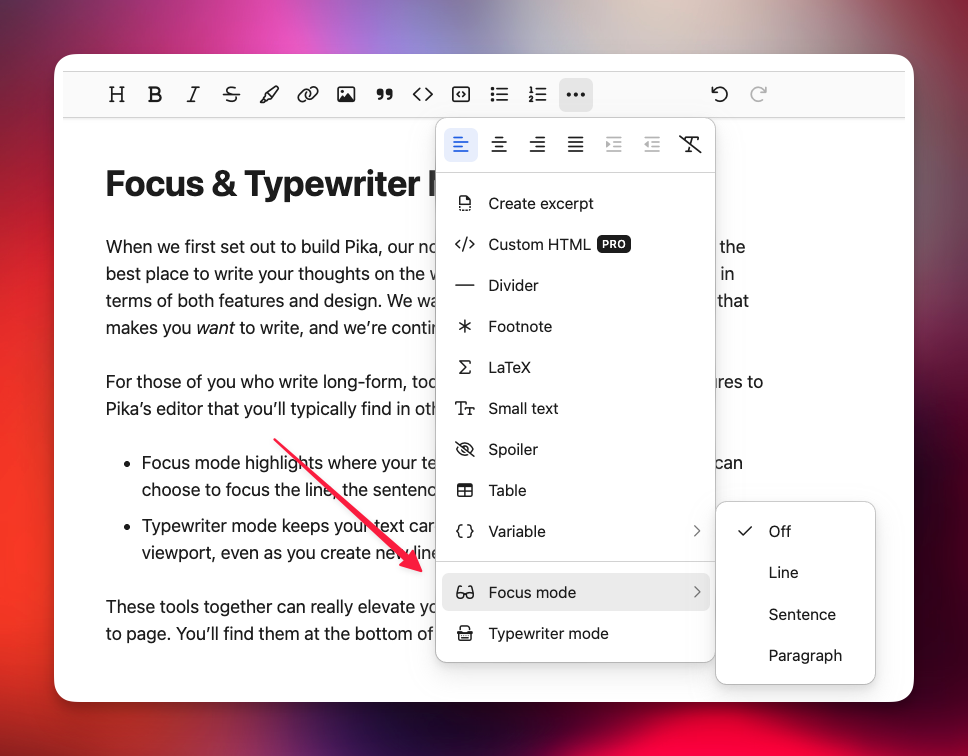
Focus mode highlights where your text caret is while you’re typing. You can choose to focus the line, the sentence, or the paragraph you’re in.
Typewriter mode keeps your text caret always in the very center of the viewport, even as you create new lines.
You’ll find these options at the bottom of the editor toolbar’s ••• “More” menu:
Together, these two tools can really elevate your writing habits and ability to get words to page. We hope you find them useful!