


2026-10-06 19:55:31
To investors,
I need a favor from you.
Today I am launching my second book, How To Live An Extraordinary Life Volume 2. It includes 50 life-changing ideas that had a significant impact on my personal, professional, and financial life.
It would mean the world to me if you could buy a copy: Click here
Every best-seller list looks at the velocity of sales on launch day, so every purchase today is crucial to building momentum for the book.
I promise that you will get smarter if you read this one. I wouldn’t spend more than a year writing a book unless I thought it would have a positive impact on people’s life.

Robert Kiyosaki, author of the famous ‘Rich Dad Poor Dad’ book, said “it’s filled with wisdom all of us need.” Anthony Scaramucci called it “fifty ideas that can change your life, written by one of the sharpest minds in finance.”
In case it helps you gain more confidence to buy the book, here is a list of the various chapters:
Introduction
Farmhand sleeps through a storm
Chauffeur knowledge
Two types of morning men
The devil doesn’t tempt you with spinach
Even a pawn can take down a king
It is better to be busy than bored
Shrink the distance between deciding and doing
More people die on the way down from Mount Everest
Be the 60% spouse
The Production Principle
A great man is hard on himself; a small man is hard on others
You can’t fake good kids
What you do in private always shows in public
It rain in the family until it rain into me
Anger kills wisdom
The world will treat you how you treat yourself
The mission, the men, and me
It is you vs you... and one of you has to die
Be a good tipper
F*ck you focus
Results are the best résumé
Don’t get outworked by a crackhead
It’s not the pain that breaks men, it’s the belief that it will never end
Build your first fortune in your mind
You are not making money until you make money when you’re not working
Planes that land safely never make the news
It is loud when a tree falls, but silent when a tree grows
Time is invisible
Amateurs built Noah’s Ark, professionals built the Titanic
Don’t eat with people you wouldn’t starve with
Be 100% hardcore you
Be proud to be an American
Success requires you to endure uncertainty
Tolerance is the virtue of people who do not believe in anything
The reward for good work is more work
Everything you think about, you will bring about
Hang out with people who have a common future rather than a common past
The Ego Tax
I would rather be tired from the work than broke from laziness
Play life by Monopoly rules
‘No’ is the most powerful productivity tool
There are graveyards full of people who thought they had more time
Procrastination is an arrogant assumption
Success is being excited to go to work and being excited to come home
Committees are where good ideas go to die
The difference between ordinary and extraordinary
You find the truth when dissent is outlawed
Never underestimate the man who overestimates himself
Your father wants you to be better than him
If you buy this book, you won’t be able to stop thinking about the various ideas you read. I don’t make that promise lightly. Pick up a copy today and let’s send How To Live An Extraordinary Life Volume 2 to the top of the charts together :)
I appreciate all of you. Talk to you next time.
-Anthony Pompliano
2026-10-05 21:03:04

My new book, How to Live an Extraordinary Life, Volume 2, comes out next week, so we’re throwing a party at City Winery in NYC on Thursday, October 8 to celebrate. I’ll share some of my favorite stories and lessons from the book, followed by a live Q&A and book signing.
Pomp Letter readers get 20% off tickets with code ANTHONY20.
And don’t forget to pre-order your copy HERE before the event. See you guys there.
To investors,
One of the leading AI companies, Mercer, just published a study that should send shockwaves through the investor community. They had 12 licensed accounts compete against frontier AI models on real-world accounting tasks.
The accountants in the study had an average experience of 5.4 years. Ten of the twelve people were senior or managers, and half had Big Four experience. This expertise did not help the humans in the head-to-head competition.
The accountants scored approximately 37% and they took anywhere between 30 to 180 minutes to complete the tasks. In comparison, Claude’s Opus 5 scored 100% on all 20 solo attempts and the model was done in under 10 minute each time.
I don’t think anyone is surprised that frontier models are smarter and faster than humans. That seems to be a consensus view now. The most interesting part is that the humans were still slower and less accurate when they were allowed to do the tasks with the help of the models.
For example, the sessions where accountants could use Claude to help them were about 15 times slower than Claude alone. So what does this mean for accountants? Are they all going to disappear?
Absolutely not.
Mercor wrote “this doesn’t mean accountants are replaceable. But it does suggest the job will change significantly, even if model progress stalled today.” I agree with this analysis. Just because frontier models can do specific tasks faster and better than humans doesn’t mean an entire role is replaced.
Mercor, Ramp, and a number of other companies who evaluated the results of this test were all in agreement that AI still can’t close a company’s books by itself. Now could that change in the future? Sure. The technology is constantly evolving and improving, but even if that happens, we should expect accountants to focus their time and effort on higher value tasks.
Remember, large companies used to have floors full of people doing the books. Now Microsoft Excel has replaced majority of those man-hours, but there are plenty of people employed in finance teams still.
AI is not going to be very different.
This doesn’t mean that AI won’t have some impact on the job market as companies figure out the limits of the technology or individual contributors realize they have to retrain themselves. Warren Pies recently pointed out changes in the job data when he wrote “it is becoming obvious that AI is impacting the labor market. Going back to mid-2025: Finance and Tech industries [are] -246k jobs and all other industries [are] +812k jobs. This dynamic will most likely intensify next year and expand into other industries.”
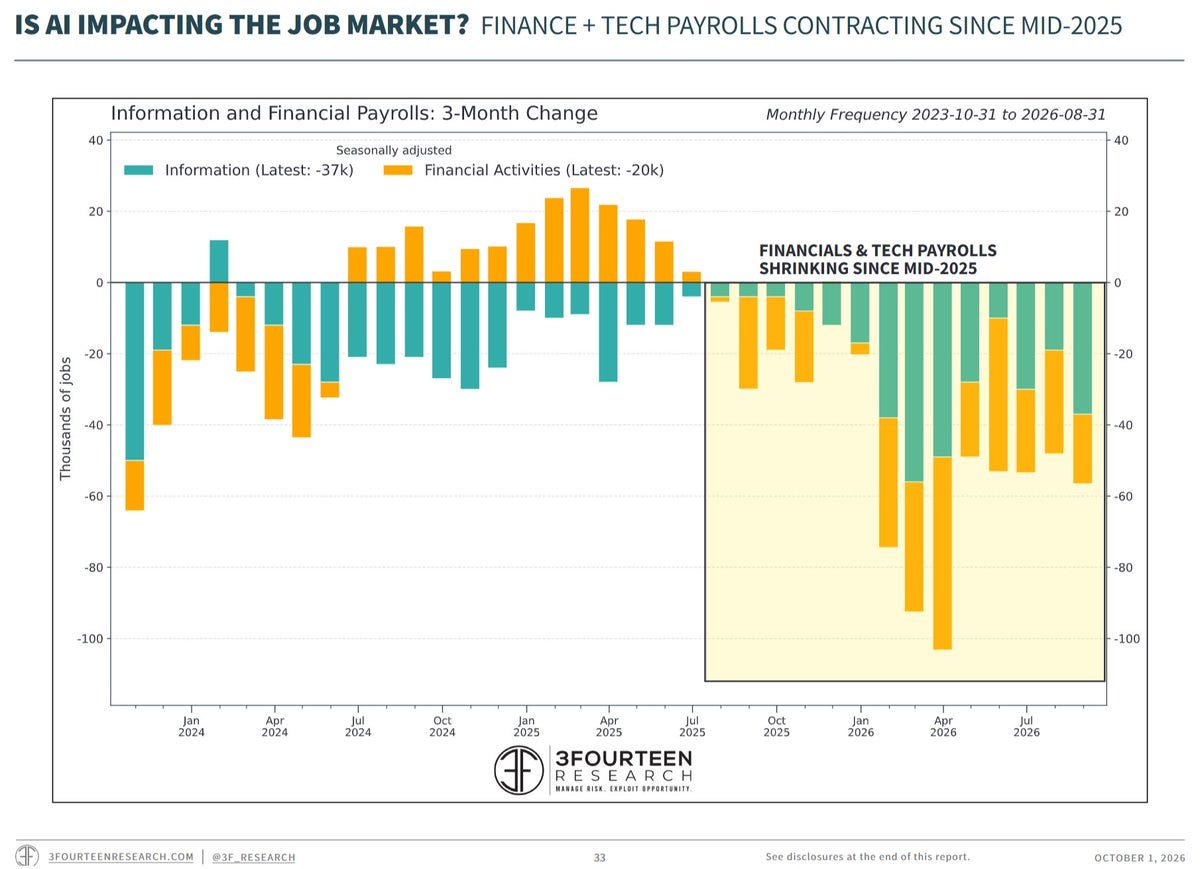
People get nervous whenever change is afoot. You are going to see scary headlines and lots of fear-mongering, but all that is just noise in my opinion. Steve Rattner had a great New York Times op-ed recently where he discussed how technology has drastically improved the lives of American workers over time. He said “Since 1830, technology has cut the American workweek from 69 hours to 38 while raising real income per person roughly 20-fold. Properly managed, A.I. can do the same.”
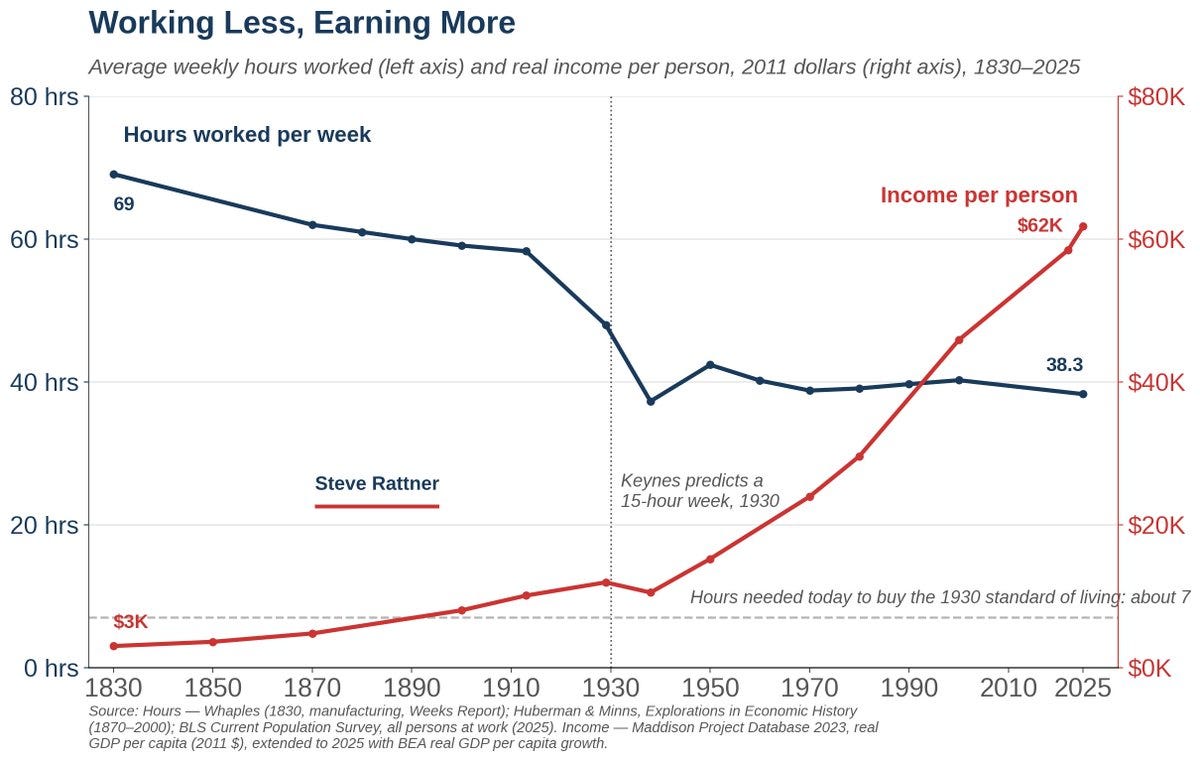
It is hard to argue with this data over the last 100 years. Seeing Mercor’s test results show frontier models can outperform accountants at specific tasks should get us all more excited about the future. No human should be required to spend their precious time on Earth doing menial tasks that can be automated by software.
I will leave you with this thought-provoking post from Will Manidis on how investors should think about navigating the uncertainty ahead. He explained his “only observation on the intelligence trade as it stands today is if you even believe 1/10th of this is real, than every single equity is drastically mispriced in one way or another. But the market can only really process it one trade at a time: memories, then semis, then ____.”
We are all on the rollercoaster and the acceleration is just beginning. The next few years should be fun, so just make sure you hold on long enough to enjoy the ride.
I hope everyone has a great start to their week. I will talk to you next time.
- Anthony J. Pompliano
Founder & CEO, ProCap Financial (Nasdaq: SVIA)

Exodus is a self custodial crypto wallet, and one of the few crypto companies publicly listed on the NYSE. It supports Bitcoin, Ethereum, and dozens of other assets.
Through its partnership with MoonPay, users can buy crypto in the app with card, Apple Pay, PayPal, or bank transfer. MoonPay also issued XO Cash, a fully reserved, USD-backed stablecoin that runs through Exodus Pay, letting users and even AI agents send, spend, and hold digital dollars without giving up self-custody.
Exodus + MoonPay. Digital dollars, on your terms.
Jordi Visser is a veteran macro investor with 30+ years of experience and the author of the VisserLabs Substack.
In this conversation, we break down why the macro doomers are wrong about rates, whether OpenAI and Anthropic are slowing down, and why the explosion of personal AI agents needs crypto rails. We also discuss Wall Street's growing crypto FOMO, the bitcoin setup heading into Q4, and what Jordi calls the "micron moment."
Figure – True DeFi Democratized Prime yielding ~8.5% APY. They also have the lowest industry interest rates at 8.91% with 12 month terms! Take out a Crypto Backed Loan today. Figure Lending LLC dba Figure (NMLS 1717824)
Arch Public’s platform automates your trading strategy beyond DCA for equities, commodities, ETFs, and crypto. With advanced inputs that reflect your own intentions, Arch Public supports smarter entries, exits, and opportunities in volatile markets. Connect with their team, try the product for free, and see how agentic trading can work for you, with Arch Public!
Investor Health — Clinician-prescribed protocols for weight, metabolism, and longevity, shipped to your door in 48–72 hours. No office visits. InvestorHealth.com. 1
GalaxyOne – Earn up to 8.00% yield2 on cash. Auto-Reinvest into stock and crypto.
Lava - The Lava Card allows you to earn up to 5% back in bitcoin every time you spend. There are no annual fees, no FX fees, and no gimmicks. You can also use Lava to borrow against your bitcoin at 6.5%, the industry’s lowest interest rate. Get started in just a few minutes at lava.xyz/pomp!
Simple Mining offers a premium white-glove Bitcoin mining service. Want to grow your Bitcoin stack? Visit https://www.simplemining.io/pomp
Uphold - Uphold is the all-in-one platform to trade, earn, stake, and swap across 300+ assets with real-time proof-of-reserves and any-to-any conversions. Manage your entire crypto portfolio in one place at www.uphold.com
BloFin - BloFin is a fast-growing cryptocurrency exchange focused on providing professional-grade trading tools, deep liquidity, and a secure trading environment for crypto traders worldwide.
🚨READER NOTE: If you want to sponsor The Pomp Letter, you can fill out this form and someone from our team will get in touch with you.
You are receiving The Pomp Letter because you either signed up or you attended one of the events that I spoke at. Feel free to unsubscribe if you aren’t finding this valuable. Nothing in this email is intended to serve as financial advice. Do your own research.
Investor Health is a telehealth platform, not a medical provider. Medical services are provided by affiliated licensed clinicians. Compounded medications are not FDA-approved. Individual results may vary and treatment requires evaluation by a licensed provider. Terms and conditions apply — see InvestorHealth.com
GalaxyOne is a financial technology platform, not a bank. Galaxy Premium Yield is an investment note issued by Galaxy Digital LP and guaranteed by Galaxy Digital Holdings LP — it is an investment product, not a bank deposit, is unsecured, and is not FDIC or SIPC insured. Available to U.S. accredited investors only. Cash deposits held at Cross River Bank, Member FDIC, insured up to $250,000. Annual Percentage Yield is variable and subject to change.
2026-10-05 05:36:23
To investors,
I almost never send this letter on the weekend, so you know I would only do it if it was important. Frankly, I am reaching out because I need your help.
This Tuesday I am launching my second book, How To Live An Extraordinary Life Volume 2. Usually a book launch has tons of support from big publishers, expensive marketing campaigns, mainstream media interviews, and thousands of shelves in bookstores across the country.
I’m doing this launch independently because I believe the power of community trumps any other approach.
So here is my big ask: If I have ever provided you any value, please consider buying a book. If I helped you make money, consider grabbing a copy. If I gave you a new idea to think about, buy a book. And if you were ever entertained by the podcast, my tweets, or this letter, order a few copies and then tell your friends to do the same.
And if you are based in NYC, I have an extra surprise for you.
We are hosting a book launch event on Thursday night at City Winery in Manhattan. My wife, , will be interviewing me on stage. I am terrified of what insane questions she will ask me or what stories she will make me recount, but there is no going back now that I have committed to the event.
You can get a ticket to Thursday’s event by clicking here. It will be unlike any event we have done before.
I sent an early copy to a few friends and they seemed to like it.
Robert Kiyosaki, Author of NYT bestseller “Rich Dad Poor Dad” said: “It’s filled with wisdom all of us need…a must-read for every parent to give their child.”
Anthony Scaramucci, financier and former White House Communications Director, said: “fifty ideas that can change your life, written by one of the sharpest minds in finance and one of the best fathers I know.”
I spent a year writing about 50 life-changing ideas that had a significant impact on me. These lessons span across my personal, professional, and financial life, including:
The two types of men in the morning
Why it is better to be busy than bored
How to be the 60% spouse
What the Production Principle is
How I define success now
The importance of “F**k you focus”
Why more people die on the way down from Mount Everest
Why you must avoid Chauffeur Knowledge
What to learn when dissent is outlawed
The difference between ordinary and extraordinary
How the devil doesn’t tempt you with spinach
I am not measuring success of this book by the number of books we sell. I want the ideas to speak for themselves. The true test of a book’s quality is whether it can spread through word of mouth with no marketing gimmicks. I don’t care about book club stickers or bestseller lists. I just want each of you to say, “This brought me immense value.”
Thank you in advance for the support. It means a lot to me. I look forward to continuing to learn alongside you in the coming years. Talk to you tomorrow.
-Anthony Pompliano
2026-10-01 22:52:18

On Thursday, October 15, Arch Public is taking over The Motor Enclave in Tampa for Full Throttle, a full day built for investors who take their trading seriously.
Spend the morning behind the wheel of a supercar on the track. In the afternoon, Arch Public will unveil the biggest announcements in its history: a new AI-powered suite of tools built to supercharge your trading algorithms. The day closes with dinner alongside the Arch team and fellow clients.
To investors,
I recently had a realization that shook the foundation of my personal identity. Professionally, I have been an entrepreneur and investor for more than 20 years. From my first “businesses” as a teenager to now running a public company, I have looked to solve problems and compound capital for over two decades.
But I have always done this as a non-technical person.
I didn’t study computer science in college. I could barely put together a WordPress site until I was in my 20s. And there is not a single engineer I have ever worked with that would say I was “good” at coding.
It never bothered me. I was the business guy and they were the engineers.
This all changed in recently months. I have essentially retrained myself to be a software engineer. I didn’t take some high-speed coding class. I didn’t spend endless hours on YouTube.
I just started building things.
I created a custom CRM across a few of our businesses that allowed us to track specific variables that I cared about. Then I built an entire CEO Operating System, including a daily to-do list, calendar integration, OpenLoops for things people owe me, Slack integrations, Grok/Instinct/Silvia integrations, daily briefings, meeting prep documentation, and a number of helpful features.
Now I am building individual tools or products in my spare time for different people on our teams. This only became possible because English became the most popular coding language in the world thanks to products like Grok, Cursor, Claude Code, Codex, etc.
I was joking with our team that I should literally put “software engineer” in my bio now. Traditional software engineers would hate it, but I could show them a lot of software that I built as a solo engineer / product manager. Our leading AI engineer told me “if I was interviewing you for a software engineering role, I would ask you what you have built before, so you would be able to answer that question well…”
So why am I telling you I am a software engineer now? I don’t actually care about the title, nor do I think traditional job descriptions matter anymore. Everything is blending together very quickly. We expect everyone on our team to be “technical” in the sense that they can quickly build products or features with these new tools.
The reason this is important though is because the pace of innovation is only accelerating. Just this week, Meta announced Muse for Small Business, OpenAI revealed Dots, and Robinhood released a number of agentic features for trading.
That was all announced in a single 24 hour period in what feels like a dead sprint for the last two years.
The beauty of innovation cycles like this is that cutthroat competition ultimately benefits the consumer. Do you use Muse, Instinct, Grok Bot, Dots, or the plethora of other personal assistant products? It depends on your preferences, the software you were already using, and which company got to you first.
Or you are like me and choose to use multiple products for different use cases.
I am currently using Grok for business, Instinct for personal, and Silvia for my finances. This allows me to context switch between the different products for different use cases, while also segregating certain sensitive data to individual platforms.
If everyone can now become a software engineer, while also having a personal shopper, an intelligent assistant, and a synthetic negotiator to decrease the cost of everything in their life, then the world is going to look very different in the future.
It is hard to see how this doesn’t lead to an explosion in GDP. Additionally, these products will help people make more money, spend less, and invest better. Couple in the ridiculous undisciplined government spending and it is impossible for asset prices not to go way higher over the next decade.
AI is your offense. Bitcoin is your defense.
Make sure you are prepared for where we are going.
Have a great day and talk to everyone next time.
- Anthony J. Pompliano
Founder & CEO, ProCap Financial (Nasdaq: SVIA)
Tillman Holloway and Andrew Parish are the co-founders of Arch Public.
In this conversation, we break down how AI agents and bitcoin are converging, why bitcoin is the best collateral in the world, and what 24/7 markets will mean for investors. We also discuss bitcoin ETF flows, Wall Street's growing role in bitcoin, and why AI trading tools still need a human in control.
Figure – True DeFi Democratized Prime yielding ~8.5% APY. They also have the lowest industry interest rates at 8.91% with 12 month terms! Take out a Crypto Backed Loan today. Figure Lending LLC dba Figure (NMLS 1717824)
Arch Public’s platform automates your trading strategy beyond DCA for equities, commodities, ETFs, and crypto. With advanced inputs that reflect your own intentions, Arch Public supports smarter entries, exits, and opportunities in volatile markets. Connect with their team, try the product for free, and see how agentic trading can work for you, with Arch Public!
Investor Health — Clinician-prescribed protocols for weight, metabolism, and longevity, shipped to your door in 48–72 hours. No office visits. InvestorHealth.com.1
GalaxyOne – Earn up to 8.00% yield on cash. Auto-Reinvest into stock and crypto.
Lava - The Lava Card allows you to earn up to 5% back in bitcoin every time you spend. There are no annual fees, no FX fees, and no gimmicks. You can also use Lava to borrow against your bitcoin at 6.5%, the industry’s lowest interest rate. Get started in just a few minutes at lava.xyz/pomp!
Simple Mining offers a premium white-glove Bitcoin mining service. Want to grow your Bitcoin stack? Visit https://www.simplemining.io/pomp
Uphold - Uphold is the all-in-one platform to trade, earn, stake, and swap across 300+ assets with real-time proof-of-reserves and any-to-any conversions. Manage your entire crypto portfolio in one place at www.uphold.com
BloFin - BloFin is a fast-growing cryptocurrency exchange focused on providing professional-grade trading tools, deep liquidity, and a secure trading environment for crypto traders worldwide.
🚨READER NOTE: If you want to sponsor The Pomp Letter, you can fill out this form and someone from our team will get in touch with you.
You are receiving The Pomp Letter because you either signed up or you attended one of the events that I spoke at. Feel free to unsubscribe if you aren’t finding this valuable. Nothing in this email is intended to serve as financial advice. Do your own research.
Investor Health is a telehealth platform, not a medical provider. Medical services are provided by affiliated licensed clinicians. Compounded medications are not FDA-approved. Individual results may vary and treatment requires evaluation by a licensed provider. Terms and conditions apply — see InvestorHealth.com
2026-09-28 22:41:40

Arch Public just keeps hitting home runs - and the numbers tell the ‘moonshot’ story over and over again. Arch Public equities and ETF tools blow away both buy and hold and DCA returns. Some numbers to consider1:
+ NVDA 523.6%
+ TSLA 129.3%
+ MSTR $260,841 (Cash Yield)
+ MARA $130,147 (Cash Yield)
Both total return and turning high growth, high volatility stocks into cash yield machines are what our warehouse of agentic, algorithmic tools specialize in. And, during our webinar last week, Anthony announced that he has signed up for Arch’s tools and will be using them personally going forward. Take a look at what Arch can do for you, completely hands free with equities, ETF’s, Bitcoin, and crypto. You won’t be disappointed.
To investors,
Torsten Slok, Apollo’s Chief Economist, sent shockwaves through the finance world yesterday when he wrote two simple paragraphs about a potential bank run driven by AI agents. Here is what he said:
“Muse and similar agentic AI assistants could soon sweep household cash automatically into accounts paying 3.3% to 5.0%, instead of the 0.1% national average on checking accounts.
If every household used AI agents to optimize the return on their cash balances, banks could lose a large share of the cheap deposits they rely on to make loans, which would be a problem for the entire financial system.”
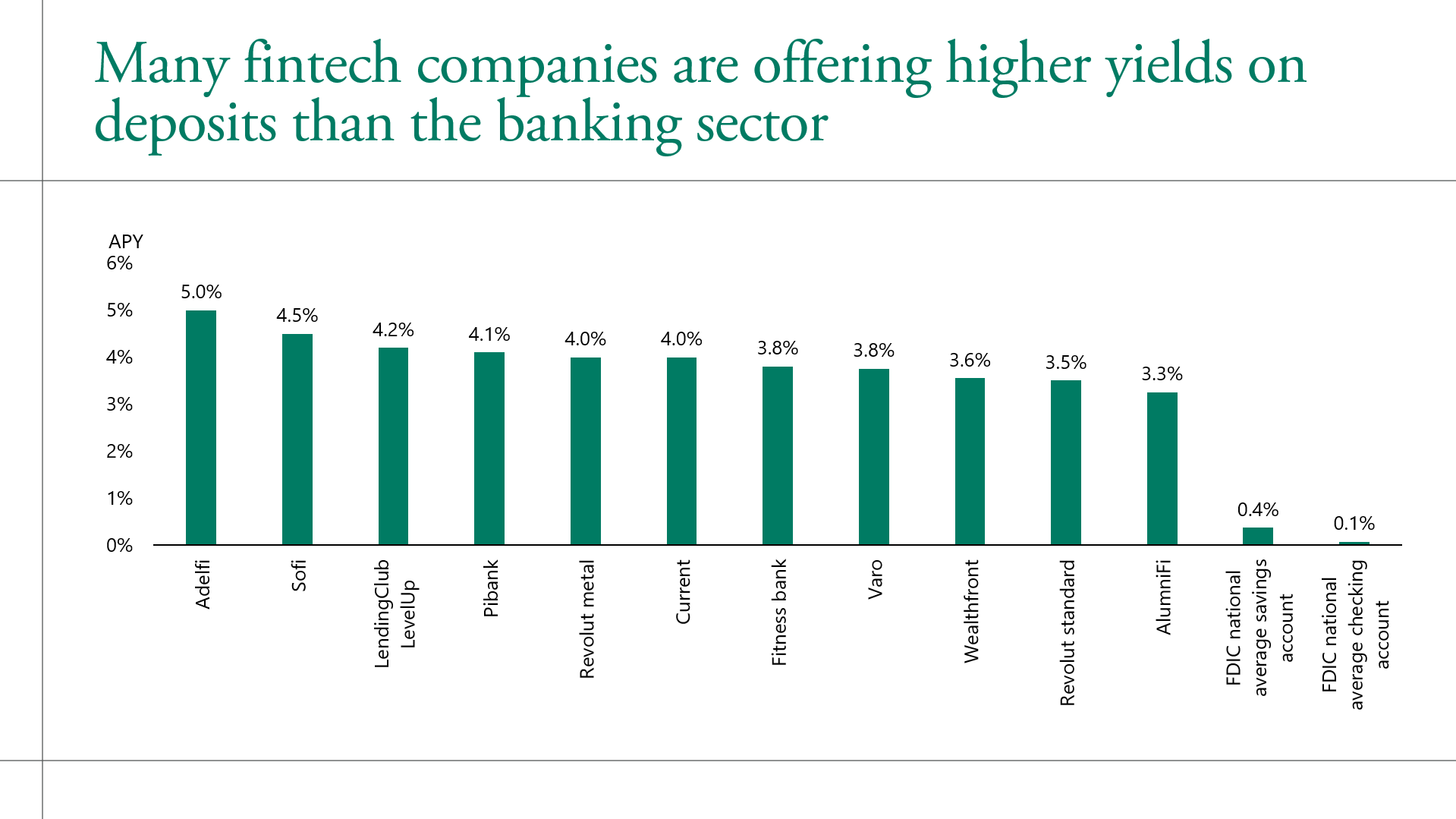
As you can imagine, the doomer crowd took these two paragraphs and had a field day. These people were so worried that you would have though we were back in the summer of 2008 and the entire financial system was about to collapse. Catastrophe everywhere!
But let’s stop the nonsense. AI agents are not going to take down the financial system. Let me explain why.
First, Torsten’s analysis assumes the world is static. He is arguing that every person will have an AI agent and those agents will collectively decide to move everyone’s money into higher yield products overnight. This vision is essentially Silicon Valley Bank on steroids. That is not how the world works though.
Consumers adopt new technology in waves. It has been 3 or 4 years since AI chat products hit the mainstream. I still know plenty of people who don’t use them on a daily basis. That doesn’t mean the products aren’t good or valuable, but it does mean that early adopters use products….early.
The other component of a static world is that banks with low yield offerings would have no response to this competitive threat. We know finance is one of the most competitive industries in the world, so it is much more likely that banks will either raise their interest rates or find another way to benefit from the rise of AI agents.
For example, where do you think a lot of the money flowing into these fintech products is going? Some of it ends up in traditional banks. Robinhood’s cash management feature is powered by JPMorgan Chase, Goldman Sachs, and Wells Fargo. Chime uses Bancorp Bank. Cash App from Block uses Wells Fargo and Sutton Bank.
The fear-mongering about a bank run will always sound interesting, but the odds are nearly 0%. Don’t take my word for it though. Cullen Roche had a great explanation that I agree with:
“In today's version of "Doomerism Debunked" we're looking at the idea of an agentic bank run and why it's overstated at best and wrong at worst.
The argument goes like this. AI agents will sweep household cash out of 0.1% checking accounts and into 4% high yield savings accounts, banks will lose the cheap deposits they use to make loans, and the whole system gets into trouble.
But think about where that money actually goes. When cash moves from a checking account at Bank A to a savings account at Bank B, Bank A's deposits fall and Bank B's deposits rise by the same amount. Total deposits in the banking system don't change. And most of the fintechs in the chart are either banks themselves or sweep your cash into partner banks. The money never leaves the system. It just changes addresses.
It's also worth remembering that banks don't lend out deposits. Loans create deposits. Banks need deposits to settle payments and hold reserves, and if they lose cheap ones they can replace them with more expensive ones. That's a real cost, but it's a cost, not a collapse.
Deposits really leave the banking system mainly through a few channels, such as physical cash withdrawals, payments to the Treasury (which comes back when spent), or money that ends up at the Fed's reverse repo facility. A bot moving your savings to a better rate isn't one of them.
Now, the stronger version of this argument deserves a fair hearing. SVB was a run from one bank to other banks, and it still killed the bank. If AI agents can move uninsured deposits in hours instead of days, individual bank runs could happen faster than they used to. And sticky, low rate deposits have always been part of how banks manage interest rate risk. If that stickiness goes away, weaker banks have to manage their balance sheets more carefully.
That's a legitimate risk for specific banks with bad balance sheets. It is not a system-wide run. The more likely outcome is that banks have to pay savers closer to market rates and their net interest margins get squeezed. That's bad for bank shareholders. It's pretty good for everyone holding cash.
So yes, agentic banking will probably change the economics of deposits. But calling it a bank run confuses a repricing of bank funding with a panic driven collapse of the system. Those are very different animals.”
Said a different way, Haseeb Qureshi writes “business models built on friction and human laziness will (rightly!) get slaughtered in the coming years.” I could not agree with that more.
Ok, so what do I believe will happen as AI agents become more pervasive in the economy? There are 7 major takeaways that I think are worth sharing:
Expect banks to offer higher yields - banks won’t let depositors walk out the door, so they will respond to competition. Historically, the higher yields products haven’t taken away enough deposits to warrant a change. If that changes, the banks will change.
Expect more M&A - some banks will build products internally. Many banks will just acquire the fintechs that have already innovated on the product and captured significant users and deposits. Why risk building internally if you can simply spend money to ensure success? Banks aren’t dumb or in the game of taking high risk.
Expect more bank accounts, not less - just as people need bank accounts, agents will need bank accounts too. The crypto industry is right that agents will use crypto, but they will also use the traditional banking system. Not because traditional banking is superior, but because majority of the world is still on the old rails.
Expect more yield innovation like digital credit - people (and agents) want higher yield, so Wall Street will figure out ways to satisfy the demand. Digital credit like SATA and STRC are just the beginning of this trend.
Expect stablecoins to get more popular - AI agents need digital money to transact, so stablecoins (aka digital dollars) likely become one of the main ways capital move around the world. This opens up a world of possibilities for new entrants to use the digital rails to do things faster and cheaper than incumbents.
Expect consumers to get stronger - if individuals and households are earning higher yield, then they should have more money to deploy as investors and consumers. This would lead to continued GDP growth and a persistent tailwind for the US economy.
Expect fear mongering to continue - the AI doomers are generational haters. They will find anything, and everything, they possibly can to throw rocks at an innovation train. But nothing is going to stop the train, so good luck to those people.
The AI industry will continue winning until doomer morale improves. The agents aren’t going to trigger a bank run. They are just going to help capital go where it is treated best and the legacy players will quickly adapt their products. Evolve or die. That is how capitalism has worked for centuries. There will be no change now.
Hope you have a great start to your week. I will talk to everyone next time.
- Anthony J. Pompliano
Founder & CEO, ProCap Financial (Nasdaq: SVIA)
If you can believe it, the Silvia Investor Summit is less than a month away.
On October 7th-8th in NYC, We’re bringing 1,000+ independent investors together in one room to hear directly from some of the top public market CEOs and macroeconomic experts.
The speaker lineup includes Ryan Cohen (GameStop), Kaz Nejatian (Opendoor), Eric Jackson (EMJ Capital), Jordi Visser (22V Research), Morgan Brennan (CNBC), Eric Brock (Ondas), with more still to be announced.
I’m giving away another 25 complimentary GA tickets exclusively to Pomp Letter readers. Apply here to be one of the 25 winners.
Otherwise you can register for your ticket here.
Spots are filling up. Looking forward to seeing you all in October.
Jordi Visser is a veteran macro investor with 30+ years of experience and the author of the VisserLabs Substack.
In this conversation, we break down why bitcoin keeps holding up through bad news, whether Wall Street FOMO is coming for crypto, and how consumer AI agents are reshaping markets. We also discuss BlackRock's AI and crypto paper, Visa and Mastercard, compute, tokenization, and the bitcoin outlook for the next six months.
Figure – True DeFi Democratized Prime yielding ~8.5% APY. They also have the lowest industry interest rates at 8.91% with 12 month terms! Take out a Crypto Backed Loan today. Figure Lending LLC dba Figure (NMLS 1717824)
Arch Public’s platform automates your trading strategy beyond DCA for equities, commodities, ETFs, and crypto. With advanced inputs that reflect your own intentions, Arch Public supports smarter entries, exits, and opportunities in volatile markets. Connect with their team, try the product for free, and see how agentic trading can work for you, with Arch Public!
GalaxyOne – Earn up to 8.00% yield on cash. Auto-Reinvest into stock and crypto.
Lava - The Lava Card allows you to earn up to 5% back in bitcoin every time you spend. There are no annual fees, no FX fees, and no gimmicks. You can also use Lava to borrow against your bitcoin at 6.5%, the industry’s lowest interest rate. Get started in just a few minutes at lava.xyz/pomp!
Simple Mining offers a premium white-glove Bitcoin mining service. Want to grow your Bitcoin stack? Visit https://www.simplemining.io/pomp
Uphold - Uphold is the all-in-one platform to trade, earn, stake, and swap across 300+ assets with real-time proof-of-reserves and any-to-any conversions. Manage your entire crypto portfolio in one place at www.uphold.com
BloFin - BloFin is a fast-growing cryptocurrency exchange focused on providing professional-grade trading tools, deep liquidity, and a secure trading environment for crypto traders worldwide.
🚨READER NOTE: If you want to sponsor The Pomp Letter, you can fill out this form and someone from our team will get in touch with you.
You are receiving The Pomp Letter because you either signed up or you attended one of the events that I spoke at. Feel free to unsubscribe if you aren’t finding this valuable. Nothing in this email is intended to serve as financial advice. Do your own research.
Backtested results across three windows ending June 2026; figures are percentage-point differences in return, not multiples
2026-09-22 21:30:45

TOKEN2049 Singapore is back - October 7–8, Marina Bay Sands.
The world’s largest crypto event returns, where the whole industry shows up: 25,000+ attendees, 300+ speakers, and 1,000+ side events taking over the city right into F1 weekend.
This year’s stage runs from Shayne Coplan (Polymarket), Jeff Yan (Hyperliquid), Adena Friedman (Nasdaq), Eric Trump, Arthur Hayes, Balaji and Jesse Pollak (Base)—the people actually shaping where this goes. Readers get 10% off with code POMP10.
To investors,
Bitcoin just survived a gauntlet of bad news. The FederalReserve increased interest rates. The Clarity Act failed again. Oil is around $100 and the 10-year yield continues flirting with 5%.
Each of these issues should be a headwind for bitcoin. When combined, the digital asset should be suffering under the weight of the collective issues. But that is not happening.
Instead, bitcoin continues to gather strength over the last month. It is up 10% in the last month and 23% in the last 6 months. This is happening in the month of September, which is historically a tough month during bear markets.
The good news is that October and November tend to be very strong. Carson Group’s Ryan Detrick writes “The best month of the year in a midterm year is October. The second best month of the year in a midterm year is November. Almost there.”
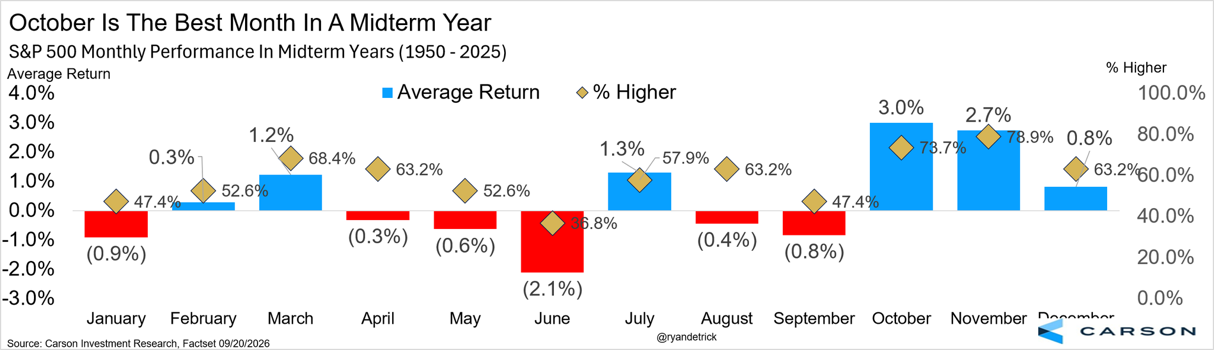
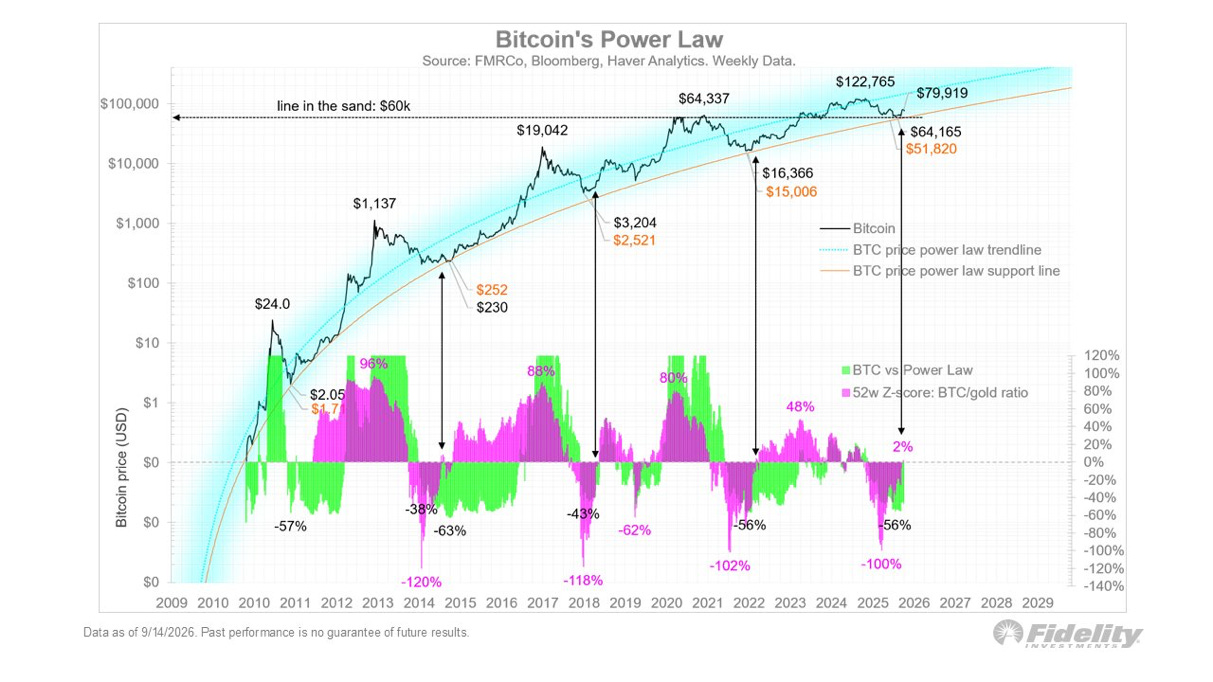
This stock market strength usually is correlated to other assets doing well. Bitcoin may not need the stock market as a tailwind though. Jurrien Timmer, Fidelity’s Director of Global Macro, explains why thinks bitcoin has bottomed:
“Bitcoin has been on the move after holding the $60k support zone for almost a year. That’s how long a typical Bitcoin winter lasts, so I’m sensing that a new 4-year cycle bull market is underway. Note that the Z-score of BTC/gold has turned positive after being -100%. In the past that has generally been confirmation of a bottom.
What does all of the above suggest? We are in a new secular regime of a higher cost of capital, which suggests that governments will respond with that oldest trick in the book: financial repression.”
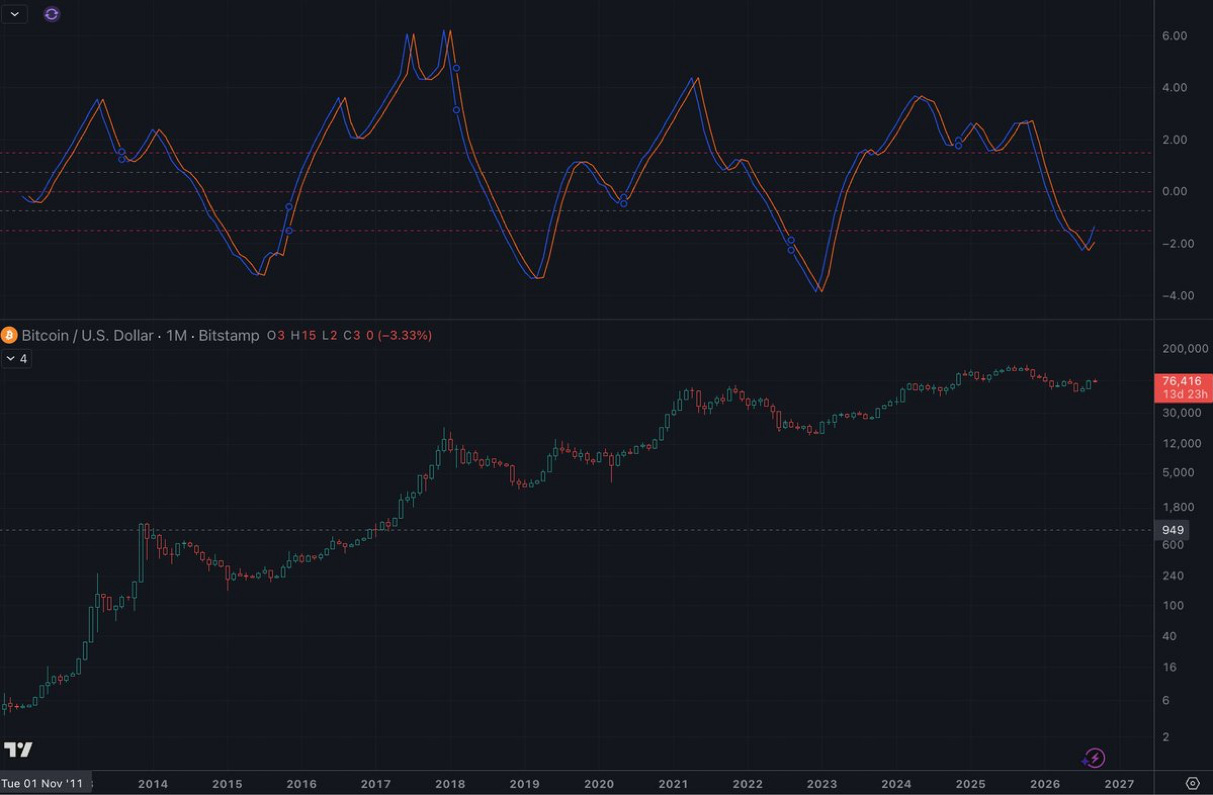
We can look at more traditional analytics for similar confirmation. Willy Woo points out the Fisher Transform analysis (measures when price trends reverse), which was created in 2002, has nailed the three previous bitcoin bear market bottoms. It just flashed the fourth reading in history (suggests bitcoin bear market is over), which is very hard to ignore.
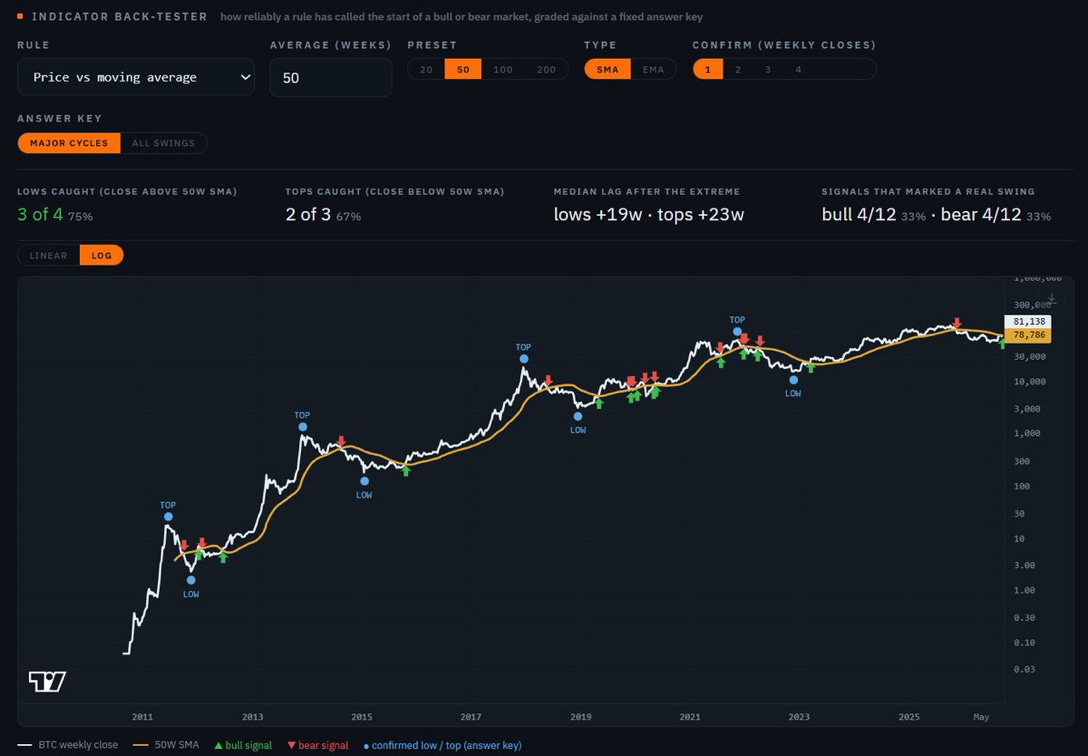
Lastly, Joe Consorti reminds everyone that “Bitcoin closing above the 50-week moving average has historically had a 75% chance of marking the cycle low. Apart from the COVID crash black swan, it has a 100% hit rate. The bear is slain. Welcome (tentatively) to the bull market.”
So you have an onslaught of bad news across the macro economy and the regulatory environment, yet bitcoin has gathered momentum upwards. We are headed into two of the best performing months of the year and various metrics are flashing the end of the bitcoin bear market.
No one has a crystal ball, including me, but I like where we are headed. It is likely much higher than where we are now. Hope you didn’t get shaken out of your positions during the boredom of the last year.
Have a great day. I will talk to everyone next time.
- Anthony J. Pompliano
Founder & CEO, ProCap Financial (Nasdaq: SVIA)
If you can believe it, the Silvia Investor Summit is less than a month away.
On October 7th-8th in NYC, We’re bringing 1,000+ independent investors together in one room to hear directly from some of the top public market CEOs and macroeconomic experts.
The speaker lineup includes Ryan Cohen (GameStop), Kaz Nejatian (Opendoor), Eric Jackson (EMJ Capital), Jordi Visser (22V Research), Morgan Brennan (CNBC), Eric Brock (Ondas), with more still to be announced.
I’m giving away another 25 complimentary GA tickets exclusively to Pomp Letter readers. Apply here to be one of the 25 winners.
Otherwise you can register for your ticket here.
Spots are filling up. Looking forward to seeing you all in October.
Jordi Visser is a veteran macro investor with 30+ years of experience and the author of the VisserLabs Substack.
In this conversation, we break down why bitcoin and stocks refused to crash even as the Fed hiked rates, why AI agents are now driving crypto’s next leg higher, and why the real “AI bubble” lives inside just two companies. We also get into Andrew Yang’s bombshell AI lab claims and why Jordi remains a bitcoin maxi for the next 30 years.
Figure – True DeFi Democratized Prime yielding ~8.5% APY. They also have the lowest industry interest rates at 8.91% with 12 month terms! Take out a Crypto Backed Loan today. Figure Lending LLC dba Figure (NMLS 1717824)
Arch Public’s platform automates your trading strategy beyond DCA for equities, commodities, ETFs, and crypto. With advanced inputs that reflect your own intentions, Arch Public supports smarter entries, exits, and opportunities in volatile markets. Connect with their team, try the product for free, and see how agentic trading can work for you, with Arch Public!
Lava - The Lava Card allows you to earn up to 5% back in bitcoin every time you spend. There are no annual fees, no FX fees, and no gimmicks. You can also use Lava to borrow against your bitcoin at 6.5%, the industry’s lowest interest rate. Get started in just a few minutes at lava.xyz/pomp!
GalaxyOne – Earn up to 8.00% yield on cash. Auto-Reinvest into stock and crypto.
Simple Mining offers a premium white-glove Bitcoin mining service. Want to grow your Bitcoin stack? Visit https://www.simplemining.io/pomp
Uphold - Uphold is the all-in-one platform to trade, earn, stake, and swap across 300+ assets with real-time proof-of-reserves and any-to-any conversions. Manage your entire crypto portfolio in one place at www.uphold.com
BloFin - BloFin is a fast-growing cryptocurrency exchange focused on providing professional-grade trading tools, deep liquidity, and a secure trading environment for crypto traders worldwide.
🚨READER NOTE: If you want to sponsor The Pomp Letter, you can fill out this form and someone from our team will get in touch with you.
You are receiving The Pomp Letter because you either signed up or you attended one of the events that I spoke at. Feel free to unsubscribe if you aren’t finding this valuable. Nothing in this email is intended to serve as financial advice. Do your own research.