


2026-08-02 01:42:48
In the monthly Hardcover Report email + blog post this past month, I talked about the concept of a personal reset. It’s a topic I’ve touched on a bunch in the past, but this past reset has felt unusually productive for me. I wanted to share a few things about what I’ve been doing that have been working (and also using this a bit of personal journaling so I’m more consciencously aware of what’s working  ).
).
A personal reset, as I’ve dubbed it, is a time when you decide to make a notable change in your routine when you realize your current path isn’t taking you where you want it to. Resets come in all sizes – from upending your life and living in the woods, to making a few small tweaks that let you see the world from a new point of view.
My personal reset in June (which is still ongoing) is more of a medium one. Let’s start with a brain dump of what’s changed since then and why.
In June, my wife and I took a 2-week road trip with our dog from Salt Lake City, UT to Milwaukee, WN to visit some friends and explore a few states we’d never been to. One of my personal goals before I turn 50 is to visit all 50 states – and this trip brought my up to 48 (Alaskan cruise ’27 and Hawaiian Vacation ~’28-’31 are next).
After weeks of staying in new beds each night, stopping at gas stations and rest areas for Bucky to sniff around, and constantly being on the go, coming home felt like the vacation. It was the perfect time to shake up my schedule.
Each week on Sunday, I try to spend some time reflecting in some way on what I want, what’s working for me in life, relationships, health, etc. Some weeks that means journaling, sometimes it’s setting a bunch of Todoist tasks for the week. Some weeks I skip it and end up feeling more stressed the following week. When I do this step, I feel more grounded.
In this case, I was unhappy with the direction I was going in a few areas. I’d put on ~20 pounds from where I was 2 years ago (175 lbs vs 155 lbs) when I was working with an online personal trainer. I’ve been having uncomfortable back pain. I’ve had some sore spots in my mouth I’ve been going in and out of dentist appointments for. I’d somehow been spending an increasing amount of time on social media. I’d also started having a wind down cocktail of beer more nights than not.
Things weren’t bad, but they weren’t heading in the direction I wanted to go in. So I used the post-roadtrip routine disruption to my advantage and decided to shake things up! I wrote up a very short list of changes I wanted to make.
Here’s what I ended up doing:
As of early August, I’m 7-weeks into this Personal Reset. I’ve missed workouts and food tracking, and spent some time on Reddit after my month break, but overall the changes are positively impacting my mindset.
The three most impactful changes were by far changing my social media habits, reducing alcohol and exercising more. One day I considered having a cocktail and winding down with some Reddit, and I instead did a Peloton workout.  I absolutely felt better after that hour than I would have otherwise.
One realization I’ve had this round of changes (and have encountered before), was to not just remove habits, but to replace them. Often if I’m feeling antsy to do something, I’ll grab Bucky’s leash and go for a walk with him. He likes it more, and I feel better after.
The end result of all of this is that I’m feeling healthier, more productive, and (slightly) less stressed out. After 3-weeks of Invisalign I’m starting to get the hang of taking them out. 45-minute Peloton workouts are becoming easier.
There are areas I’m still working on. I have another crown I still need to get done, I’ve fallen back into watching short form video once or twice, and some days I just absolutely don’t feel like doing any tasks around the house. I’ve been correcting course when I can and being OK with the idea of not being perfect in this routine.
2026-03-14 06:20:38

I always play a wizard.
Back in the 1990s I loved Diablo. I played it through as a Warrior, a Rogue and a Sorcerer. After trying out each path (and getting some not-so-legit items from others on BattleNet), I realized wizards were the way to go. I could clear an entire room in seconds – or die spectacularly fast.
Using a Staff of Apocalypse, I’d hit all enemies on the screen at once. Later on, I played through Ragnarok Online as a Wizard. Then Skyrim. If I wasn’t a wizard, I was a rogue – switching MP for arrows but keeping a distance from my enemies.
I’ve always been drawn to glass cannons. Wizards are optimized for dealing damage. They’re frail. They can be taken down easily. But when used right? They’re a powerhouse.
I’ve kind of applied the same mindset to my career.
I optimize for being as productive as possible — using whatever tools enable this. That philosophy led me through PHP, ColdFusion, jQuery, WordPress, Ruby, and for the last 20 years, Ruby on Rails. Each was the most powerful spell available at the time that I knew of.
More recently, the biggest upgrade to my damage output has been AI-assisted coding with Claude Code.
Most of the senior developers I’ve worked with spend time polishing their tools. They setup keyboards, custom shortcuts, and tweak their code editor in a way where they can maximize their focused time.
This ranges from the tools we choose (languages and frameworks), to the software we write in (code editors, docker), and more recently to how we leverage AI to write faster (LLM models, agents).
Each level of abstraction take a step back from tweaking bits and bytes. Improved languages and frameworks led to a major increase in what we could do in single coding session.
That’s a measurement I’ve never thought about, but it becomes more clear the more you can do in less time.
Writing jQuery was loads faster than writing all of that pure JS DOM code.
Creating a basic application in Rails, complete with it’s conventions, allowed for setting up an app with fewer decisions and get to creation that much faster.
And now with Claude Code, languages and frameworks are mostly abstractions. I am still in the “mostly look over the code it writes” phase of AI coding, but I suspect it’s only a matter of time before that domino falls and I’m shipping (more) code to production without human eyes.
Each of these jumps in productivity felt like a level up. Like I’d invested in a new skill path, unlocked a new ability and everything was smoother.
The last few months, since around the beginning of December 2025 when Anthropic released the Opus 4.5 model, have felt different. It’s no longer a question to me if I’ll be more productive with LLM-assisted coding. It’s how much more productive I’ll be.
My LLM experience isn’t too different from most developers. I started by asking ChatGPT some questions in 2023ish. By 2024 I’d tried out Cursor a bit. By July 2025 I was using Claude Code. Over a weekend I built out a prototype of the Community features on Hardcover that I’d been dreaming of. The code wasn’t the greatest, and neither were my systems at the time. It was a throwaway branch, but it showed me what was possible.
Fast forward to December 2025 and the tools, along with my ability to work with them, have improved. I’ve launched a bunch of things in only a few short months.
Often what would take a week of work can now be done in an evening.
Each of these projects would have taken longer without AI assistance. Some might not have happened at all — the activation energy would have been too high. The change to this blog (from static to dynamic) had been on my mind to do for MONTHS, and I wrapped it up in an afternoon while watching Netflix.
That ability to finally execute on those open loops in my head have been a welcomed relief. Sure, I would’ve been able to do any of the above. But they would have taken significantly more time, and involved much more frustration.
In the time it would previously take to research how to do something, LLMs can propose and implement a solution.
But here’s the thing about wizards: they’re fragile.
Optimizing for maximum damage output means accepting real vulnerabilities. The same is true for leaning hard into AI-assisted coding:
If you can’t write a for-loop without AI anymore, that’s a problem. High-level wizards sometimes forget their cantrips. The basics still matter when the magic fails.
AI is confident. It writes code that looks correct. But hallucinated APIs, deprecated methods, subtle logic bugs — the illusion of correctness is dangerous. You’re responsible for code you ship, even if you didn’t write every line.
Granting AI access to your systems is summoning power you don’t fully control. A misconfigured agent could delete a production database. Could leak customer data. Your creations can turn against you.
Wizards without mana are just squishy people with sticks. If Claude goes down, Anthropic rate-limits you, or your API budget runs dry mid-sprint — suddenly you’re coding at half speed. What’s your fallback?
The classic trope: power changes you. I’ve noticed I spend more time preparing to code and reviewing code than actually writing it. There’s a risk of losing the joy of crafting code yourself. Of becoming a code reviewer instead of a coder.
AoE spells hit your own party. AI “helping” by refactoring things you didn’t ask it to touch. Cascading changes. The blast radius of a powerful tool wielded imprecisely.
In Solo Leveling (the anime), Sung Jin-Woo doesn’t start as the strongest hunter. He’s E-rank. Weak. But he gets access to a system — a way to grind, to level up, to become something more.
Learning to use AI tools effectively is the same grind.
You don’t install Claude Code and immediately ship 10x faster. You:
– Learn what it’s good at (and what it hallucinates)
– Build intuition for prompt crafting
– Develop review habits that catch bugs
– Figure out when to use it vs. when to just write the code yourself
Every project is a dungeon. Every bug is XP. There’s no shortcut to S-rank.
One of my favorite fun fantasy books is Off to Be the Wizard. It’s about normal guy who figures out how to tweak reality; which somehow leads him back in time to the middle ages where he pretends to be a wizard.
Likewise, even having access to reality-warping “magic”, it takes practice and imagination to use it. We’re in the same place now with LLMs, where it’s unclear what the ceiling will be in what these systems can create.
 SPOILERS for Rhythm of War (Stormlight Archive Book 4)
If the wizard metaphor doesn’t resonate, here’s another frame for fantasy readers:
In Brandon Sanderson’s Stormlight Archive, there’s a tower called Urithiru — an ancient, magnificent structure that was dormant for millennia. What awakened it was the Sibling, a spren (a sentient spirit of Intelligence) that bonds with the tower and brings it to life.
The Sibling:
The parallel writes itself. The AI is the tower spirit. The infrastructure (Mac mini humming under my desk) is Urithiru. And I’m… Navani? Experimenting in the tower, trying to figure out what this thing can do, occasionally making breakthroughs that feel like magic.
The delightful absurdity: an ancient, powerful tower spirit… running on a small aluminum box in a home office.
LLMs and AI aren’t all roses. Most of these models are trained on stolen data (and are running on stolen land using stolen water). The data infused in these models is ill-begotten. They use too much electricity and water, displacing local communities. They take jobs from people by moving what a single person can do. They reproduce artists works, copying skills that took a lifetime of practice. Some companies are pandering to big tech and fascist governments.
And yet those same tools can compress 3 weeks of programming into a single day, already. Time will only make those tools more impactful.
Even as someone who aims to avoid big tech when I can, it’s hard to ignore the productivity gains available. I’m ethically split on the subject – allowing myself to use these tools while knowing it’ll be a while before these concerns are addressed (if ever).
Anyone can buy a spellbook.
But the wizard is the one who spent time learning to read it. Who knows which spell to cast when. Who understands why the incantation works — so when it fails, they can adapt.
It’s one of the most exciting times ever to be a developer. What we can do is limited by our imaginations and time.
AI is the most powerful spellbook ever written. But having access to it doesn’t make you a wizard.
You make you a wizard.
The tools are available. The dungeons are waiting. The only question is: are you ready to try?
2026-01-01 03:03:50

I’ve written a “year in review” post for the last fifteen years. I highly recommend you try it. It’s a time capsule that lets you reflect on the past year, appreciate parts of it that were great, and develop a plan for the next year. You can view any of the past 15 years’ posts here: 2010, 2011, 2012, 2013, 2014, 2015, 2016, 2017, 2018, 2019, 2020, 2021, 2022, 2023 and 2024.
There are some years with very few major life changes (2023, I’m looking at you). 2025 was not one of those years.
My themes for this year were: new house, new job (Libro.fm), new dog (Bucky), books, and Hardcover.
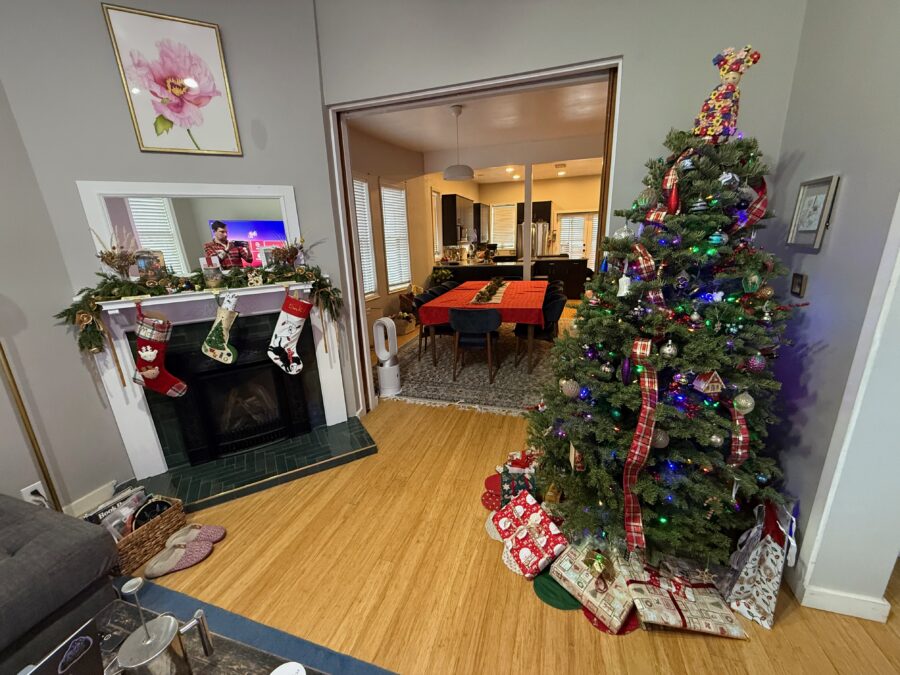
We closed on our house just after Christmas 2024. We spent two months fixing it up – repairing the foundation, adding gutters, new hot water heater, fixing sprinklers, replacing floors, replacing an AC system from the 1980s, and so much more. We moved in on February 24th, a day before our 19-year anniversary! It didn’t take long for this place to feel like home.  Since then we’ve undertaken even more projects – most recently fixing a bricked up fireplace with a gas one and beautiful tile work.
A few years earlier, back in 2022 or so, I started realizing that we wouldn’t be able to live this “retired” life forever – unless we wanted to lower our expenses to a level beyond the life we’d want. In February, a post came up on my BlueSky feed for a Ruby on Rails role at Libro.fm that made me curious. Initially I planned to not have a job this year, and spend it working on Hardcover. But the timing, combined with us spending a million dollars (only a slight exaggeration) on the new place, combined with rising prices, and an unknown political environment and stock market meant it felt like the right time to have a job. (related: Why We Traded Stocks for a House Seven Years Into FIRE, Why I Went Back to Work After 6 Years of Early Retirement)
In 2024 I started getting allergy shots with the hope that we could adopt a dog. In May 2025 things fell into place and we adopted Bucky! He’s 50 pound black golden doodle that absolutely loves us (and we love him!). He’s a quiet boy who loves car rides, needs constant attention and gets along well with our friends dogs – and even has a crush on one of them.
2025 marked 4 years of working on Hardcover. We grew from 23k users to 59k users – another 140%+ growth year! I was worried that when I got a job things would slow down, but somehow things have continued to speed up. I brought on 22 new part-time team members to fill in the gap and keep the project active – 15 of them have stuck around. I wrote a blog post that went wildly viral. We migrated from Next.js to Ruby on Rails, converted to Kubernetes to autoscale, and launched a bunch of things (including Hardcover Wrapped today).
There were areas this year that didn’t go great. Besides the obvious politics, Ukraine and Palestine, I’ve been dealing with anxiety, struggling with physical health, spending entirely too much time doom scrolling and not enough time learning & exploring. I feel most healthy when my mind and body are exercised.
All of this change at once, along with a very packed schedule, and well everything else (*waves hands dramatically*) brought up something I haven’t experienced in a long time – anxiety. The addition of a job, switching from an apartment to a house (with all the maintenance involved), adopting a dog, and trying to keep Hardcover growing has not been easy. I even had my first anxiety attack!  That was months ago and fortunately hasn’t been recurring. I’m very grateful to have a partner who I’ve talked through things with and be very supportive.
After spending 6-month of 2024 working with an online personal trainer, tracking every calorie I ate and losing 20 pounds, this year I gained it all back and more.  I’m still figuring out what my fitness regime looks like while fitting it into my schedule. Currently that means going to the gym MWF – but I’ve struggled to add in cardio in a way that sticks. This is a work in progress for now.
With everything happening in the news this year, there have been times I’ve fallen down the news rabbit hole, leading to entirely too much time doom scrolling. I alternated between wanting to just do something, and trying to figure out what I can actually do. Whenever I protest or join other local events I feel that energy magnified 10,000x. More recently I’ve cut out all THC – which has led to less doom scrolling and more journaling.
A few years ago, I started doing a monthly breakdown. I love being able to look back and see what I thought was most important each month.
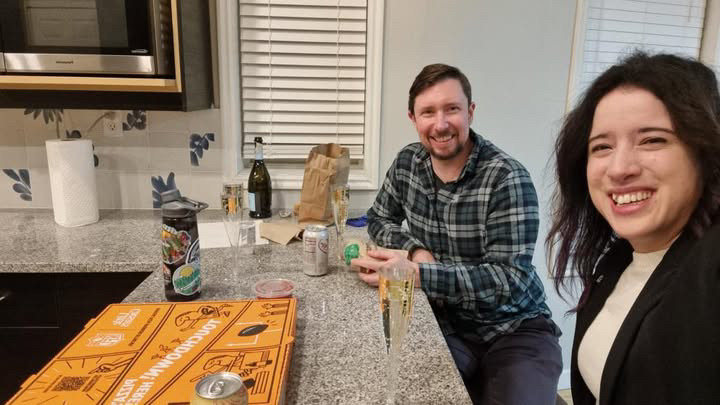
January: Sundance Film Festival, preparing the house for foundation work (removing deck, rerouting HVAC in basement), new gutters, tree trimming and various other house work. First concert for a friend (as the headliner!). Started moving some things over to the house.
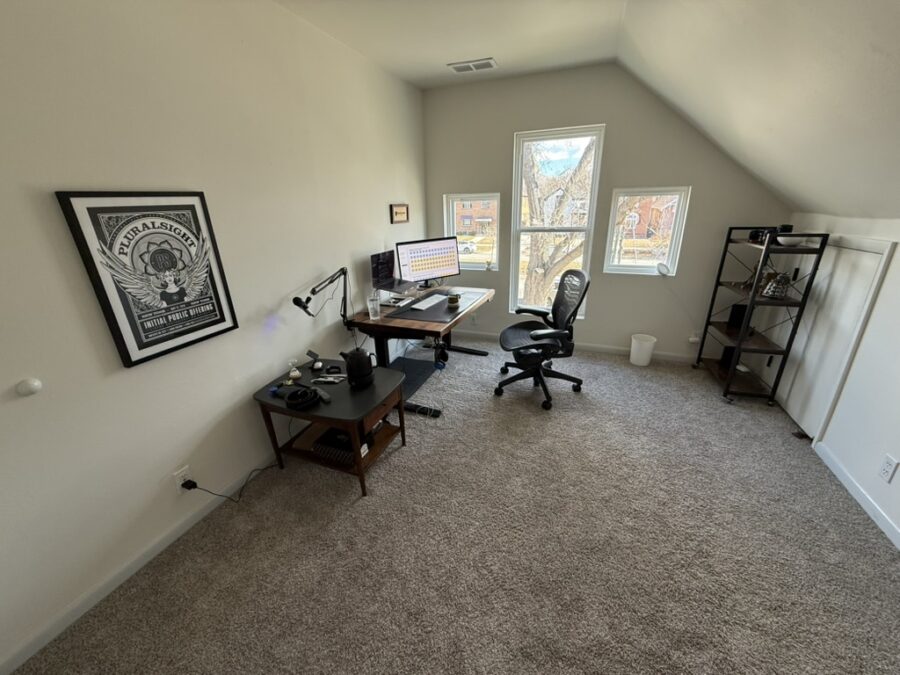
February: Moved from our apartment to the new house! Joined the Wasatch Coop. 19 year anniversary with Marilyn.

March: Oscar party (it can still be a party with just 2 people right?), Final Fantasy VII Rebirth, interviewing at Libro.fm, working on Hardcover in new house. Epic Web Conference and Web Developer Challenge: Bad video player (my submission!). Foundation repair (7 days!).

April: Cherry Blossoms picnic at the Utah Capital (hanami). Alton Brown live. Started at Libro.fm. On my 2nd day I flew to Denver for their yearly offsite! New floor installation in 2 rooms. Watching friends dogs. Meow Wolf Denver (2nd time!).

May: Eurovision 2025! My birthday! Rilo Kiley at Kilby Court! Spirited Away at a Sushi restaurant with many courses! Adopting Bucky! (all of those deserve exclamation points ). Bees game with friends.

June: Hired 22 new people to Hardcover (!). British Field Day at Liberty Park. Pride Parade. Salt Con Board Game convention. Goonies live with Sean Astin. Sip & Script (where I was the only guy).

July: Fourth of July Camping Trip with friends, Las Vegas trip to see Lady Gaga and O (Cirque show), Peking duck at Jasmine @ the Belagio, Pioneer Day Parade.

August: Marilyns Birthday party, My Morning Jacket concert, Nine Inch Nails concert, Bike Prom.

September: Japanese Breakfast concert, OK Go concert, FanX SLC, Running a Libro.fm booth at a bookseller convention.

October: Dressed up for Halloween (Dungeon Crawler Carl themed of course), Sarah Millican comedy show, Hardcover migration to Kubernetes.

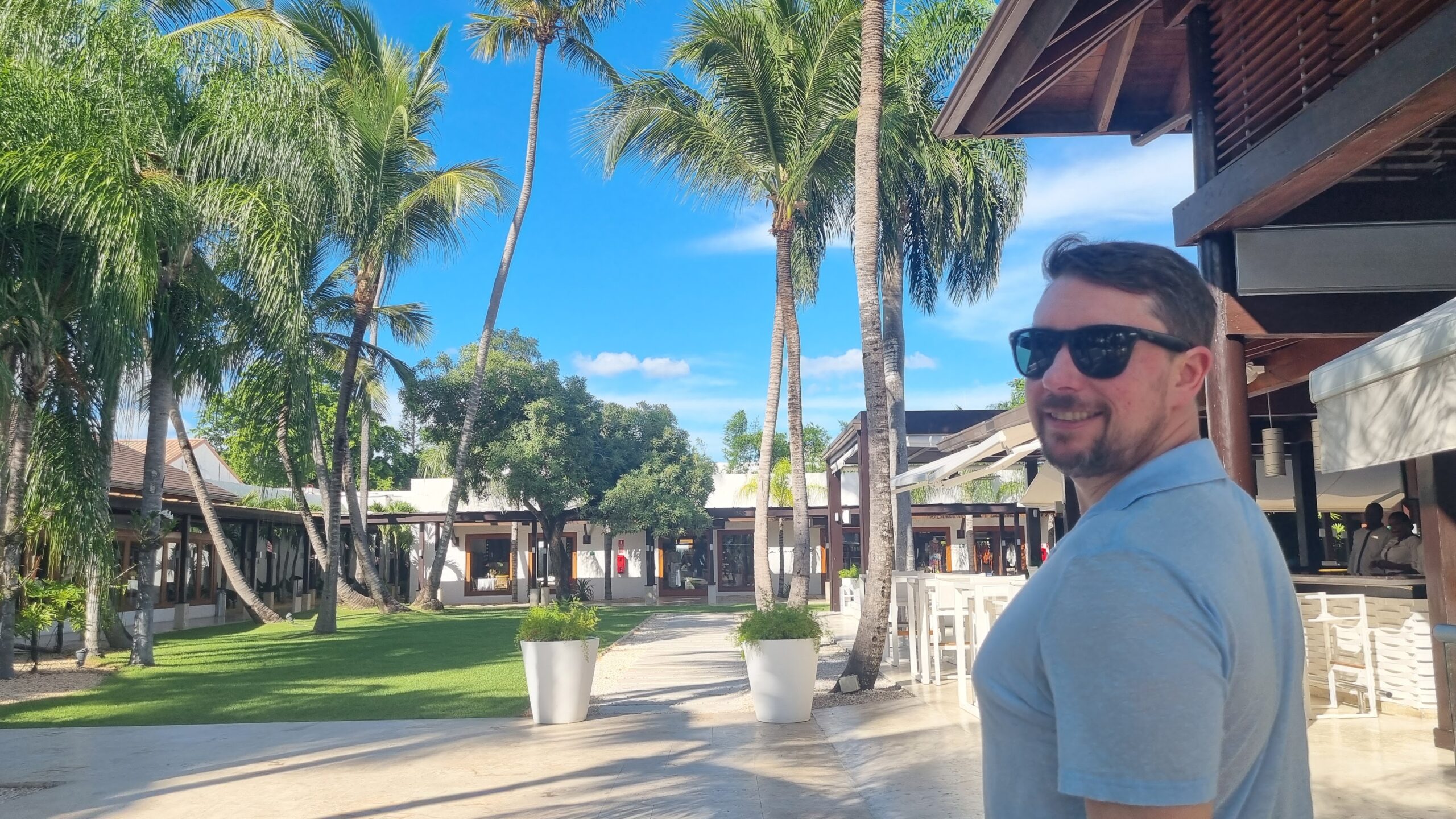
November: Marilyn’s cousins wedding in the Dominican Republic, Friendsgiving, Thanksgiving, Distant Worlds Final Fantasy Concert, cold recovery.

December: Redid our fireplace, quit THC, starting using Happy to code from my phone, tons of Hardcover work, Dragonsteel Nexus 2025, Worldhopper Ball, Hardcover Wrapped.
I struggled to find the energy to be as creative as I wanted this year. After 7 years without a job, trying to get back into a schedule where I could work on projects on nights and weekend was a big change.
With that, I still was able to do a few major things this year!
I wrote 23 blog posts:
Most of my creative side went towards Hardcover. In January we released the Hardcover 2024 Year in Books – removing all AI.
AdamFortuna.com – In January, I migrated the site from Next.js and Vercel to Astro on Netlify. Code is available.
At the Epic Web Convention in March, CodeTV recorded an episode on the theme Build the Most Devious Video Player. My team built a player that hit a missing niche – brid theming. 
In March, we fully moved Hardcover away from Next.js and to Ruby on Rails. A blog post I wrote about the migration went viral – bringing in 60k+ views and being shared on a bunch of tech newsletter. It resulted in nearly no new users (but a few links back that could help with SEO).
I’d been trying AI coding tools over the years. I used Chat GPT to brainstorm solutions to things I was working on. I used Cursor for some of the Next.js to Rails migration. But around July 2025 I started using Claude Code which blew my mind  I started using it at work, which has allowed me to take on projects I previously wouldn’t have dared (ex: Python, DevOps, Infra). More recently I’ve been working on Hardcover issues from my phone using Happy along with CloudFlare Dev Tunnels.
The first AI Coding I tried was building out the planned Hardcover Discussions feature over a weekend which included Reddit-like discussions, Facebook like groups and Meetup-like events. It was an ambitious first project, but it worked (kind of). It was more of a learning experience for me than anything else. I designed the database tables myself, but most everything else was done by Claude. The worst thing Claude did was deploy it’s development version I was working on to Production () – which broke Hardcover temporarily until I could figure out what was happening. Fortunately the migrations only created new tables.
In November, on a whim, I created the Hardcover Popular Books by Month Bump Chart to try out the latest Claude model (Opus 4.5). It leveraged a bunch of the existing charting libraries I created manually in D3.js for the Hardcover Stats pages, and was just a fun project.
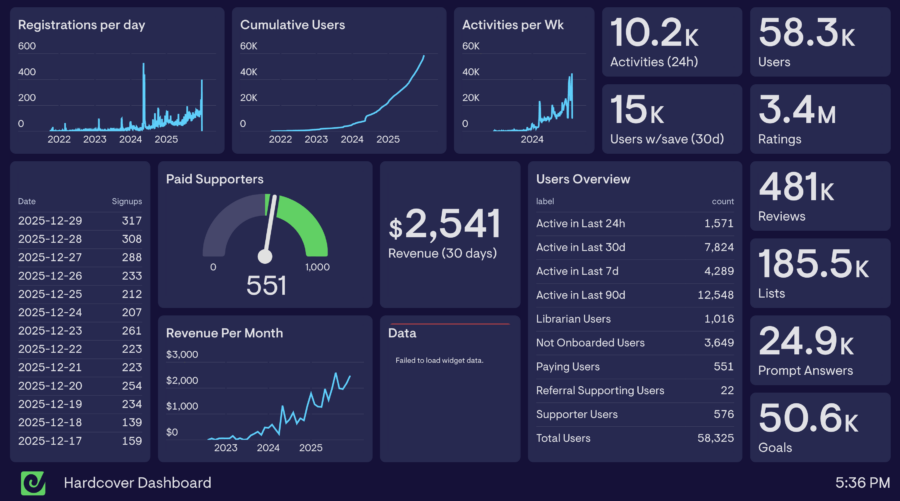
Most of the other projects on Hardcover that I worked on aren’t the most noteworthy: fixing bugs, improving the experience, making it more smooth and polished. Making continuous small improvements there has set things up for 2026 to be an amazing year.

Favorite concert: Rilo Kiley! I didn’t realize how much I binged this band’s entire catalog back in the day. I knew every word to every song. So did some of the people around me, which ended up being fun with a group of girls around us starting singing along to “A Better Son or Daughter” to each other and making friends.


Favorite meal: This is a tough one! The Spirited Away themed sushi dinner was incredible and memorable. The peking duck dinner at the Bellagio with the fountain show and cocktails was delicious – and one I keep thinking about how tasty it was.

Favorite Board Game: Dune Imperium: Uprising! We played this for the first time at SaltCon, a local board game convention, and immediately got a copy. It’s a great combination of engine building, resource management, strategy and battle.

Favorite Video Game: This is a tough one – mostly because I haven’t finished any of the games I’ve been playing. I’m in the middle of Silksong, Final Fantasy VII: Rebirth, Final Fantasy Tactics Remake, Baulders Gate 3, Split Fiction and Celeste – Mario Kart World too in that I haven’t mastered all the courses. If I had to pick a favorite it’d probably be FFVII for how it made me feel (Golden Saucer!), with Silksong a close second.

Favorite spot I visited: After a bunch of travel in 2024 (South Korea, Spain, Portugal), this year we took a bit of a travel break. I love this spot by the beach in the Dominican Republic perhaps the most.

Favorite Live Event: Alton Brown’s live show was a ton of fun, as was the O Cirque show. I think my favorite though was watching Eurovision Live at home – with a dozen or more friends and a bunch of tiny flags.
Favorite Movies: I was not great at keeping track of what I watched. A few I remember include: Kiss of the Spider Woman (2025), Sinners, Smile. I kept track of the ones I watched at Sundance 2025.
Favorite Shows: Andor S2, Pluribus S1, Adolescence, Severance S2, The Pitt S1, The Gilded Age S3, Paradise S1, Murderbot S1, Only Murders in the Building S5, Star Trek Strange New Worlds S3, White Lotus S3, The Residence S1 – and one of my unexpected favorites of the year: Bon Appetit, Your Majesty S1
Favorite Books: I put together a list of my favorites this year. My top 5: Dungeon Crawler Carl (#1 of 7 in Dungeon Crawler Carl), A Drop of Corruption (#2 of 2 in Shadow of the Leviathan), The Eye of the Bedlam Bride (#6 of 7 in Dungeon Crawler Carl), Wind and Truth (#5 of 5 in The Stormlight Archive), Part of Your World (#1 of 3 in Part of Your World). I started reading romance this year, and it’s been a welcomed escape.
Favorite new programming discovery: Claude Code, for sure. For months my wife thought I was saying “clawed code”, which makes me smile whenever I think about. 
Favorite Project: Getting completely off Next.js and Vercel for all projects. The Popular Books by Month Bump Chart is the kind of fun labs project I want to do more of. Hardcover Wrapped.
Favorite Course or Education Experience: To prepare for some projects we have planned on Hardcover, I’ve been going through courses on DeepLearning.ai. I’d watched courses by the main instructor on Coursera back in the day, and so far it’s been useful. Although lately learning has been more focused on using Claude Code as a collaborator and describing what I want then looking the results.
I didn’t do a great job of journaling throughout the year – which is when I usually review these and see if I’m on track. Looking at them now might be the first time I’ve checked on them in months, or even since I wrote them.
 Create a Hygge Home – Well, I’m writing this from our living room with a fire going next to me, a Christmas tree sparkling nearby, a cosy board gaming table that invites us to play more, and lots of candles.
Play lots of games (board and video) – Somehow I hit this one! I could’ve played more of both, but I played lots, and more than 2024 for sure. Fortunately I didn’t make a resolution to finish games.
Welcome a dog – In May we adopted Bucky who is the bestest boy. He’s laying tummy up next to me right now.
 Write at least one post here a month – I wrote 9 non-Hardcover blog posts (10 if you include this one). That’s pretty close to my target of 12. I think if I had written more it would have balanced out my anxiety more.
 Work on a side project (tech-specific) – Aside from a one-day hack project, and converting this site to Astro, I didn’t have any other non-Hardcover projects. I do have something I’d like to do in 2026 though, and using LLMs could enable it’s development much faster.
Continue learning Japanese – I didn’t pick this one up at all. Without a clear goal in mind I haven’t felt the urge to do this. For now I’m going to put this one on the sidelines.
Continue enjoying fitness – Our new place is within walking distance from a gym, which led to 80 visits in 2025. I didn’t get into a good Peloton or cardio habit this year, but I’ve recently been jumping on more often.
Grow Hardcover to ramen profitability – My hope was to grow income to where it’d pay it’s bills and some of mine. We didn’t make it to that point, but it is generating more income than we spend! Things are moving in the right direction.
4 , 2 , 2 – that’s not bad!
Some years I’ve done monthly themes, sometimes start-stop-continue. This time I’m setting goals based on things I think I can accomplish, and if I complete them (or even work towards them) they’ll improve my life.
Cook meals from cookbooks often – A lot of this year was spent adjusting to new routines, which left little time for meal planning. That often meant throwing something together at the last minute. We have a number of cookbooks with recipes I’d love to make from a variety of cuisines. I’m planning to start the year by setting a theme per month (a cookbook) and trying to create a few recipes out of it each month.
Create and launch the new Line Of Thought App – I have an idea for an app I want to build that’ll be on iOS and Apple Watch, and NOT have a backend component. This app would be entirely on the app, which is a different paradigm than I’m used to. My incentive to build this is just for me to use it, but I’d also like to learn a bit about iOS development while I’m at it. This will be a new experience using Claude Code and Swift.
Continue staying off social media – For December I’ve largely stayed off social media. I got on Reddit for a short time (when /r/suggestmeabook announced they were going to use Hardcover for book data!), but the time on there didn’t feel like it was improving my day. I’d like to completely stay off any short form video content, and mostly off Reddit.
Deepen my marriage & relationship with my wife – This last year was a busy one. Between everything with the house, dog, job and schedule we didn’t have as much time to be around each other as the previous few years. I want to set more time aside to slow down and make sure we’re being good partners. Right now I’m thinking about topics we learned from Gottman training we attended a few years ago – like a state of the union discussion, and taking time to sit down and discuss plans.
Read more books – It’s hard to replace social media unless you have something to switch to. In my case that’s reading more books. I have a Kobo Libra Color that I love, along with a BUNCH of physical books. There are some Hardcover integrations I want to try running a calibre server too. The main time I want to read more is in the morning – staying of my phone and picking up a book instead.
Improve my online workflow an AI assistant – As I’ve gotten more into Claude Code and using LLMs for coding, I’m realizing that for just about everything I do online, coding is the bottleneck – but it no longer needs to be. With better AI-assisted processes, these bottlenecks should be me reviewing code, not writing it. Turning ideas into code is easy. Iterating those into products is the step AI’s can’t do (or at least, not without getting additional inputs from somewhere). I’ve been reading about systems like PAI for organizing this on a personal level that I’d like to try.
Get into a cardio routine – I have my gym routine down, but not so much my cardio routine. Lately I’ve enjoyed riding the Peloton more often, and want to figure out a schedule that I can stick to and not be overwhelmed by. I have a few spots in my schedule I want to try this, with the hope some will stick.
Get digitally organized – Over the years I’ve let my very organized life slip more and more. Now I have photos that aren’t backed up, notes spread across 4 different platforms, 0kb files locally that are artifacts of a botched Dropbox sync and more. I’d like to clean things up, improve backup strategies locally and in the cloud and embrace Obsidian for organization.
Create a Community on Hardcover – For a social media site, Hardcover has very few community features. We’ve pushed the biggest social aspects to get the foundation right, and keep the community on Discord. I have a big goal in mind for this project, and it’s the one I’m most looking forward to this year. We’ve talked to dozens of users, done surveys, talked to users on Discord, prototyped pages – we know what we want to build, we just have to do it.
Practice being present without improving anything – I want to regularly do things that don’t improve me, scale, or ship. This can mean aimless walks with Bucky, board games or video games without the stress of finishing, meditating, or other things that have no specific goal in mind.
Whew that’s 3,593 words, 30% longer than last year. I suspect it’s because I haven’t written much this year I’m making up for it now.
Adam
2025-12-22 04:05:28

I was born in 1982. I was 5 when I played Super Mario Bros. for the first time – holding the controller withs hands just big enough to hit all of the buttons. By the time the Super Nintendo and Genesis came out, my hands had grown with the controllers.
For me, that was the Golden Age of video games. I’d spend countless hours playing the original Zelda (NES) all the way through over and over. Some weeks I’d scour every inch of A Link to the Past‘s (SNES) levels, looking for areas I shouldn’t be able to access at different points in the game. I’d challenge myself to beat all the bosses in Mega Man 2 (NES) using only the Mega Buster. I’d go through Donkey Kong Country (SNES) to hit 101% – finding the secret room inside the other secret room.
Looking back it seems like I spent years playing these games, but it was likely only weeks or months on each of them. For a time I wanted to create video games. I loved the idea that people were enjoying something I poured my heart into – even without them even knowing who I was.
There was one game that captured my heart unlike any other: SimCity 2000 (Macintosh).
SimCity is a city-building game – the first of it’s genre. SimCity Classic was released in 1989, and followed up with SimCity 2000 in 1993 for Windows and Mac.
Here’s how it works:

You start with a blank slate of land that’s randomly generated. You can roll the dice and have it generate terrain with more mountains, forests, rivers, an ocean or tweak it tile by tile.
Once your map is decided, you have free reign to build your city. You don’t do this by placing individual building like you might think. You do this by zoning areas as residential (green), commercial (gray) or industrial (yellow), giving them power and water, and then waiting for people to magically move in.

It was the first time I remember building something for myself and hoping people would love it.
As more people join, your population increases – as does your tax revenue. With those funds you can build more services to entice more emigration. Police stations and fire stations to keep people safe; schools and colleges to continue education; parks and marinas for people to have fun; and roads, highways, railways and subways to help people travel.

As your city grows, there’s always a bottleneck to fix. Density spikes and you need more police. Buildings go abandoned because there aren’t enough jobs or workers. Taxes are too high so people flee to other cities. Pollution, crime, commute times and other factors can drive population change. If you ignore those issues your city suffers.
I took to SimCity 2000 with an obsessive addiction. I’d play during every waking minute, even leaving our family computer on overnight so I’d have plenty of money (& growth) when I woke up to check it before school.
I was in eighth grade at the time, I and remember prototyping SimCity maps on college ruled paper and pencil on the bus to school. It was the first time I ever prototyped.
When I made it home, I’d transfer my paper design to my city, seeing it take the shape I had in my head.
It was satisfying in a new way that I’d never experienced before.
Spoilers ahead for SimCity 2000’s endgame.
After a few months playing, I’d reached the point where almost every square I could use was taken up by arcologies (short for architectural ecology). Arcologies were a late game addition that allowed you to build a futuristic structure that housed 70,000 people in a small 4×4 area.

One morning I woke up to check on my city before school like I did every day. To my complete shock, my city was gone! In it’s place were hundreds of craters where my arcologies used to be. After my panic subsided, I realized this was the end game. My arcologies had blasted off into space – the next step on the their journey.
This was in the days before Chat GPT (or even Google), so my only way to learn what happened was to find a site on Yahoo! that explained the ending.
In college I got really into Dance Dance Revolution. I started a website with a bunch of DDR stats and a phpBB forum that became the goto community for players in the southeastern US (DDR was a very social game).

The code for this site is available on GitHub. It’s bad. It’s “I didn’t know SQL had an ORDER BY clause so I’d pull back everything and sort it in PHP” kind of bad.
But there was something about building this site that gave me a similar feeling to playing SimCity 2000.
In both cases I’d build out paths for people to take without my input. It felt exciting to see some organization of data and experiences into a route that users actually took!
Creating these experiences hooked me. Since then I’ve built quite a few projects, and in every one of them I aimed to recapture that SimCity 2000 feeling.
Back in 2005 I heard about and started learning Ruby on Rails. It sped up my development in a way nothing else has (at least, not until recently with Claude Code, but that’s another blog post).
Since then, Ruby on Rails has been my goto tool in my toolbox enabling me to recapture that feeling of being a world builder.
I’m still building worlds 20 years later. Most recently that’s building paths for people to listen to audiobooks at Libro.fm by day, and creating paths to discover books at Hardcover by night.
The same skills that were honed playing SimCity are directly applicable to web development – even if I didn’t realize as a middle schooler.
Choosing a terrain for your city is like picking your underlying architecture. For me that’s been Rails as my starting point.
Sketching your city in a notebook is, of course, prototyping your application. You’re making a plan to implement.
Deciding on zoning for your city is similar to picking out your features. You’re making choices for your users what they’ll be able to do and where.
The newspaper you receive each year is your product feedback. Ignore this at your peril, or follow it to stay on course with what your users want.
Power plants are your infrastructure. Without them the lights will be out. When this goes wrong, it’s all hands on deck.
Roads, subways and highways are your information architecture. This is how your users will get around. If you mess this up, everyone will be stuck.
Water and sewage are your background jobs and async processes. They’re out of sight and out of mind – at least when they’re working.
Tax rates are your product pricing. Set them too high and people will leave en mass.
Police, firefighters and hospitals are your error tracking, alerting and observability that ensures things are running smoothly.
And of course disasters are disasters. 
For both SimCity 2000 and software development, no single decision is going to reward you with instant success. It’s orchestrating each of these many decisions so they work together that creates something harmonious.
In every system there’s going to be a bottleneck. For most of my projects that’s been getting people to give it their attention in the first place. Whether you’re playing SimCity or building for millions of users, if you can understand what your systems needs and focus on that, your system will grow – if you give it time.
2025-03-31 02:58:33

In the product world, we often try to reduce users down to a single persona – a representation of this users motivations. By bucketing them into a neat little box it makes it easier to design and plan for.
But this isn’t a post about other peoples personas: it’s about yours.
Lately I’ve been toggling between multiple focuses. Writing on this blog, building Hardcover, as a husband, a friend and even as an employee (if I choose to get a job). Each of these are me, but a different version.
For anyone creating online, they’re likely hit with the same question: what tone do I use for each project?
We’ve recently seen renewed interested in the Personal-Website-Verse – a desire to create something online that you can own not tied to social media.
At Epic Web Conference 2025 last week, multiple talks were about building up your personal brand: Epic Bets: Practical tips for betting on yourself by Aaron Francis, Why You Should Learn Out Loud In 2025 by Madison Kanna and Networking through Streaming on Twitch by Leah Thompson.
With more people creating online, it means more people figuring out their voice online.
Lately I’ve been trying to write more. Each place I write has a different tone and a different reason for writing.
For this blog, my motivation is to share what I’m learning, what I’m experiencing, how I’m growing, what problems I’m working through and how. Journaling in public motivates me and helps me hold myself accountable. I have a secondary motivation to grow my own personal brand not attached to any projects. Projects come and go, but blog was here before them, and will be here after.
On minafi.com, my motivation is to help others make positive money decisions and cultivate healthy mindsets around money. A secondary motivation is to create a business around this topic, although I’ve invested much less time towards that lately. It took years and hundreds of articles to feel like I found my voice. I figured out I could create standout content in this space with a dash of coding mixed with content.
On Hardcover, my motivation is to grow a book-focused community. I want people to feel connected, included and seen. I have a secondary motivation of having people become paid members and fund the project. It took me years to realize that my role in Hardcover isn’t a developer, and a connector.
I have little doubt that I’ll add more projects to this list in time, each with their own motivation.
Each of my secondary motivations is business related – my personal brand, financial brand and Hardcover’s success.
When you think about the persona of users using your app or website, their main motivation isn’t to spend time there; it’s to solve a problem.
A few years ago, I started taking that approach my writing.
That problem can be your own! Learning in public, obstacles you overcame, how you’re figuring out a problem in your life. I love a good growth story.
While working at Code School, we spent some time working on a company mission. I was inspired and wrote my own. Writing this post today made me realize that after 7 years, it was no longer in line with what I cared most about. I decided to update it. Here’s what I came up with:
I help connect people to transform their ideas into reality by enlivening community.
I’ve been hesitant to call myself a community builder. It makes me think of major connectors – people with large followings, conference creators, popular vloggers.
Enlivening community doesn’t mean I need to start the community. It can mean enjoying other peoples company at a meetup or conference, supporting projects that favor connection, and helping others succeed with their own ideas.
This mission is inspiring. That’s what a personal mission should be! If it can give you butterflies in your stomach because it’s so important to you, then you’ve succeeded.
You use your personal mission statement in each project you participate in. If you’re able to bring that energy to a job, a side project, or even a personal blog, it will be successful – if only because it’s accomplishing what you’ve set out to do.
2025-03-10 06:45:35

Eight years ago, back in 2017, I wrote about five people who inspire me. These five share something important: they’re all great teachers. Each of them is not just good at experimenting and innovating, but can put those learnings into teaching.
A lot has changed since 2017, but people who blend creativity and education are still some of the most inspiring people to me today – with one exception. The ones I’m most drawn today tend to add one another piece: optimism. That’s not to say the previous ones didn’t; it’s more likely that I’m noticing it more, and appreciating it more.
A few weeks ago I started thinking about who inspires me today. Most are people I’ve never met, and only had occasional social media-related interactions with – following on BlueSky, occasionally joining live streams from, reading blogs, newsletters and listing to podcasts.
I debated writing a note to each of these people, but decided to do a post celebrating them all instead. Thank you all for being cool and inspiring people. 
Most people in tech might know Cassidy Williams from her hilarious TikToks which gave me many laughs during lockdown. From newsletter jokes, JavaScript parodies to whatever this is, the more far out and unexpected, the more I end up laughing.
Meanwhile she’s been working at some of the most fun developer-focused companies like CodePen, Netlify and GitHub – bringing her passion and energy to code collaboration in a way that’s needed.
When we launched Hardcover on Producthunt, Cassidy commented at 12:01am – literally the first comment by anyone outside the team. She’s an advocate for small players, women, and diversity in tech (which is also a theme for this list in general).

Cassidy puts out a newsletter every week (rendezvous with cassidoo) with an interview coding question of the week. She seems like a fun person to hang out with, and I’m sure is an amazing mom.
Jason is a prolific creator in the programming space. Like a lot of people, I found Jason through his show Learn With Jason, where he and a guest build something in about 90 minutes. The format is both educational and entertaining.
His episode with Colby Fayock on Using WordPress with Next.js ended up being a template for this blog (before I moved from Next.js to Astro), and for the Hardcover Blog. His live streams are more organized and better run than ones by big companies. You can tell he takes setup seriously, yet maintains a lighthearted and fun vibe when on camera.
His post about AI generated art back in 2022 inspired me to create AI art of my wife using the same guide as a valentines day gift.
The only decoration I have on my desk is a Rainbow Corgi Duck which I use as a watch stand while working.

Jason has launched many other fun projects over the last few years. The Web Dev Challenge is one of my favorites. Four Developers build something with the same theme with the same time limitations. The variety and limitations spark new creative ideas. It’s like Project Runway for coders.
He’s recently launched Leet Heat – a show that’s a combination of Hot Ones and Jeopardy.
His most recent project, CodeTV, pulls together content from all of his different projects into a channel for developers. It’s like Dropout TV for devs. I’m a supporter and over in the Discord if you want to say hi. 
My first post about Ruby on Rails on this blog was in May 2005. Rails 0.13.1 had been released, and they were amping up for the big 1.0 which came out in December of that year. In those early days, I learned a lot by doing side projects, working at IZEA, EnvyLabs and Code School, and from Railscasts.
In about 2017 my role at Code School started leaning more towards management. With 11 people on my team, I wasn’t as up to date on the latest dev trends. When I switched to Product Management, I spent even less time coding – mostly only on small internal tools and on projects in my offtime.
In December of 2018 I left my job at Pluralsight, with the goal of having more time to build things I’d always dreamed of (The Minafi Investor Bootcamp was the first).
Of all the Rails education resources I found, Chris Olivers’ Go Rails was the most useful without a doubt. It filled the Railscasts void in my heart, but also featured longer series. Having a solution to a specific problem solved in a single video enables just in time learning – a format we often struggled with at Pluralsight/Code School.
I’d recommend it as the first step to anyone wanting to learn Ruby on Rails even today. It helped me to rebuild and refresh my Rails knowledge and gain back some developer confidence.
When Hardcover reached the point where we wanted to accept payments, I went to Go Rails to see what Chris recommended only to find he created a payment gem (pay) that works with multiple backends! We’ve been using it for subscriptions on Hardcover for the last 3 years.
As someone who knows how hard it is to create great developer content, but also creating entire systems around that content, I have huge respect for Chris and everything he’s built. I’m excited to see he’s a Co-Chair for the final RailsConf in Philadelphia – he seems perfect to help grow the Rails community.
Technology is one thing we as humans use to advance civilization, create art, and increase productivity. That nexus is where Maggie thrives – theorizing about the future, but rooted in reality today on how to take that next step forward. She shares the same space in my mind with Bret Victor; both of them pushing design and user experience with technology.
Maggie is the first person I heard use the term Digital Garden to refer to their site. That might seem like a small change, but it impacts the way we think. If your blog is only one thing, that’s the format you’ll stick to.
For a few years in mid 2010s, I spent a lot of time Twitter. I still remember something I wanted to communicate and trying to get it down to 140 characters. I was locked into that box, which limited my own creativity in how I thought through a problem. If you can change how you communicate to span more mediums, it opens up how you can think through a problem and communicate your takeaways with the world. Maggie understands that.
Maggie’s Garden stretches all kinds of formats – from her numerous podcast interviews to talks she’s given alongside posts in different stages (from seedling to evergreen).
Her talk about The Expanding Dark Forest and Generative AI from 2023 seems as prescient today as it was then.
I remember reading her Command K Bars essay around the same time I was implementing search in a modal on Hardcover (also using Command K to open). That’s happened multiple times with Maggie’s writing – touching on things that I’m working on only to see she’s written an entire analysis of the topic.
One of the best ways to get me to listen to your podcast is to have Maggie on.
I love a good data visualization. If someone can communicate a complex topic using interactivity, great design, color, and typography in a way that presets the topic better than in words alone then I’m often left in awe. It’s a combination of vision and execution in a way that can fall flat if something doesn’t feel right.
In 2023 I read Shirley Wu and Nadieh Bremer’s book Data Sketches. It ended up being in my top 3 books of the year, alongside The Will of the Many and Tomorrow, and Tomorrow, and Tomorrow.
Data Sketches hits on something that very few things I’ve ever read does: the journey. The format of the book is like this: each month Shirley and Nadieh would build out a data visualization (independently, so two separate data vizzes) and write about the process. The book is a collection of those notes, sketches of works in progress and the final products.
Her Interactive Visualization of Every Line from Hamilton (on Pudding) came at a time when I knew every line from Hamilton. Seeing it presented in this way blew my mind.

I enjoyed reading through what was in their minds as they were trying to solve problems – including what didn’t work. After reading Data Sketches, I was immediately inspired, started learning Svelte, and built The Social Histomap (very rough, but a good learning experience).
Shirley gave an incredible keynote called Taking Up Space that everyone should watch. It’s amazing and had me tearing up at times. Between physical art installations, digital creations and self reflection, I found myself nodding along and smiling at each creation.
In 2024 she tried something I’ve only dreamed of: establishing a studio in Tokyo. I didn’t even realize you could create a company and then sponsor your own visa in Japan  .
.
I can’t wait to see what she creates next in the intersection of art and technology as well as hearing more about life in Japan!
Chelsea started The Financial Diet a few years before I started Minafi – both in the financial space. Between her book, podcast, and YouTube channel, she’s extremely prolific in the financial sphere and created a safe space for women to talk about money.
I recently finished the book Men Who Hate Women. It’s a sobering analysis of the hate-filled communities that bully women while hiding behind anonymity online.
Chelsea has no doubt experienced her share of online hate. Her recent response to the trolls was a masterclass in how to respond. When I showed it to my wife, she gasped and snapped in agreement.
One thing about financial content: once you learn enough there’s very little to do. You switch from spending time understanding how to diversify your portfolio and reduce your taxes to working on your mindset. It’s part of why I stopped blogging about financial topics – I got tired of looking at every problem through the lens of finances.
Somehow Chelsea continues to post new content that inspires me in areas beyond the financial. She has her pulse on the intersection between politics, money and feminism – which has branches to mental health, motivation, and just living your best life. Whenever one of her videos shows up I always watch it.
When I started Hardcover, it wasn’t originally a book tracking social network. It’s precursor was an embedded angular application on my blog to show what I was reading. When Goodreads announced they were shutting down their API, my backend would have to change and that sparked me to start Hardcover.
At the time I hadn’t heard of The StoryGraph. I was looking for book tracking services with an API, and none existed (only a few exist even today). It wasn’t until a few months into Hardcover that I stumbled on it. Since then I’ve joined Nadia’s The One-Woman Dev Team Diaries newsletter, watched her many talks at conventions, and celebrated SG’s success.
Meanwhile Nadia seems so authentically herself. Posting what she’s reading in her newsletters, sharing elaborate dances on her Instagram as a form of self expression, and acting as a proponent of anti-corporate sentiment.
The StoryGraph is a competitor to Hardcover, but in the same way The Financial Diet is a competitor to Minafi. I’m excited to see SG push the envelope and innovate on recommendations and what readers are asking for. Many of the same problems readers mention my own interviews are ones Nadia is working on. It’s incredibly rare to be able to look at a new product release and trace it back to the source problems, while seeing how the connection was made to this solution.
The rise of SG also proves the distaste for Goodreads in a way no other site has. I’m excited to be building products in the same space as Nadia, and would love to work on something together someday.
When I look back at my previous post, I see people who are more in the category of thought leaders. When I look at this list, I see a mix of teachers, learners and sharers. People who want to connect different groups together with each other and all grow because of it (still true about the first list, but I’m noticing it more).
I think that better encapsulates where I am in my life right now too – looking to grow the Hardcover community, build more things that I find fun, and spending more time with my real-life friends and family.
If anyone on this list is ever in Salt Lake City and wants to meet up, I’d love to buy you a coffee/beer/meal/book. 
